


A prospective study of carpal tunnel syndrome: workplace and individual risk factors
Supporting Files

-
Jun 20 2013
-
Details
-
Alternative Title:Occup Environ Med
-
Personal Author:
-
Description:Objectives
To quantify the risk for carpal tunnel syndrome (CTS) from workplace physical factors, particularly hand activity level and forceful exertion, while taking into account individual factors including age, gender, body mass index (BMI), and pre-existing medical conditions.
Methods
Three healthcare and manufacturing workplaces were selected for inclusion on the basis of range of exposure to hand activity level and forceful exertion represented by their jobs. Each study participants job tasks were observed and evaluated ’ onsite and videotaped for further analysis, including frequency and duration of exertion and postural deviation. Individual health assessment entailed electrodiagnostic testing of median and ulnar nerves, physical examination and questionnaires at baseline with annual follow-up for 2 years.
Results
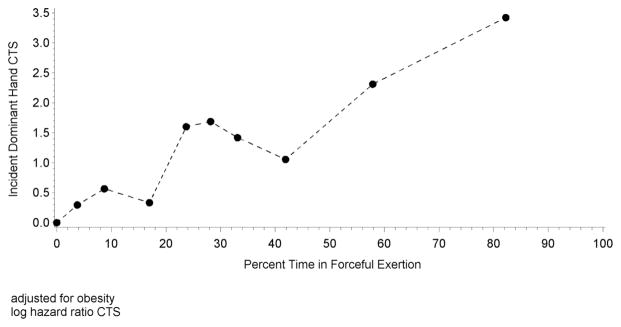
The incidence of dominant hand CTS during the study was 5.11 per 100 person-years (29 cases). Adjusted HRs for dominant hand CTS were as follows: working with forceful exertion ≥20% but <60% of the time: 2.83 (1.18, 6.79) and ≥60% of the time vs <20%: 19.57 (5.96, 64.24), BMI ≥30 kg/m2 (obesity): 3.19 (1.28, 7.98). The American Conference for Governmental Industrial Hygienists (ACGIH) Threshold Limit Value (TLV) for hand activity level also predicted CTS, HR=1.40 (1.11, 1.78) for each unit increase in the TLV ratio, controlling for obesity and job strain.
Conclusions
Workplace and individual risk factors both contribute to the risk for CTS. Time spent in forceful exertion can be a greater risk for CTS than obesity if the job exposure is high. Preventive workplace efforts should target forceful exertions.
-
Subjects:
-
Source:Occup Environ Med. 70(8):568-574.
-
Pubmed ID:23788614
-
Pubmed Central ID:PMC4552318
-
Document Type:
-
Funding:
-
Volume:70
-
Issue:8
-
Collection(s):
-
Main Document Checksum:urn:sha256:c3da09e6a6103f591b2db8be8d3ccccf5a3d378a135f184b4c7c5913d205b424
-
Download URL:
-
File Type:
 [PDF
- 511.63 KB
]
[PDF
- 511.63 KB
]
Supporting Files


ON THIS PAGE

CDC STACKS serves as an archival repository of CDC-published products including
scientific findings,
journal articles, guidelines, recommendations, or other public health information authored or
co-authored by CDC or funded partners.
As a repository, CDC STACKS retains documents in their original published format to ensure public access to scientific information.
As a repository, CDC STACKS retains documents in their original published format to ensure public access to scientific information.
You May Also Like
COLLECTION
CDC Public Access