



Tracking Stroke Hospitalization Clusters Over Time and Associations With County-Level Socioeconomic and Healthcare Characteristics
Supporting Files

-
1 2013 ; 1-2013
-
Available in CDC Stacks on 2015-08-12T00:00:00Z
File Language:
English
Details
-
Alternative Title:Stroke
-
Personal Author:
-
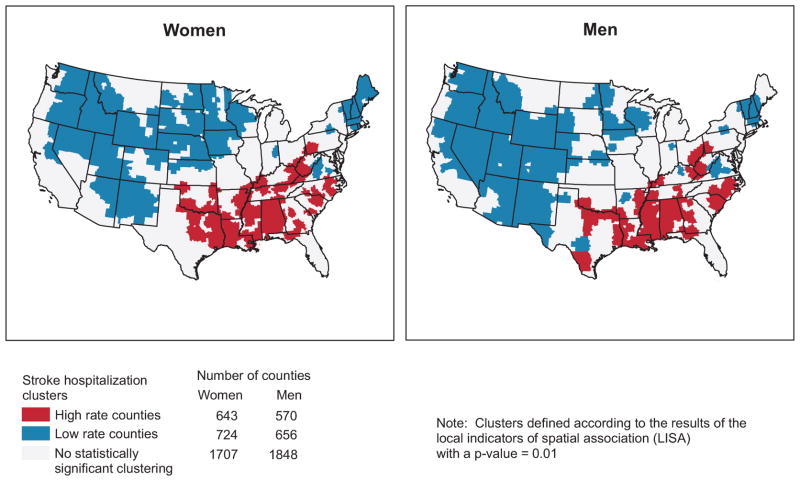
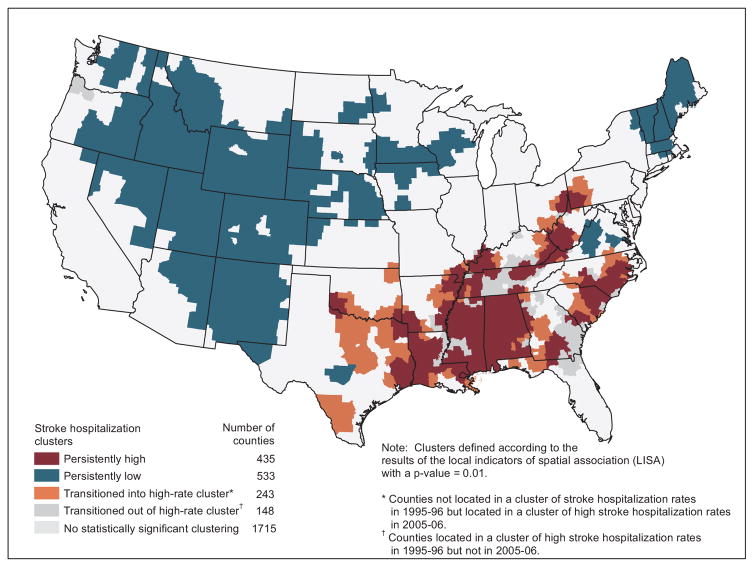
Description:Background and Purpose ; This study evaluated clustering of stroke hospitalization rates, patterns of the clustering over time, and associations with community-level characteristics. ; Methods ; We used Medicare hospital claims data from 1995–1996 to 2005–2006 with a principal discharge diagnosis of stroke to calculate county-level stroke hospitalization rates. We identified statistically significant clusters of high- and low-rate counties by using local indicators of spatial association, tracked cluster status over time, and assessed associations between cluster status and county-level socioeconomic and healthcare profiles. ; Results ; Clearly defined clusters of counties with high- and low-stroke hospitalization rates were identified in each time. Approximately 75% of counties maintained their cluster status from 1995–1996 to 2005–2006. In addition, 243 counties transitioned into high-rate clusters, and 148 transitioned out of high-rate clusters. Persistently high-rate clusters were located primarily in the Southeast, whereas persistently low-rate clusters occurred mostly in New England and in the West. In general, persistently low-rate counties had the most favorable socioeconomic and healthcare profiles, followed by counties that transitioned out of or into high-rate clusters. Persistently high-rate counties experienced the least favorable socioeconomic and healthcare profiles. ; Conclusions ; The persistence of clusters of high- and low-stroke hospitalization rates during a 10-year period suggests that the underlying causes of stroke in these areas have also persisted. The associations found between cluster status (persistently high, transitional, persistently low) and socioeconomic and healthcare profiles shed new light on the contributions of community-level characteristics to geographic disparities in stroke hospitalizations.
-
Subjects:
-
Keywords:
-
Source:Stroke. 44(1):146-152
-
Pubmed ID:23192758
-
Pubmed Central ID:PMC4533978
-
Document Type:
-
Funding:
-
Volume:44
-
Issue:1
-
Download URL:
-
File Type:
 [PDF - 852.02 KB]
 -
Collection(s):
-
Main Document Checksum:urn:sha256:e64e3ef0a4c40093dded972236888c124b297f65efb8af055d1256ab48150fcc
Supporting Files


File Language:
English
 Was this page helpful?
 Found an issue?



CDC STACKS serves as an archival repository of CDC-published products including
scientific findings, journal articles, guidelines, recommendations, or other public health information authored or
co-authored by CDC or funded partners.
As a repository, CDC STACKS retains documents in their original published format to ensure public access to scientific information.
As a repository, CDC STACKS retains documents in their original published format to ensure public access to scientific information.
You May Also Like
COLLECTION
CDC Public Access