


Maternal Residential Atrazine Exposure and Risk for Choanal Atresia and Stenosis in Offspring
Supporting Files

-
Oct 01 2012
-
File Language:
English
Details
-
Alternative Title:J Pediatr
-
Personal Author:
-
Description:Objective
To assess the relationship between estimated residential maternal exposure to atrazine during pregnancy and risk for choanal atresia or stenosis in offspring.
Study Design
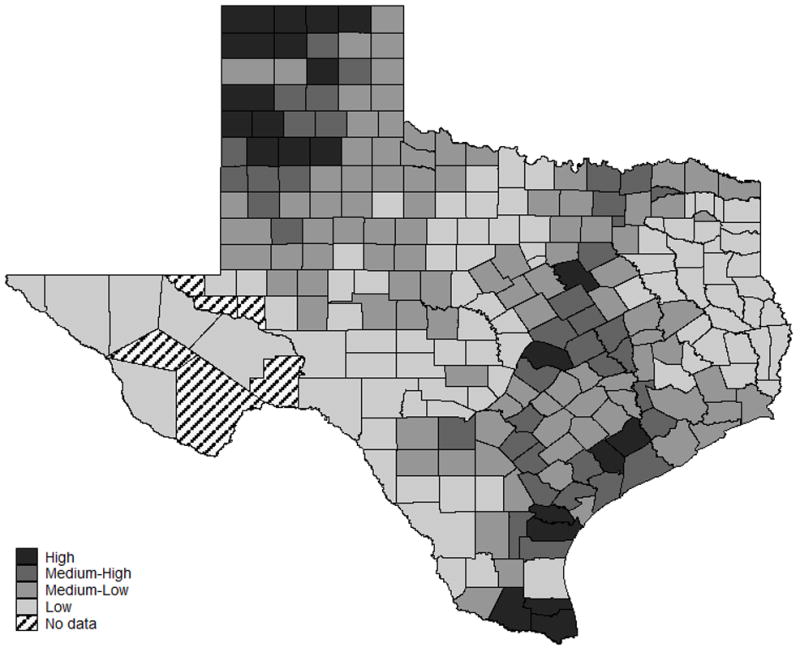
Data for 280 nonsyndromic cases and randomly selected, population-based controls delivered during 1999 to 2008 were obtained from the Texas Birth Defects Registry. County-level estimates of atrazine levels obtained from the United States Geological Survey were assigned to cases and controls based on maternal county of residence at delivery. Unconditional logistic regression was used to assess the relationship between maternal residential atrazine exposure and risk for choanal atresia or stenosis in offspring.
Results
Compared to offspring of mothers with low levels of estimated residential atrazine exposure, those with high levels had nearly a two-fold increase in risk for choanal atresia or stenosis (adjusted odds ratio: 1.79, 95% confidence interval: 1.17–2.74). A significant linear trend was also observed with increasing levels of atrazine exposure (adjusted P = 0.002).
Conclusions
A link between maternal exposure to endocrine disruptors, such as atrazine, and choanal atresia risk is plausible based on previous findings. Our results further support this hypothesis.
-
Subjects:
-
Source:J Pediatr. 162(3):581-586.
-
Pubmed ID:23036484
-
Pubmed Central ID:PMC4105141
-
Document Type:
-
Funding:
-
Place as Subject:
-
Volume:162
-
Issue:3
-
Collection(s):
-
Main Document Checksum:urn:sha256:63bd5c307da02c63bb5cfeeb9e828ccf74e01df037feff104b11756d8dd146ed
-
Download URL:
-
File Type:
 [PDF
- 150.37 KB
]
[PDF
- 150.37 KB
]
Supporting Files


File Language:
English
ON THIS PAGE

CDC STACKS serves as an archival repository of CDC-published products including
scientific findings,
journal articles, guidelines, recommendations, or other public health information authored or
co-authored by CDC or funded partners.
As a repository, CDC STACKS retains documents in their original published format to ensure public access to scientific information.
As a repository, CDC STACKS retains documents in their original published format to ensure public access to scientific information.
You May Also Like
COLLECTION
CDC Public Access