



Permanent Neonatal Diabetes Mellitus: Prevalence and Genetic Diagnosis in the SEARCH for Diabetes in Youth Study
Supporting Files

-
5 2013
-
File Language:
English
Details
-
Alternative Title:Pediatr Diabetes
-
Personal Author:
-
Corporate Authors:
-
Description:Background
Neonatal diabetes mellitus (NDM) is defined as diabetes with onset before 6 months of age. Nearly half of individuals with NDM are affected by permanent neonatal diabetes mellitus (PNDM). Mutations in KATP channel genes (KCNJ11, ABCC8) and the insulin gene (INS) are the most common causes of PNDM.
Objective
To estimate the prevalence of PNDM among SEARCH for Diabetes in Youth (SEARCH) study participants (2001-2008) and to identify the genetic mutations causing PNDM.
Methods
SEARCH is a multi-center population-based study of diabetes in youth < 20 years of age. Participants diagnosed with diabetes before 6 months of age were invited for genetic testing for mutations in the KCNJ11, ABCC8 and INS genes.
Results
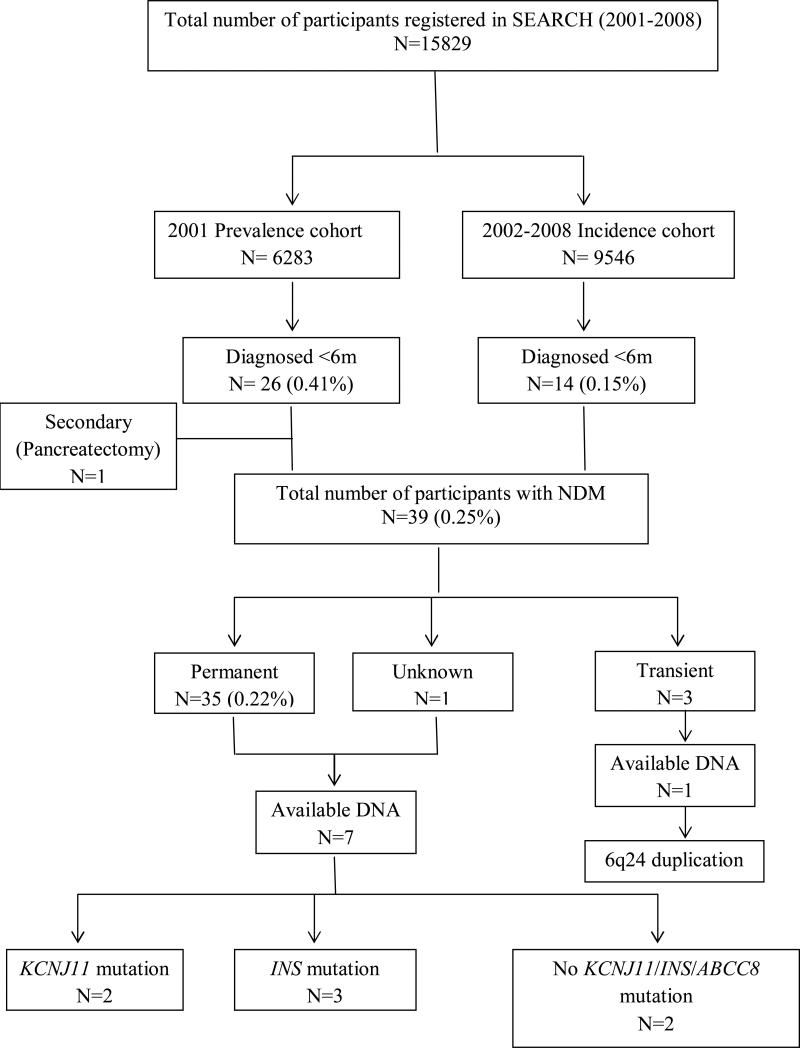
Of the 15,829 SEARCH participants with diabetes, 39 were diagnosed before 6 months of age. Thirty five of them had PNDM (0.22% of all diabetes cases in SEARCH), 3 had transient neonatal diabetes that had remitted by 18 months and one was unknown. The majority of them (66.7%) had a clinical diagnosis of type1 diabetes by their health care provider. Population prevalence of PNDM in youth <20 years was estimated at 1 in 252,000. Seven participants underwent genetic testing; mutations causing PNDM were identified in five (71%), (two KCNJ11, three INS).
Conclusions
We report the first population-based frequency of PNDM in the US based on the frequency of PNDM in SEARCH. Patients with NDM are often misclassified as having type1 diabetes. Widespread education is essential to encourage appropriate genetic testing and treatment of NDM.
-
Subjects:
-
Keywords:
-
Source:Pediatr Diabetes. 14(3):174-180
-
Pubmed ID:23050777
-
Pubmed Central ID:PMC4101463
-
Document Type:
-
Funding:U01 DP000247/DP/NCCDPHP CDC HHSUnited States/ ; U48/CCU419249/PHS HHSUnited States/ ; M01 RR000069/RR/NCRR NIH HHSUnited States/ ; U18DP002708-01/DP/NCCDPHP CDC HHSUnited States/ ; U18 DP002714/DP/NCCDPHP CDC HHSUnited States/ ; U01 DP000248/DP/NCCDPHP CDC HHSUnited States/ ; P30 DK57516/DK/NIDDK NIH HHSUnited States/ ; U48/CCU519239/PHS HHSUnited States/ ; U18DP002710-01/DP/NCCDPHP CDC HHSUnited States/ ; U01DP000248/DP/NCCDPHP CDC HHSUnited States/ ; UL1 TR000423/TR/NCATS NIH HHSUnited States/ ; U01 DP000250/DP/NCCDPHP CDC HHSUnited States/ ; P30 DK057516/DK/NIDDK NIH HHSUnited States/ ; HIR 10-001/HX/HSRD VAUnited States/ ; 1U18DP002709/DP/NCCDPHP CDC HHSUnited States/ ; U48/CCU819241-3/PHS HHSUnited States/ ; M01RR00037/RR/NCRR NIH HHSUnited States/ ; U18 DP002710/DP/NCCDPHP CDC HHSUnited States/ ; U18DP002714/DP/NCCDPHP CDC HHSUnited States/ ; U01 DP000245/DP/NCCDPHP CDC HHSUnited States/ ; DP-05-069/DP/NCCDPHP CDC HHSUnited States/ ; U48/CCU919219/PHS HHSUnited States/ ; M01 RR000037/RR/NCRR NIH HHSUnited States/ ; DP-10-001/DP/NCCDPHP CDC HHSUnited States/ ; U01 DP000244/DP/NCCDPHP CDC HHSUnited States/ ; U58CCU919256/PHS HHSUnited States/ ; 1UL1RR026314-01/RR/NCRR NIH HHSUnited States/ ; U18DP000247-06A1/DP/NCCDPHP CDC HHSUnited States/ ; U01DP000247/DP/NCCDPHP CDC HHSUnited States/ ; UL1 RR029882/RR/NCRR NIH HHSUnited States/ ; M01 RR00069/RR/NCRR NIH HHSUnited States/ ; U58/CCU019235-4/PHS HHSUnited States/ ; U18 DP002709/DP/NCCDPHP CDC HHSUnited States/ ; 098395/WT_/Wellcome TrustUnited Kingdom/ ; U01 DP000246/DP/NCCDPHP CDC HHSUnited States/ ; U01 DP000254/DP/NCCDPHP CDC HHSUnited States/ ; UL1 RR026314/RR/NCRR NIH HHSUnited States/ ; U18 DP002708/DP/NCCDPHP CDC HHSUnited States/ ; UL1RR029882/RR/NCRR NIH HHSUnited States/
-
Volume:14
-
Issue:3
-
Collection(s):
-
Main Document Checksum:urn:sha-512:b57e4f2926e7e1b0d88eab66bb37537f4679f6a0e7856453af2271abaad961948820be7956adc0bd9ea28653c8af27c066d1548663a686690e29465b50be8291
-
Download URL:
-
File Type:
 [PDF
- 352.90 KB
]
[PDF
- 352.90 KB
]
Supporting Files


File Language:
English
 Was this page helpful?
 Found an issue?
CDC STACKS serves as an archival repository of CDC-published products including
scientific findings,
journal articles, guidelines, recommendations, or other public health information authored or
co-authored by CDC or funded partners.
As a repository, CDC STACKS retains documents in their original published format to ensure public access to scientific information.
As a repository, CDC STACKS retains documents in their original published format to ensure public access to scientific information.
You May Also Like
COLLECTION
CDC Public Access