



Comparison of PCR ribotyping and multilocus variable-number tandem-repeat analysis (MLVA) for improved detection of Clostridium difficile
Supporting Files
Public Domain

-
Sep 30 2011
File Language:
English
Details
-
Alternative Title:BMC Microbiol
-
Personal Author:
-
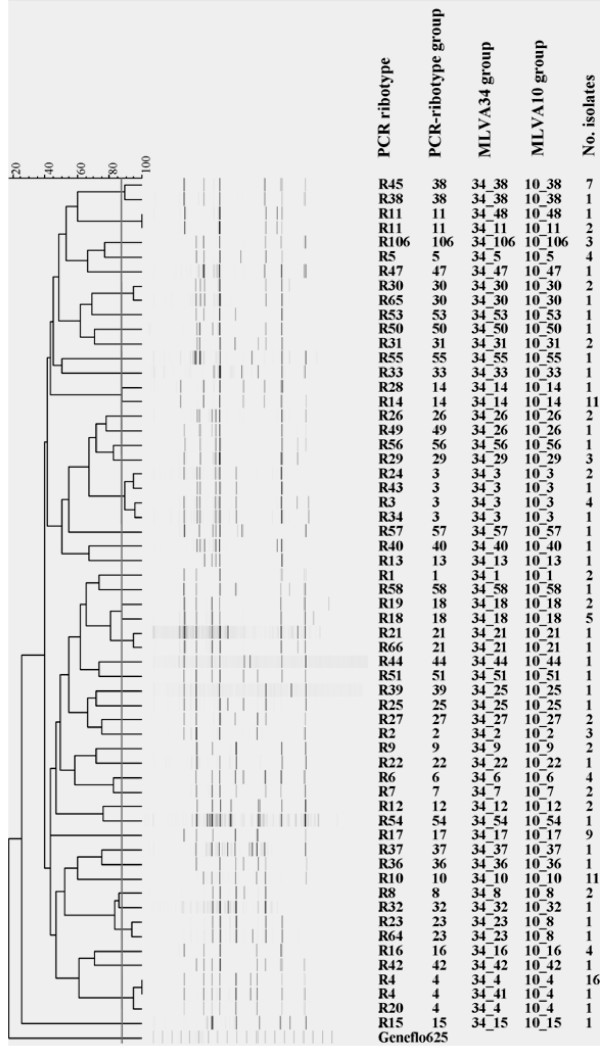
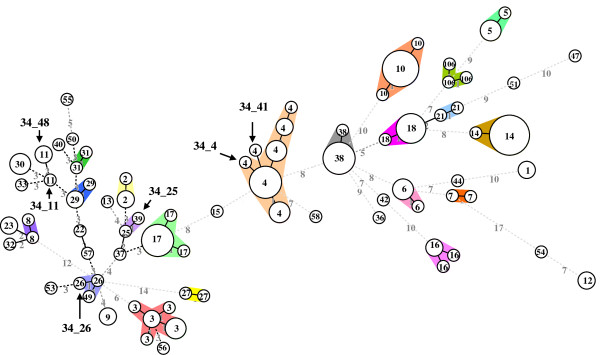
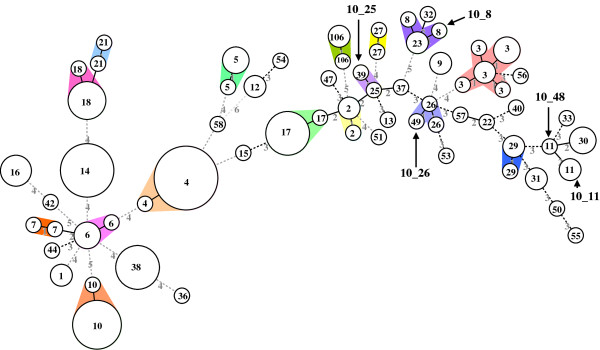
Description:Background ; Polymerase chain reaction (PCR) ribotyping is one of the globally accepted techniques for defining epidemic clones of Clostridium difficile and tracing virulence-related strains. However, the ambiguous data generated by this technique makes it difficult to compare data attained from different laboratories; therefore, a portable technique that could supersede or supplement PCR ribotyping should be developed. The current study attempted to use a new multilocus variable-number tandem-repeat analysis (MLVA) panel to detect PCR-ribotype groups. In addition, various MLVA panels using different numbers of variable-number tandem-repeat (VNTR) loci were evaluated for their power to discriminate C. difficile clinical isolates. ; Results ; At first, 40 VNTR loci from the C. difficile genome were used to screen for the most suitable MLVA panel. MLVA and PCR ribotyping were implemented to identify 142 C. difficile isolates. Groupings of serial MLVA panels with different allelic diversity were compared with 47 PCR-ribotype groups. A MLVA panel using ten VNTR loci with limited allelic diversity (0.54-0.83), designated MLVA10, generated groups highly congruent (98%) with the PCR-ribotype groups. For comparison of discriminatory power, a MLVA panel using only four highly variable VNTR loci (allelic diversity: 0.94-0.96), designated MLVA4, was found to be the simplest MLVA panel that retained high discriminatory power. The MLVA10 and MLVA4 were combined and used to detect genetically closely related C. difficile strains. ; Conclusions ; For the epidemiological investigations of C. difficile, we recommend that MLVA10 be used in coordination with the PCR-ribotype groups to detect epidemic clones, and that the MLVA4 could be used to detect outbreak strains. MLVA10 and MLVA4 could be combined in four multiplex PCR reactions to save time and obtain distinguishable data.
-
Subjects:
-
Source:BMC Microbiol. 2011; 11:217.
-
Document Type:
-
Volume:11
-
Download URL:
-
File Type:
 [PDF - 590.88 KB]
 -
Collection(s):
-
Main Document Checksum:urn:sha-512:ad09c4543f6cdc62a90d07b5e8c60f40e032d7750358328d3c6e2b1d43b5675c95c8dbbdfc45d367d9c94cdb68be76b393b532b17ac6cf78d43b0dbc82c59d9b
Supporting Files


File Language:
English
 Was this page helpful?
 Found an issue?



CDC STACKS serves as an archival repository of CDC-published products including
scientific findings, journal articles, guidelines, recommendations, or other public health information authored or
co-authored by CDC or funded partners.
As a repository, CDC STACKS retains documents in their original published format to ensure public access to scientific information.
As a repository, CDC STACKS retains documents in their original published format to ensure public access to scientific information.
You May Also Like
COLLECTION
CDC Public Access