



Improved Diagnostic Accuracy of Group A Streptococcal Pharyngitis Using Real-Time Biosurveillance
Supporting Files

-
9 20 2011 ; 9-20-
-
Available in CDC Stacks on 2013-05-12T00:00:00Z
File Language:
English
Details
-
Alternative Title:Ann Intern Med
-
Personal Author:
-
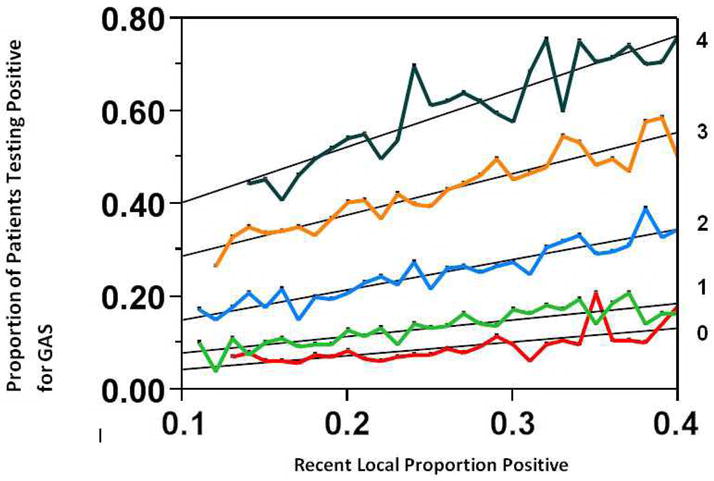
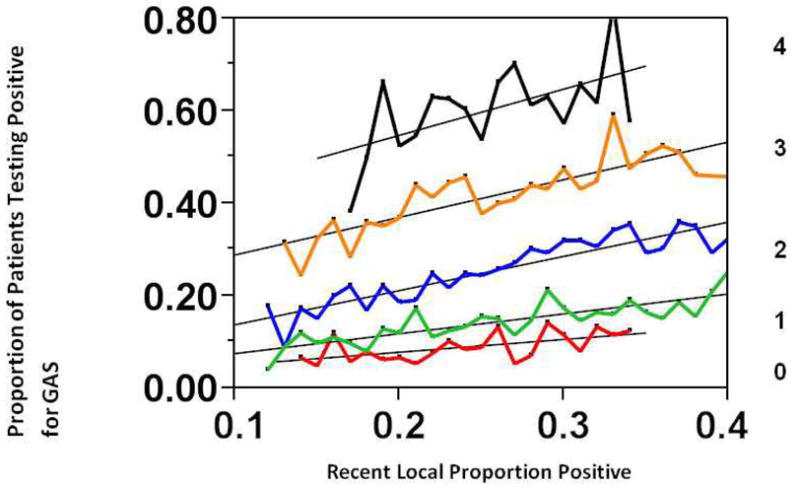
Description:Background ; Clinical prediction rules do not incorporate real time incidence data to adjust estimates of disease risk in symptomatic patients. ; Objective ; To measure the value of integrating local incidence data into a clinical decision rule for diagnosing group A streptococcal (GAS) pharyngitis in patients age 15 years and older. ; Design ; Retrospective analysis of clinical and biosurveillance predictors of GAS pharyngitis. ; Setting ; Large U.S.-based retail-health chain. ; Patients ; 82,062 patient visits for pharyngitis. ; Measurements ; Accuracy of the Centor score, was compared with that of a biosurveillance-responsive score, essentially an adjusted Centor score based on real-time GAS pharyngitis information from the 14 days prior to a patient’s visit – the recent local proportion positive (RLPP). ; Results ; Increased RLPP correlated with likelihood of GAS pharyngitis (r2 =0.79, p<0.001). Local incidence data enhanced diagnostic models. For example, when RLPP >0.30, managing patients with Centor scores of 1 as if scores were 2 would identify 62,537 previously missed patients annually while misclassifying 18,446 patients without GAS pharyngitis. Decreasing the score of patients with Centor values of 3 by one point for RLPP <0.20, would spare unnecessary antibiotics for 166,616 patients while missing 18,812 true positives. ; Limitations ; Analyses were conducted retrospectively. Real time regional GAS pharyngitis data are generally not yet available to clinicians. ; Conclusions ; Incorporating live biosurveillance data into clinical guidelines for GAS pharyngitis and other communicable diseases should be considered to reduce missed cases when the contemporaneous incidence is elevated and spare unnecessary antibiotics when the contemporaneous incidence is low. Delivering epidemiologic data to the point of care will enable the use of real-time pre-test probabilities in medical decision-making. ; Primary Funding Source ; The Mentored Public Health Research Scientist Development Award K01 HK000055 from the Centers for Disease Control and Prevention and R01 LM007677 from the National Library of Medicine, National Institutes of Health.
-
Subjects:
-
Source:Ann Intern Med. 155(6)
-
Pubmed ID:21930851
-
Pubmed Central ID:PMC3651845
-
Document Type:
-
Funding:1G08LM009778/LM/NLM NIH HHSUnited States/ ; R01 LM007677/LM/NLM NIH HHSUnited States/ ; K01 HK000055/HK/PHITPO CDC HHSUnited States/ ; K01HK000055/HK/PHITPO CDC HHSUnited States/ ; P01HK000088/HK/PHITPO CDC HHSUnited States/ ; P01 HK000088/HK/PHITPO CDC HHSUnited States/ ; G08 LM009778/LM/NLM NIH HHSUnited States/
-
Volume:155
-
Issue:6
-
Download URL:
-
File Type:
 [PDF - 869.02 KB]
 -
Collection(s):
-
Main Document Checksum:urn:sha-512:03a57fabc7473327abb55e630f891fc498e532a311c0f88b48f33fdc1c9b3526a4080ea4656fe5f6e84b6e0c994c6ef22c2d2b68697576e3da584f9144fce778
Supporting Files


File Language:
English
 Was this page helpful?
 Found an issue?


CDC STACKS serves as an archival repository of CDC-published products including
scientific findings, journal articles, guidelines, recommendations, or other public health information authored or
co-authored by CDC or funded partners.
As a repository, CDC STACKS retains documents in their original published format to ensure public access to scientific information.
As a repository, CDC STACKS retains documents in their original published format to ensure public access to scientific information.
You May Also Like
COLLECTION
CDC Public Access