


Hospital and Surgeon Variation in Complications and Repeat Surgery Following Incident Lumbar Fusion for Common Degenerative diagnoses
Supporting Files

-
Jun 20 2012
-
File Language:
English
Details
-
Alternative Title:Health Serv Res
-
Personal Author:
-
Description:Objective
To identify factors that account for variation in complication rates across hospitals and surgeons performing lumbar spinal fusion surgery.
Data sources
Discharge registry including all non-federal hospitals in Washington State from 2004–2007.
Study Design
We identified adults (n = 6,091) undergoing an initial inpatient lumbar fusion for degenerative conditions. We identified whether or not each patient had a subsequent complication within 90 days. Logistic regression models with hospital and surgeon random-effects were used to examine complications, controlling for patient characteristics and comorbidity.
Principal findings
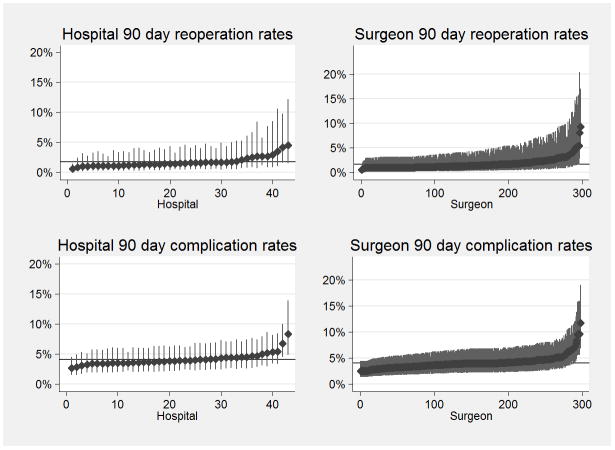
Complications within 90 days of a fusion occurred in 4.8% of patients, and 2.2% had a reoperation. Hospital effects accounted for 8.8% of the total variability, and surgeon effects account for 14.4%. Surgeon-factors account for 54.5% of the variation in hospital reoperation rates, and 47.2% of the variation in hospital complication rates. The discretionary use of operative features, such as the inclusion of Bone Morphogenetic Proteins, accounted for 30% and 50% of the variation in surgeons’ reoperation and complication rates, respectively.
Conclusions
To improve the safety of lumbar spinal fusion surgery, quality improvement efforts that focus on surgeons’ discretionary use of operative techniques, may be more effective than those that target hospitals.
-
Subjects:
-
Source:Health Serv Res. 48(1):1-25.
-
Pubmed ID:22716168
-
Pubmed Central ID:PMC3465627
-
Document Type:
-
Funding:
-
Place as Subject:
-
Volume:48
-
Issue:1
-
Collection(s):
-
Main Document Checksum:urn:sha256:db94147d275541231099aa9308b35a975315858ba22ff49851e7e10a2ec94b94
-
Download URL:
-
File Type:
 [PDF
- 374.10 KB
]
[PDF
- 374.10 KB
]
Supporting Files


File Language:
English
ON THIS PAGE

CDC STACKS serves as an archival repository of CDC-published products including
scientific findings,
journal articles, guidelines, recommendations, or other public health information authored or
co-authored by CDC or funded partners.
As a repository, CDC STACKS retains documents in their original published format to ensure public access to scientific information.
As a repository, CDC STACKS retains documents in their original published format to ensure public access to scientific information.
You May Also Like
COLLECTION
CDC Public Access