


Neighborhoods, Obesity, and Diabetes — A Randomized Social Experiment
Supporting Files

-
10 20 2011
-
File Language:
English
Details
-
Alternative Title:N Engl J Med
-
Personal Author:
-
Description:BACKGROUND
The question of whether neighborhood environment contributes directly to the development of obesity and diabetes remains unresolved. The study reported on here uses data from a social experiment to assess the association of randomly assigned variation in neighborhood conditions with obesity and diabetes.
METHODS
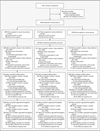
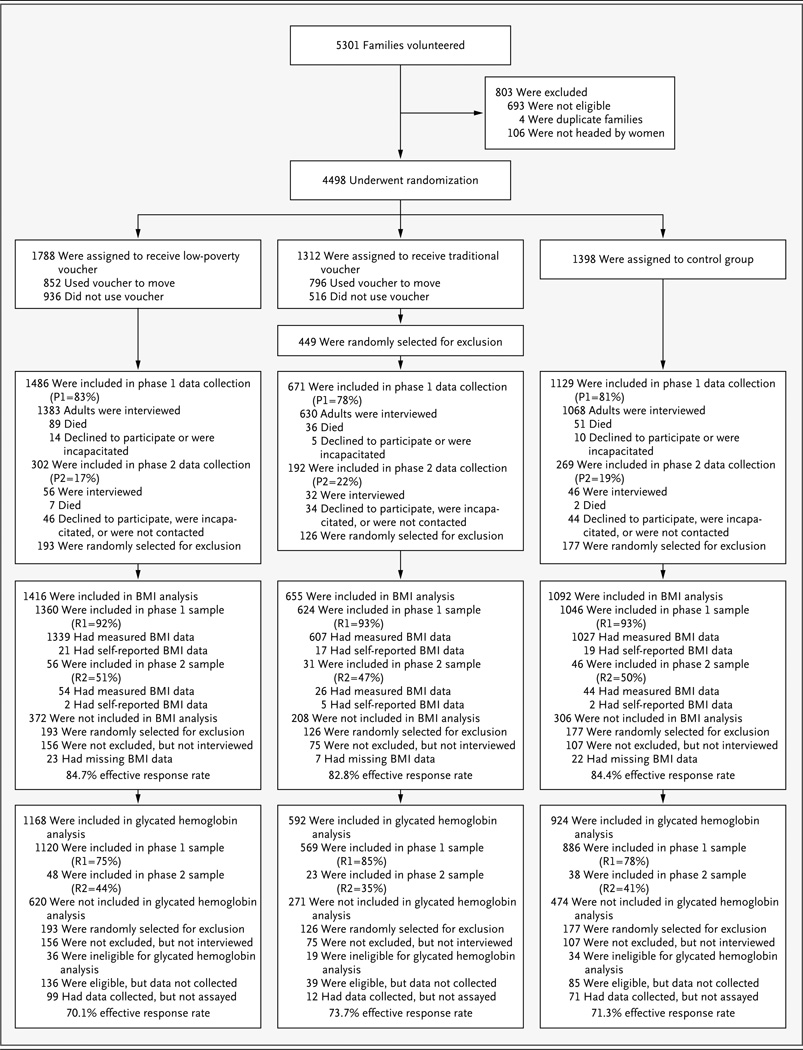
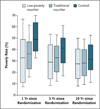
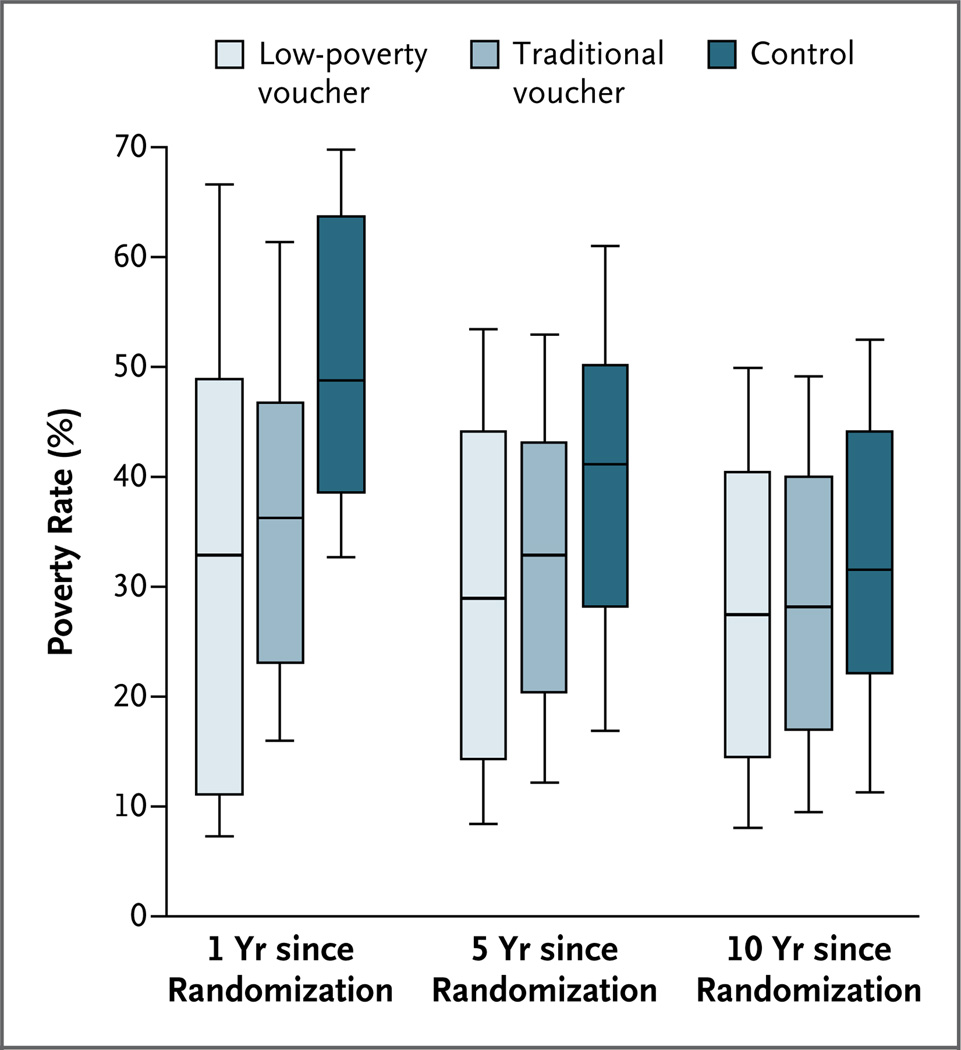
From 1994 through 1998, the Department of Housing and Urban Development (HUD) randomly assigned 4498 women with children living in public housing in high-poverty urban census tracts (in which ≥40% of residents had incomes below the federal poverty threshold) to one of three groups: 1788 were assigned to receive housing vouchers, which were redeemable only if they moved to a low-poverty census tract (where <10% of residents were poor), and counseling on moving; 1312 were assigned to receive unrestricted, traditional vouchers, with no special counseling on moving; and 1398 were assigned to a control group that was offered neither of these opportunities. From 2008 through 2010, as part of a long-term follow-up survey, we measured data indicating health outcomes, including height, weight, and level of glycated hemoglobin (HbA1c).
RESULTS
As part of our long-term survey, we obtained data on body-mass index (BMI, the weight in kilograms divided by the square of the height in meters) for 84.2% of participants and data on glycated hemoglobin level for 71.3% of participants. Response rates were similar across randomized groups. The prevalences of a BMI of 35 or more, a BMI of 40 or more, and a glycated hemoglobin level of 6.5% or more were lower in the group receiving the low-poverty vouchers than in the control group, with an absolute difference of 4.61 percentage points (95% confidence interval [CI], −8.54 to −0.69), 3.38 percentage points (95% CI, −6.39 to −0.36), and 4.31 percentage points (95% CI, −7.82 to −0.80), respectively. The differences between the group receiving traditional vouchers and the control group were not significant.
CONCLUSIONS
The opportunity to move from a neighborhood with a high level of poverty to one with a lower level of poverty was associated with modest but potentially important reductions in the prevalence of extreme obesity and diabetes. The mechanisms underlying these associations remain unclear but warrant further investigation, given their potential to guide the design of community-level interventions intended to improve health. (Funded by HUD and others.)
-
Subjects:
-
Source:N Engl J Med. 2011; 365(16):1509-1519
-
Pubmed ID:22010917
-
Pubmed Central ID:PMC3410541
-
Document Type:
-
Funding:R01 MH077026/MH/NIMH NIH HHSUnited States/ ; R01 MH077026-05/MH/NIMH NIH HHSUnited States/ ; 5P30 AG012857/AG/NIA NIH HHSUnited States/ ; P01-AG005842-22S1/AG/NIA NIH HHSUnited States/ ; R24 HD051152-04/HD/NICHD NIH HHSUnited States/ ; 1K23AG032870-01A1/AG/NIA NIH HHSUnited States/ ; R01 HD040404-08/HD/NICHD NIH HHSUnited States/ ; R56 AG031259-02/AG/NIA NIH HHSUnited States/ ; R01 HD040444-08/HD/NICHD NIH HHSUnited States/ ; R49-CE000906/CE/NCIPC CDC HHSUnited States/ ; R49 CE000906/CE/NCIPC CDC HHSUnited States/ ; K23 AG032870-01A1/AG/NIA NIH HHSUnited States/ ; R01-MH077026/MH/NIMH NIH HHSUnited States/ ; P01 AG005842-22S1/AG/NIA NIH HHSUnited States/ ; R01 HD040404/HD/NICHD NIH HHSUnited States/ ; P30 AG012857-14/AG/NIA NIH HHSUnited States/ ; R56-AG031259/AG/NIA NIH HHSUnited States/ ; P30 AG012857/AG/NIA NIH HHSUnited States/ ; R01-HD040444/HD/NICHD NIH HHSUnited States/ ; R24-HD051152-04/HD/NICHD NIH HHSUnited States/ ; R01 HD040444/HD/NICHD NIH HHSUnited States/ ; R56 AG031259/AG/NIA NIH HHSUnited States/ ; R24 HD051152/HD/NICHD NIH HHSUnited States/ ; P01 AG005842/AG/NIA NIH HHSUnited States/ ; K23 AG032870/AG/NIA NIH HHSUnited States/ ; R01 AG031259/AG/NIA NIH HHSUnited States/ ; R01-HD040404/HD/NICHD NIH HHSUnited States/
-
Volume:365
-
Issue:16
-
Collection(s):
-
Main Document Checksum:urn:sha-512:668abc10e29e7c21d9cd0cc848f52d9bbbe9edbc5881c60bc0a7708f48cf68d7e02fefb9f0098d95d0a36e78d9d331d93fb71d008cc309038ceab643d395fa98
-
Download URL:
-
File Type:
 [PDF
- 1.72 MB
]
[PDF
- 1.72 MB
]
Supporting Files


File Language:
English
ON THIS PAGE

CDC STACKS serves as an archival repository of CDC-published products including
scientific findings,
journal articles, guidelines, recommendations, or other public health information authored or
co-authored by CDC or funded partners.
As a repository, CDC STACKS retains documents in their original published format to ensure public access to scientific information.
As a repository, CDC STACKS retains documents in their original published format to ensure public access to scientific information.
You May Also Like
COLLECTION
CDC Public Access