



Prophylactic oophorectomy rates in relation to a guideline update on referral to genetic counseling
Supporting Files

-
May 04 2012
-
File Language:
English
Details
-
Alternative Title:Gynecol Oncol
-
Personal Author:
-
Description:Objective
We sought to determine whether prophylactic oophorectomy rates changed after the introduction of a 2007 health plan clinical guideline recommending systematic referral to a genetic counselor for women with a personal or family history suggestive of an inherited susceptibility to breast/ovarian cancer.
Methods
We conducted a retrospective cohort study of female members of Group Health, an integrated delivery system in Washington State. Subjects were women aged ≥35 years during 2004–2009 who reported a personal or family history consistent with an inherited susceptibility to breast/ovarian cancer. Personal and family history information was collected on a questionnaire completed when the women had a mammogram. We ascertained oophorectomies from automated claims data and determined whether surgeries were prophylactic by medical chart review. Rates were age-adjusted and age-adjusted incidence rate ratios (IRR) and 95% confidence intervals (CI) were computed using Poisson regression.
Results
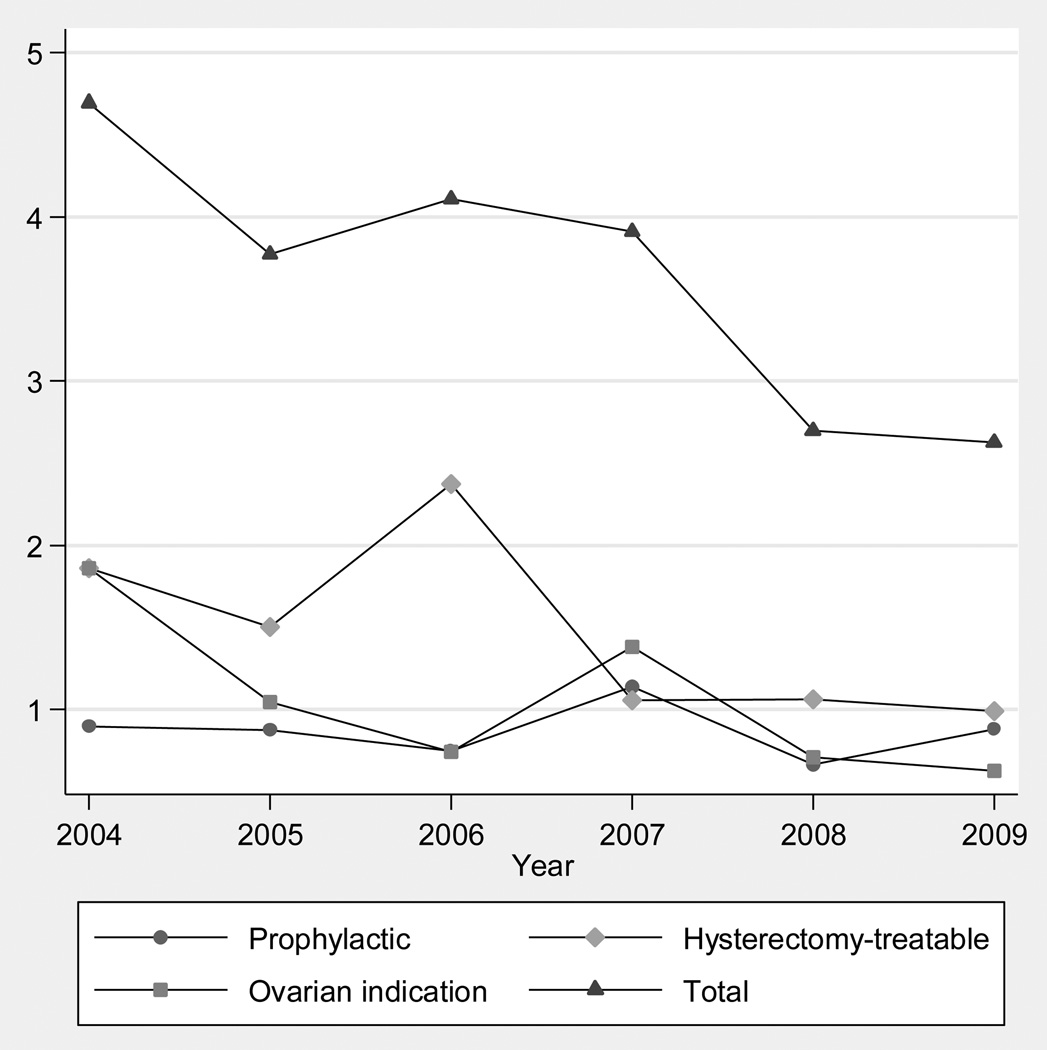
Prophylactic oophorectomy rates were relatively unchanged after compared to before the guideline change, 1.0 versus 0.8/1,000 person-years, (IRR = 1.2; 95% CI: 0.7–2.0), whereas bilateral oophorectomy rates for other indications decreased. Genetic counseling receipt rates doubled after the guideline change (95% CI: 1.7–2.4) from 5.1 to 10.2/1,000 person-years. During the study, bilateral oophorectomy rates were appreciably greater in women who saw a genetic counselor compared to those who did not regardless of whether they received genetic testing as part of their counseling.
Conclusion
A doubling in genetic counseling receipt rates lends support to the idea that the guideline issuance contributed to sustained rates of prophylactic oophorectomies in more recent years.
-
Subjects:
-
Source:Gynecol Oncol. 2012; 126(2):229-235.
-
Pubmed ID:22564716
-
Pubmed Central ID:PMC3383401
-
Document Type:
-
Funding:N01-PC-35142/PC/NCI NIH HHS/United States ; N01 CN067009/CN/NCI NIH HHS/United States ; R18DP001142/DP/NCCDPHP CDC HHS/United States ; U01 CA063731/CA/NCI NIH HHS/United States ; N01 PC035142/PC/NCI NIH HHS/United States ; P01 CA154292/CA/NCI NIH HHS/United States ; CA63731/CA/NCI NIH HHS/United States ; R18 DP001142/DP/NCCDPHP CDC HHS/United States ; N01PC35142/CA/NCI NIH HHS/United States
-
Volume:126
-
Issue:2
-
Collection(s):
-
Main Document Checksum:urn:sha256:4189c23c066968c441e12fde84e125b8cc5c9e5c1c9b8dcda3c745c9eedb94c0
-
Download URL:
-
File Type:
 [PDF
- 919.50 KB
]
[PDF
- 919.50 KB
]
Supporting Files


File Language:
English
 Was this page helpful?
 Found an issue?


CDC STACKS serves as an archival repository of CDC-published products including
scientific findings,
journal articles, guidelines, recommendations, or other public health information authored or
co-authored by CDC or funded partners.
As a repository, CDC STACKS retains documents in their original published format to ensure public access to scientific information.
As a repository, CDC STACKS retains documents in their original published format to ensure public access to scientific information.
You May Also Like
COLLECTION
CDC Public Access