



A comparison of syringe disposal practices among injection drug users in a city with versus a city without needle and syringe programs
Supporting Files

-
6 1 2012 ; 6-1-
-
Available in CDC Stacks on June 01, 2013, 12:00 AM
File Language:
English
Details
-
Alternative Title:Drug Alcohol Depend
-
Personal Author:
-
Description:Background
The United States (U.S.) approved use of federal funds for needle and syringe programs (NSPs) in December 2009. This study compares syringe disposal practices in a U.S. city with NSPs to a U.S. city without NSPs by examining the prevalence of improperly discarded syringes in public places and the self-reported syringe disposal practices of injection drug users (IDUs) in the two cities.
Methods
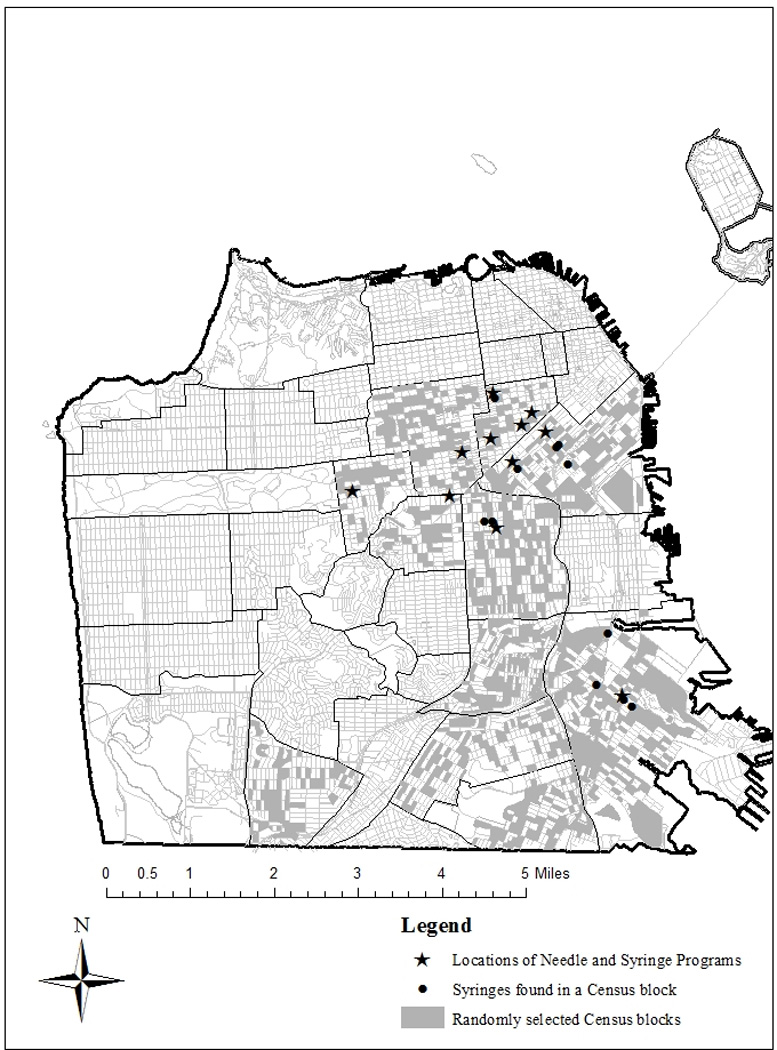
We conducted visual inspection walkthroughs in a random sample of the top-quartile of drug-affected neighborhoods in San Francisco, California (a city with NSPs) and Miami, Florida (a city without NSPs). We also conducted quantitative surveys of adult IDUs in San Francisco (N=602) and Miami (N=448).
Results
In the visual inspections, we found 44 syringes/1000 census blocks in San Francisco, and 371/1000 census blocks in Miami. Survey results showed that in San Francisco 13% of syringes IDUs reported using in the 30 days preceding the study interviews were disposed of improperly versus 95% of syringes by IDUs in Miami. In multivariable logistic regression analysis, IDUs in Miami had over 34 times the adjusted odds of public syringe disposal relative to IDUs in San Francisco (adjusted odds ratio=34.2, 95% CI = 21.92, 53.47).
Conclusions
We found eight-fold more improperly disposed syringes on walkthroughs in the city without NSPs compared to the city with NSPs, which was corroborated by survey data. NSPs may help IDUs dispose of their syringes safely in cities with large numbers of IDUs. -
Keywords:
- injection drug users (IDUs)
- needle and syringe programs (NSPs)
- HIV
- hepatitis
- Adolescent
- Adult
- Age Factors
- Confidence Intervals
- Data Collection
- Female
- Florida
- HIV Seropositivity
- Ill-Housed Persons
- Humans
- Male
- Middle Aged
- Needle Sharing
- Needle-Exchange Programs
- Odds Ratio
- Residence Characteristics
- San Francisco
- Sex Factors
- Socioeconomic Factors
- Substance Abuse, Intravenous
- Syringes
- Young Adult
-
Source:Drug Alcohol Depend. 2011; 123(1-3):255-259
-
Pubmed ID:22209091
-
Pubmed Central ID:PMC3358593
-
Document Type:
-
Funding:R01 DA023377/DA/NIDA NIH HHSUnited States/ ; U62 PS000967/PS/NCHHSTP CDC HHSUnited States/ ; P30 AI073961/AI/NIAID NIH HHSUnited States/ ; 5U62PS000967-02/PS/NCHHSTP CDC HHSUnited States/ ; 5P30AI073961/AI/NIAID NIH HHSUnited States/ ; R01 DA021627/DA/NIDA NIH HHSUnited States/ ; R01 DA021627-01A1/DA/NIDA NIH HHSUnited States/
-
Volume:123
-
Download URL:
-
File Type:
 [PDF - 866.77 KB]
 -
Collection(s):
-
Main Document Checksum:urn:sha256:36faa765fe2c2087b0dac06b550ca29cd8ea605fc7e2b92a2d026bf788d9900f
Supporting Files


File Language:
English
 Was this page helpful?
 Found an issue?


CDC STACKS serves as an archival repository of CDC-published products including
scientific findings, journal articles, guidelines, recommendations, or other public health information authored or
co-authored by CDC or funded partners.
As a repository, CDC STACKS retains documents in their original published format to ensure public access to scientific information.
As a repository, CDC STACKS retains documents in their original published format to ensure public access to scientific information.
You May Also Like
COLLECTION
CDC Public Access