



Spectrum of Cancer Risk among U.S. Solid Organ Transplant Recipients: The Transplant Cancer Match Study
Supporting Files

-
Nov 2 2011
-
Available in CDC Stacks on 2012-05-02T00:00:00Z
File Language:
English
Details
-
Alternative Title:JAMA
-
Personal Author:Engels, Eric A. ; Pfeiffer, Ruth M. ; Fraumeni, Joseph F. ; Kasiske, Bertram L. ; Israni, Ajay K. ; Snyder, Jon J. ; Wolfe, Robert A. ; Goodrich, Nathan P. ; Bayakly, A. Rana ; Clarke, Christina A. ; Copeland, Glenn ; Finch, Jack L. ; Fleissner, Mary Lou ; Goodman, Marc T. ; Kahn, Amy ; Koch, Lori ; Lynch, Charles F. ; Madeleine, Margaret M. ; Pawlish, Karen ; Rao, Chandrika ; Williams, Melanie A. ; Castenson, David ; Curry, Michael ; Parsons, Ruth ; Fant, Gregory ; Lin, Monica
-
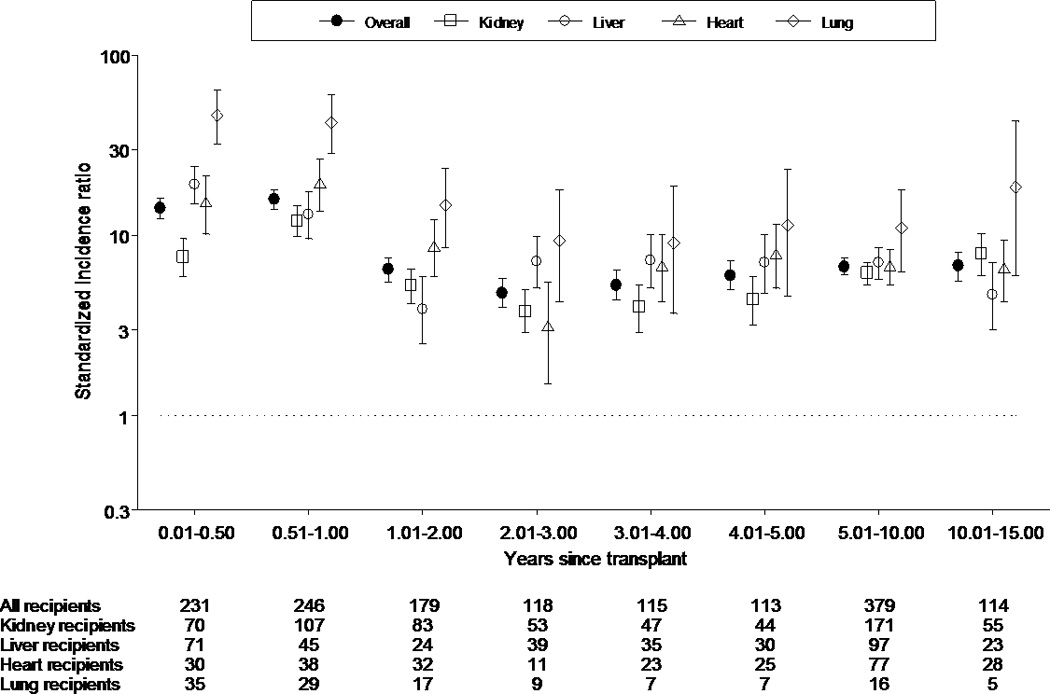
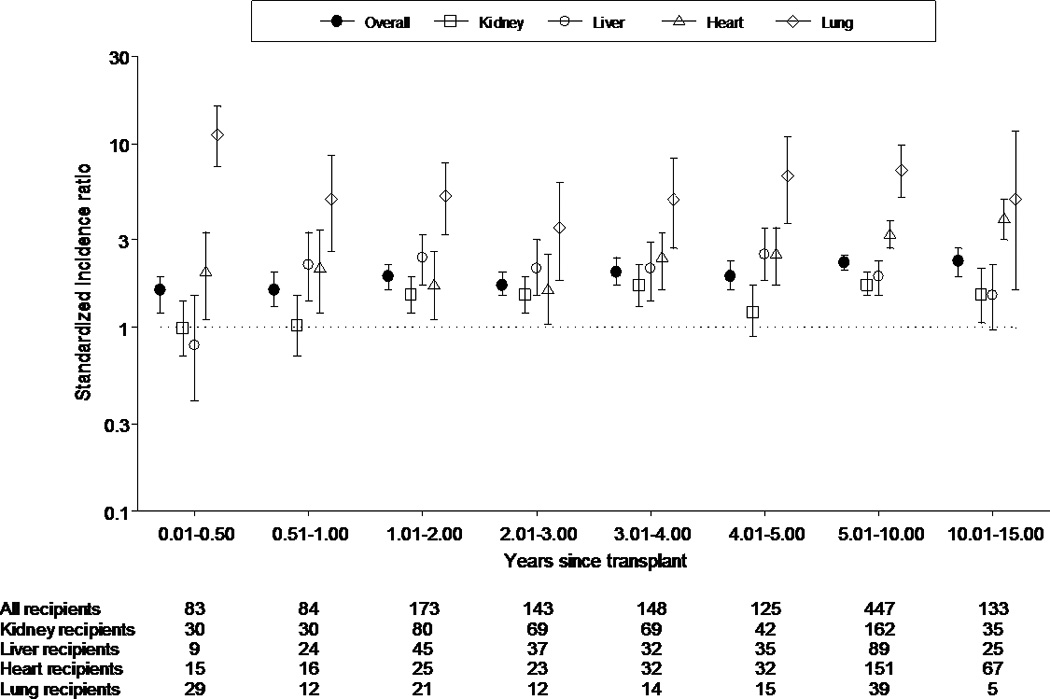
Description:Context ; Solid organ transplant recipients have elevated cancer risk due to immunosuppression and oncogenic viral infections. Since most prior research has concerned kidney recipients, large studies that include recipients of differing organs can inform cancer etiology. ; Objective ; Describe the overall pattern of cancer among solid organ transplant recipients. ; Design ; Cohort study using linked data from the U.S. Scientific Registry of Transplant Recipients (1987–2008) and 13 state/regional cancer registries. ; Participants and Setting ; Solid organ transplant recipients in the U.S. ; Main Outcome Measure ; Standardized incidence ratios (SIRs) and excess absolute risks (EARs) assessing relative and absolute cancer risk in transplant recipients compared to the general population. ; Results ; Registry linkages yielded data on 175,732 solid organ transplants (58.4% kidney, 21.6% liver, 10.0% heart, 4.0% lung). Overall cancer risk was elevated (N=10,656 cases, incidence 1374.7 per 100,000 person-years; SIR 2.10, 95%CI 2.06–2.14; EAR 719.3, 95%CI 693.3–745.6, per 100,000 person-years). Risk was increased (p<0.001) for 32 different malignancies, some related to known infections (e.g., anal cancer, Kaposi sarcoma) and others unrelated (e.g., melanoma, thyroid and lip cancers). The most common malignancies with elevated risk were non-Hodgkin lymphoma (N=1504, incidence 194.0; SIR 7.54, 95%CI 7.17–7.93; EAR 168.3, 95%CI 158.6–178.4) and cancers of the lung (N=1344, incidence 173.4; SIR 1.97, 95%CI 1.86–2.08; EAR 85.3, 95%CI 76.2–94.8), liver (N=930, incidence 120.0; SIR 11.56, 95%CI 10.83–12.33; EAR 109.6, 95%CI 102.0–117.6), and kidney (N=752, incidence 97.0; SIR 4.65, 95%CI 4.32–4.99; EAR 76.1, 95%CI 69.3–83.3). Lung cancer risk was most elevated in lung recipients (SIR 6.13, 95%CI 5.18–7.21) but also increased among other recipients (SIR 1.46, 95%CI 1.34–1.59 for kidney; 1.95, 1.74–2.19 for liver; 2.67, 2.40–2.95 for heart). Liver cancer was elevated only among liver recipients (SIR 43.83, 95%CI 40.90–46.91), who manifested exceptional risk in the first 6 months (SIR 508.97, 95%CI 474.16–545.66) and continuing two-fold excess for 10–15 years (SIR 2.22, 95%CI 1.57–3.04). Among kidney recipients, kidney cancer was elevated (SIR 6.66, 95%CI 6.12–7.23) and bimodal in onset. Kidney cancer was also increased in liver and heart recipients (SIR 1.80, 95%CI 1.40–2.29, and 2.90, 2.32–3.59, respectively). ; Conclusions ; Recipients of a kidney, liver, heart, or lung transplant have an increased risk for diverse infection-related and unrelated cancers, compared with the general population.
-
Subjects:
-
Source:JAMA. 306(17):1891-1901.
-
Pubmed ID:22045767
-
Pubmed Central ID:PMC3310893
-
Document Type:
-
Funding:15-0351/PHS HHS/United States ; 1U58 DP000807-01/DP/NCCDPHP CDC HHS/United States ; 5658DP000805-04/DP/NCCDPHP CDC HHS/United States ; 5U58/DP000808-03/DP/NCCDPHP CDC HHS/United States ; 5U58DP000812-03/DP/NCCDPHP CDC HHS/United States ; 5U58DP000817-05/DP/NCCDPHP CDC HHS/United States ; 5U58DP000824-04/DP/NCCDPHP CDC HHS/United States ; HHSH234200537009C/PHS HHS/United States ; HHSH250201000018C/PHS HHS/United States ; HHSN261200544005C/PHS HHS/United States ; HHSN261201000024C/PHS HHS/United States ; HHSN261201000034C/PHS HHS/United States ; HHSN261201000035C/PHS HHS/United States ; HHSN261201000036C/PHS HHS/United States ; HHSN261201000037C/PHS HHS/United States ; N01-PC-35137/PC/NCI NIH HHS/United States ; N01-PC-35139/PC/NCI NIH HHS/United States ; N01-PC-35142/PC/NCI NIH HHS/United States ; N01-PC-35143/PC/NCI NIH HHS/United States ; N01-PC-54405/PC/NCI NIH HHS/United States ; U58 DP000848-04/DP/NCCDPHP CDC HHS/United States ; U58DP000832/DP/NCCDPHP CDC HHS/United States ; ZIA CP010150-10/Intramural NIH HHS/United States
-
Place as Subject:
-
Volume:306
-
Issue:17
-
Download URL:
-
File Type:
 [PDF - 522.57 KB]
 -
Collection(s):
-
Main Document Checksum:urn:sha256:9c055c6c9e2fd8d4976b56c187af2cece8ceea852b411b4f4f15d8eb61aefe89
Supporting Files


File Language:
English
 Was this page helpful?
 Found an issue?





CDC STACKS serves as an archival repository of CDC-published products including
scientific findings, journal articles, guidelines, recommendations, or other public health information authored or
co-authored by CDC or funded partners.
As a repository, CDC STACKS retains documents in their original published format to ensure public access to scientific information.
As a repository, CDC STACKS retains documents in their original published format to ensure public access to scientific information.
You May Also Like
COLLECTION
CDC Public Access