


The Changing Epidemiology of Invasive Pneumococcal Disease at a Tertiary Children’s Hospital through the PCV7 Era
Supporting Files

-
Mar 2012
-
File Language:
English
Details
-
Alternative Title:Pediatr Infect Dis J
-
Personal Author:
-
Description:Background
In 2000, a 7-valent pneumococcal conjugate vaccine (PCV7) was licensed for use among U.S. children. Many sites have since reported changes in invasive pneumococcal disease (IPD). We recognized an opportunity to describe the changes in epidemiology, clinical syndromes and serotype distribution over a 14 year period including 4 years before vaccine introduction and spanning the entire PCV7 era.
Methods
Cases were defined as children <18 years of age who were cared for at Primary Children’s Medical Center for culture-confirmed IPD. We defined the pre-vaccine period as the timeframe spanning 1997–2000 and the post-vaccine period from 2001–2010. Demographics, clinical data, and outcomes were collected through electronic query and chart review. S. pneumoniae serotyping was performed using the capsular swelling method.
Results
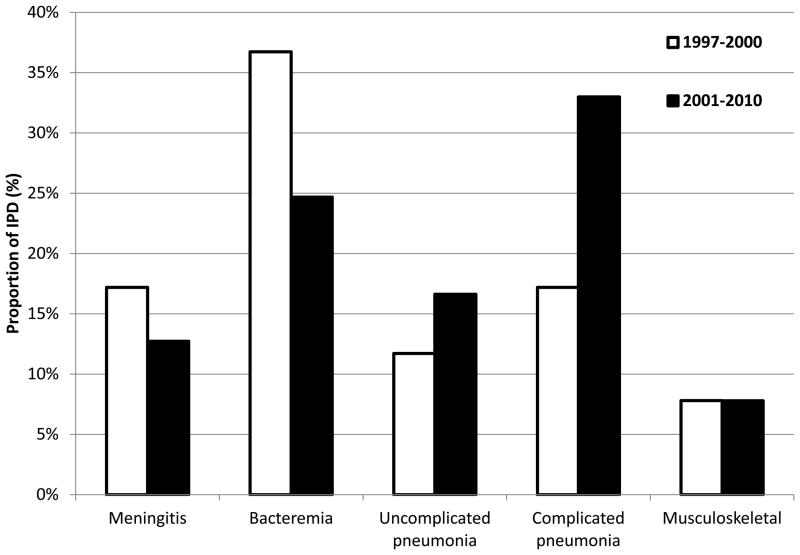
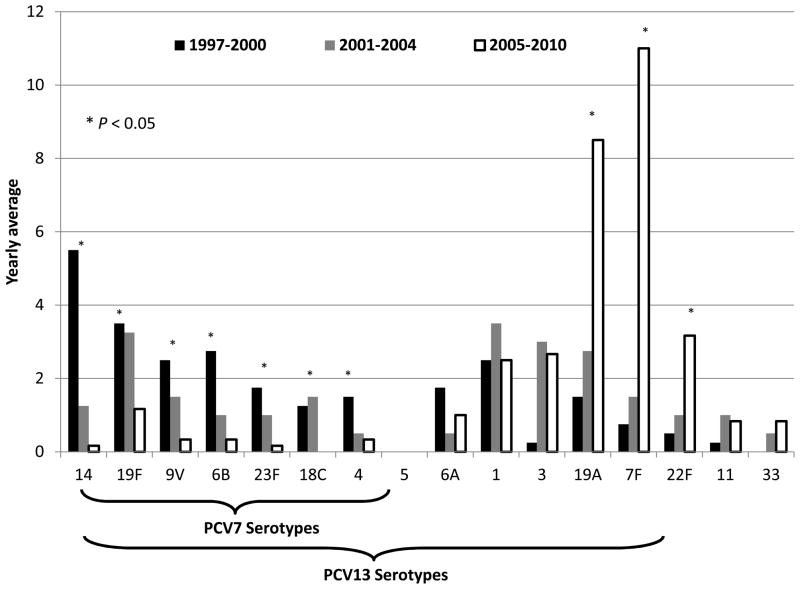
The median age of children with IPD increased from 19 months during the pre-vaccine period to 27 months during post-vaccine period (P = 0.02) with a larger proportion of IPD among children older than 5 years. The proportion of IPD associated with pneumonia increased substantially from 29% to 50% (P < 0.001). This increase was primarily attributable to an increase in complicated pneumonia (17% to 33%; P < 0.001). Non-vaccine serotypes 7F, 19A, 22F and 3 emerged as the dominant serotypes in the post-vaccine period. Of S. pneumoniae isolates collected from children <5 years of age, for which vaccine is recommended, 67% of IPD was due to serotypes in PCV13 during 2005–2010.
Conclusions
After PCV7 was introduced, significant changes in IPD were noted. One third of IPD occurred in children older than 5 years, who were outside the age group for which PCV is recommended. Continued surveillance is warranted to identify further evolution of the epidemiology, clinical syndromes, and serotype distribution of S. pneumoniae following PCV13 licensure.
-
Subjects:
-
Source:Pediatr Infect Dis J. 31(3).
-
Pubmed ID:22330164
-
Pubmed Central ID:PMC3299810
-
Document Type:
-
Funding:1K23-AI079401-01A1/AI/NIAID NIH HHS/United States ; K-24 HD047249-01A1/HD/NICHD NIH HHS/United States ; K23 AI079401/AI/NIAID NIH HHS/United States ; K24 HD047249/HD/NICHD NIH HHS/United States ; K24 HD047249-01A1/HD/NICHD NIH HHS/United States ; U01 AI074419-01/AI/NIAID NIH HHS/United States ; U01A1082482/PHS HHS/United States ; U01AI082184-01/AI/NIAID NIH HHS/United States ; U18-IP000303-01/IP/NCIRD CDC HHS/United States
-
Place as Subject:
-
Volume:31
-
Issue:3
-
Collection(s):
-
Main Document Checksum:urn:sha256:2e8a3be393cdec4385de3834430e37af8c03180e856303d29b5f45c37d9afc41
-
Download URL:
-
File Type:
 [PDF
- 425.06 KB
]
[PDF
- 425.06 KB
]
Supporting Files


File Language:
English
ON THIS PAGE




CDC STACKS serves as an archival repository of CDC-published products including
scientific findings,
journal articles, guidelines, recommendations, or other public health information authored or
co-authored by CDC or funded partners.
As a repository, CDC STACKS retains documents in their original published format to ensure public access to scientific information.
As a repository, CDC STACKS retains documents in their original published format to ensure public access to scientific information.
You May Also Like
COLLECTION
CDC Public Access