


Early Life Antecedents of Atrial Fibrillation: Place of Birth and Atrial Fibrillation Related Mortality
Supporting Files

-
Jul 27 2011
-
File Language:
English
Details
-
Alternative Title:Ann Epidemiol
-
Personal Author:
-
Description:Purpose
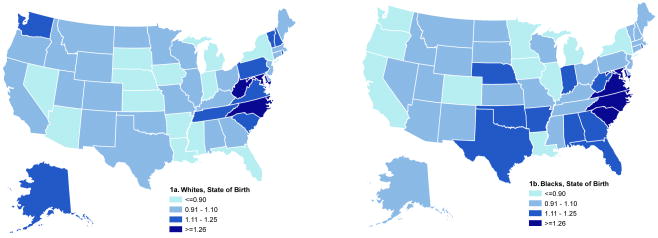
Recent evidence suggests early life factors correlate with atrial fibrillation (AF). We hypothesized that AF-related mortality, similar to stroke mortality, is elevated for individuals born in the southeastern US.
Methods
We estimated 3-year (1999-2001) average AF-related mortality rates, using US vital statistics for 55-89 year old whites (136,573 AF-related deaths) and blacks (8,288 AF-related deaths). We estimated age- and sex-adjusted odds of AF-related (contributing cause) mortality associated with birth state, and birth within the US stroke belt (SB), stratified by race. SB results were replicated using 1989-1991 data.
Results
Among blacks, four contiguous birth states were associated with statistically significant ORs>=1.25 compared to the national average AF-related mortality. The four highest-risk birth states for blacks also predicted elevated AF-related mortality among whites, but patterns were attenuated. The odds ratio for AF-related mortality associated with SB birth was 1.19 (CI 1.13, 1.25) for blacks and 1.09 (CI 1.07, 1.12) for whites, adjusting for SB adult residence.
Conclusion
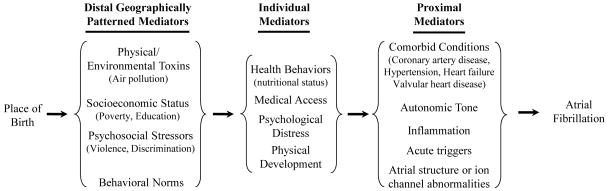
Place of birth predicted AF-related mortality, after adjusting for place of adult residence. The association of AF related mortality and SB birth parallels that of other cardiovascular diseases, and may likewise indicate an importance of early life factors in the development of AF.
-
Subjects:
-
Source:Ann Epidemiol. 2011; 21(10):732-738.
-
Pubmed ID:21798760
-
Pubmed Central ID:PMC3166377
-
Document Type:
-
Funding:R01 AG028321-01/AG/NIA NIH HHS/United States ; R01 AG027122/AG/NIA NIH HHS/United States ; N01-HC-25195/HC/NHLBI NIH HHS/United States ; 1R03OH009338-01/OH/NIOSH CDC HHS/United States ; R03 OH009338/OH/NIOSH CDC HHS/United States ; R21AG03438501/AG/NIA NIH HHS/United States ; R01 HL092577/HL/NHLBI NIH HHS/United States ; T32 AG000158/AG/NIA NIH HHS/United States ; R03 CA137666/CA/NCI NIH HHS/United States ; RC1 HL101056/HL/NHLBI NIH HHS/United States ; RC1 HL101056-01/RC/CCR NIH HHS/United States ; R01 HL102214/HL/NHLBI NIH HHS/United States ; 1RC1 HL101056/HL/NHLBI NIH HHS/United States ; R01 AG023399/AG/NIA NIH HHS/United States ; 1 R91 AG927321/AG/NIA NIH HHS/United States ; N01HC25195/HL/NHLBI NIH HHS/United States ; 1R01AG027122-01A2/AG/NIA NIH HHS/United States ; R01 HL092577-03/HL/NHLBI NIH HHS/United States ; 1R01HL102214/HL/NHLBI NIH HHS/United States ; RC1 HL101056-01/HL/NHLBI NIH HHS/United States ; 1R03CA137666-01A1/CA/NCI NIH HHS/United States ; 1R01HL092577/HL/NHLBI NIH HHS/United States ; R01 AG028321/AG/NIA NIH HHS/United States
-
Place as Subject:
-
Volume:21
-
Issue:10
-
Collection(s):
-
Main Document Checksum:urn:sha256:324b39dea511ba573eaec344d309711613f67af71bd560bfc6359a5d1a5491de
-
Download URL:
-
File Type:
 [PDF
- 244.49 KB
]
[PDF
- 244.49 KB
]
Supporting Files


File Language:
English
ON THIS PAGE



CDC STACKS serves as an archival repository of CDC-published products including
scientific findings,
journal articles, guidelines, recommendations, or other public health information authored or
co-authored by CDC or funded partners.
As a repository, CDC STACKS retains documents in their original published format to ensure public access to scientific information.
As a repository, CDC STACKS retains documents in their original published format to ensure public access to scientific information.
You May Also Like
COLLECTION
CDC Public Access