



Examining the Link between Neighborhood Context and Parental Messages to their Adolescent Children About Violence
Supporting Files

-
7 2011 ; 7-2011
-
Available in CDC Stacks on 2012-07-01T00:00:00Z
File Language:
English
Details
-
Alternative Title:J Adolesc Health
-
Personal Author:
-
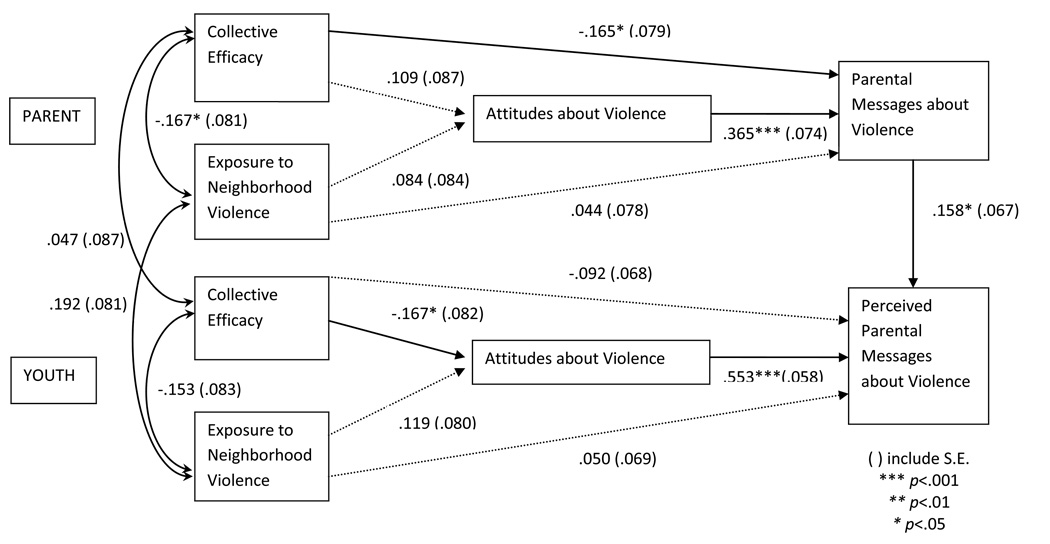
Description:Purpose ; Living in violent neighborhoods has been shown to alter adolescent’s social-cognitions and increase aggressive behavior. A similar process may also occur for parents and result in parental support of aggressive behavior. This research examines the influence of perceived neighborhood violence and neighborhood collective efficacy on parents’ attitudes toward violence and the messages they give their adolescent children about how to resolve interpersonal conflict. ; Method ; These data come from 143 African-American parents and their adolescent children recruited from 3 inner-city middle schools to participate in a parenting intervention. Models were fit using structural equation modeling in Mplus. ; Results ; Contrary to expectations, exposure to neighborhood violence was not predictive of either aggressive attitudes or conflict solutions for parents or adolescents. Rather, a mixed effect was found for neighborhood collective efficacy, with higher perceived neighborhood collective efficacy related to less violent attitudes for adolescents but not parents. Collective efficacy also predicted the messages that parents gave their adolescents about interpersonal conflict, with higher collective efficacy related to messages that were less supportive of violence. ; Conclusion ; Parent and adolescent perception of neighborhood collective efficacy influences the messages that adolescents receive about interpersonal conflict resolution. This suggests that for parents living in violent neighborhoods their appraisal of the neighborhood is more important in shaping conflict resolution messages than parents’ own experiences with violence. Parent and family-based programs to prevent youth violence need to address neighborhood factors that influence the messages adolescents receive about how to resolve conflict.
-
Subjects:
-
Keywords:
-
Source:J Adolesc Health. 2010; 49(1):58-63
-
Pubmed ID:21700158
-
Pubmed Central ID:PMC3124663
-
Document Type:
-
Funding:U49 CE000728/CE/NCIPC CDC HHSUnited States/ ; P20 MD00165/MD/NIMHD NIH HHSUnited States/ ; P20 MD000198/MD/NIMHD NIH HHSUnited States/ ; P20 MD000165-01/MD/NIMHD NIH HHSUnited States/ ; T32 HP1004/PHS HHSUnited States/ ; U49CE000728/CE/NCIPC CDC HHSUnited States/ ; P20 MD000165/MD/NIMHD NIH HHSUnited States/ ; K24 HD052559-01A2/HD/NICHD NIH HHSUnited States/ ; ImNIH/Intramural NIH HHSUnited States/ ; K24 HD052559/HD/NICHD NIH HHSUnited States/ ; 1K24HD052559/HD/NICHD NIH HHSUnited States/
-
Volume:49
-
Issue:1
-
Download URL:
-
File Type:
 [PDF - 322.41 KB]
 -
Collection(s):
-
Main Document Checksum:urn:sha256:d8be2b50127f4a8d64cb313cf2d1c21077a227d0757775db743a4e41b11581f2
Supporting Files


File Language:
English
 Was this page helpful?
 Found an issue?


CDC STACKS serves as an archival repository of CDC-published products including
scientific findings, journal articles, guidelines, recommendations, or other public health information authored or
co-authored by CDC or funded partners.
As a repository, CDC STACKS retains documents in their original published format to ensure public access to scientific information.
As a repository, CDC STACKS retains documents in their original published format to ensure public access to scientific information.
You May Also Like
COLLECTION
CDC Public Access