



Inadequate Coordination of Maternal and Infant HIV Services Detrimentally Affects Early Infant Diagnosis Outcomes in Lilongwe, Malawi
Supporting Files

-
4 15 2011 ; 4-15-
-
Available in CDC Stacks on April 15, 2012, 12:00 AM
File Language:
English
Details
-
Alternative Title:J Acquir Immune Defic Syndr
-
Personal Author:
-
Description:Objective
To assess the continuity of care and outcome of pediatric HIV prevention, testing, and treatment services, focusing on early infant diagnosis with DNA PCR.
Design
A retrospective observational cohort.
Methods
Maternal HIV antibody, infant HIV DNA PCR test results, and outcome data from HIV-infected infants from the prevention of mother-to-child transmission, early infant diagnosis, and pediatric HIV treatment programs operating in Lilongwe, Malawi between 2004 and 2008 were collected, merged and analyzed.
Results
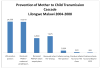
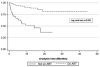
Of the 14,669 pregnant women who tested HIV antibody positive, 7,875 infants (53.7%) received HIV DNA PCR testing. One thousand eighty-four infants (13.8%) were HIV-infected. 320 (29.5%) children enrolled into pediatric HIV care, with 202 (63.1%) at the Baylor Center of Excellence. Among these, antiretroviral therapy was initiated on 110 infants (54.5%) whose median age was 9.1 months (interquartile range, 5.4 to 13.8) and a median of 2.5 months (interquartile range, 1.4 to 9.2) after HIV clinic registration. Sixty-nine HIV-infected infants (34.2%) died or were lost by December 2008. Initiation of antiretroviral therapy increased the likelihood of survival seven-fold (odds ratio, 7.1; 95% confidence interval, 3.68 -13.70).
Conclusions
Separate programs for maternal and infant HIV prevention and care services demonstrated high attrition rates of HIV-exposed and HIV-infected infants, elevated levels of mother-to-child transmission, late infant diagnosis, delayed pediatric antiretroviral therapy initiation, and high HIV-infected infant mortality. Antiretroviral therapy increased HIV-infected infant survival, emphasizing the urgent need for improved service coordination and strategies that increase access to infant HIV diagnosis, improve patient retention, and reduce antiretroviral therapy initiation delays. -
Subjects:
- AIDS Serodiagnosis
- Antiretroviral Therapy, Highly Active
- Child Health Services
- Cohort Studies
- Delivery of Health Care, Integrated
- Early Diagnosis
- Female
- HIV Antibodies
- HIV Infections
- HIV-1
- Health Planning Guidelines
- Humans
- Infant
- Infant Mortality
- Infectious Disease Transmission, Vertical
- Malawi
- Male
- Maternal Health Services
- Polymerase Chain Reaction
- Pregnancy
- Pregnancy Complications, Infectious
- Retrospective Studies
-
Keywords:
-
Source:J Acquir Immune Defic Syndr. 56(5):e122-e128
-
Pubmed ID:21224736
-
Pubmed Central ID:PMC3112277
-
Document Type:
-
Funding:U48 DP001944/DP/NCCDPHP CDC HHSUnited States/ ; D43 TW001039/TW/FIC NIH HHSUnited States/ ; #P30 AI50410/AI/NIAID NIH HHSUnited States/ ; T32 HL072748/HL/NHLBI NIH HHSUnited States/ ; R24 TW007988/TW/FIC NIH HHSUnited States/ ; R24 TW007988-03/TW/FIC NIH HHSUnited States/ ; 1U48DP001944/DP/NCCDPHP CDC HHSUnited States/ ; D43 TW001039-09/TW/FIC NIH HHSUnited States/ ; U48DP001944/ACL/ACL HHSUnited States/ ; D43 TW001036/TW/FIC NIH HHSUnited States/ ; P30 AI050410-08/AI/NIAID NIH HHSUnited States/ ; D43 TW01036/TW/FIC NIH HHSUnited States/ ; P30 AI050410/AI/NIAID NIH HHSUnited States/
-
Volume:56
-
Issue:5
-
Download URL:
-
File Type:
 [PDF - 107.25 KB]
 -
Collection(s):
-
Main Document Checksum:urn:sha256:d8eea705f57ee0c4e4bb5716d068951c4b2a4e11fc77853e40edc2f816e74936
Supporting Files


File Language:
English
 Was this page helpful?
 Found an issue?



CDC STACKS serves as an archival repository of CDC-published products including
scientific findings, journal articles, guidelines, recommendations, or other public health information authored or
co-authored by CDC or funded partners.
As a repository, CDC STACKS retains documents in their original published format to ensure public access to scientific information.
As a repository, CDC STACKS retains documents in their original published format to ensure public access to scientific information.
You May Also Like
COLLECTION
CDC Public Access