


Difference in response reliability predicted by spectrotemporal tuning in the cochlear nuclei of barn owls
Supporting Files

-
Mar 2 2011
File Language:
English
Details
-
Alternative Title:J Neurosci
-
Personal Author:
-
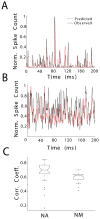
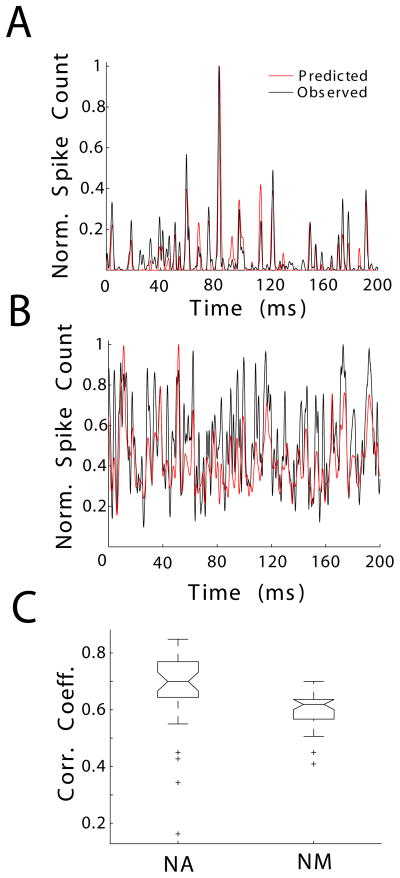
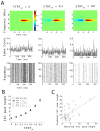
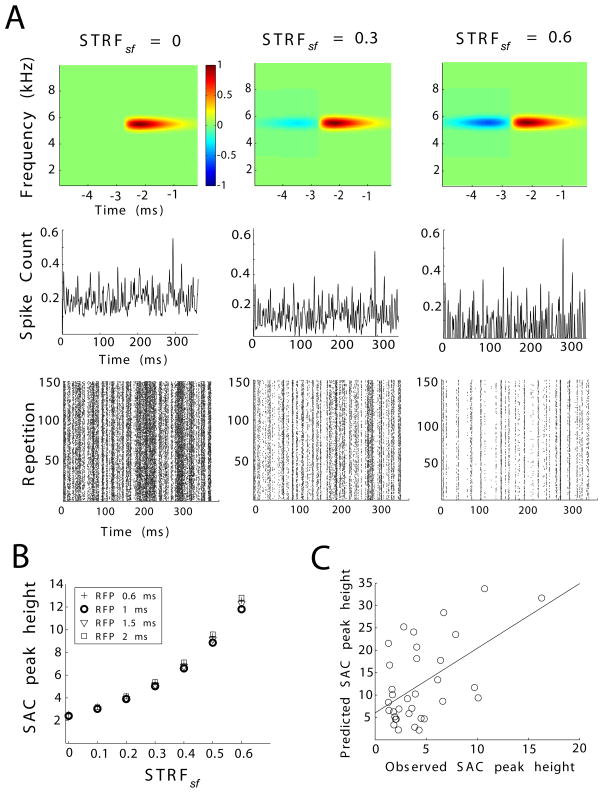
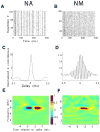
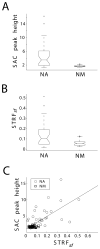
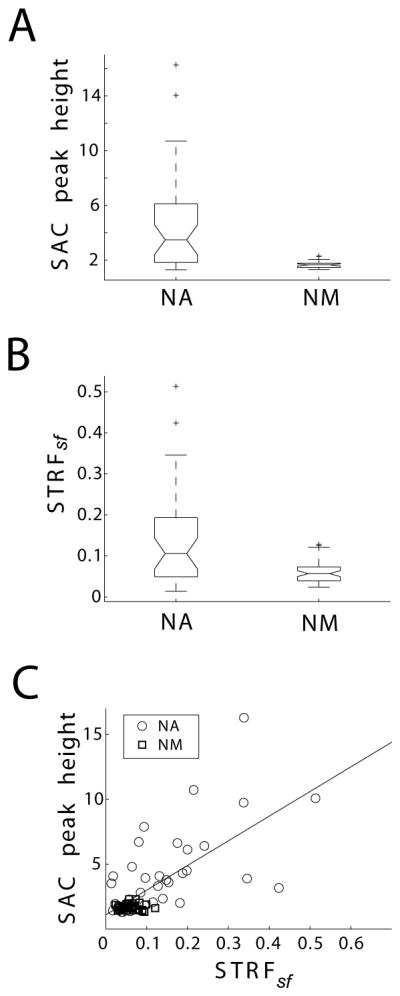
Description:The brainstem auditory pathway is obligatory for all aural information. Brainstem auditory neurons must encode the level and timing of sounds, as well as their time-dependent spectral properties, the fine structure, and envelope, which are essential for sound discrimination. This study focused on envelope coding in the two cochlear nuclei of the barn owl, nucleus angularis (NA) and nucleus magnocellularis (NM). NA and NM receive input from bifurcating auditory nerve fibers and initiate processing pathways specialized in encoding interaural time (ITD) and level (ILD) differences, respectively. We found that NA neurons, although unable to accurately encode stimulus phase, lock more strongly to the stimulus envelope than NM units. The spectrotemporal receptive fields (STRFs) of NA neurons exhibit a pre-excitatory suppressive field. Using multilinear regression analysis and computational modeling, we show that this feature of STRFs can account for enhanced across-trial response reliability, by locking spikes to the stimulus envelope. Our findings indicate a dichotomy in envelope coding between the time and intensity processing pathways as early as at the level of the cochlear nuclei. This allows the ILD processing pathway to encode envelope information with greater fidelity than the ITD processing pathway. Furthermore, we demonstrate that the properties of the STRFs of the neurons can be quantitatively related to spike timing reliability.
-
Subjects:
-
Source:J Neurosci. 31(9):3234-3242.
-
Pubmed ID:21368035
-
Pubmed Central ID:PMC3059808
-
Document Type:
-
Funding:
-
Volume:31
-
Issue:9
-
Collection(s):
-
Main Document Checksum:urn:sha256:6e244cb84d36a9a82fdcbf8bb08beea436dc3a11f99d12750a387c15bc1590b3
-
Download URL:
-
File Type:
 [PDF
- 1.65 MB
]
[PDF
- 1.65 MB
]
Supporting Files


File Language:
English
ON THIS PAGE





CDC STACKS serves as an archival repository of CDC-published products including
scientific findings,
journal articles, guidelines, recommendations, or other public health information authored or
co-authored by CDC or funded partners.
As a repository, CDC STACKS retains documents in their original published format to ensure public access to scientific information.
As a repository, CDC STACKS retains documents in their original published format to ensure public access to scientific information.
You May Also Like
COLLECTION
CDC Public Access