


Central Line-Associated Bloodstream Infections in Neonates with Gastrointestinal Conditions: developing a candidate definition for mucosal barrier injury bloodstream infections
Supporting Files

-
Oct 02 2014
-
Details
-
Alternative Title:Infect Control Hosp Epidemiol
-
Personal Author:
-
Description:Objectives
To develop a candidate definition for central line-associated blood stream infection (CLABSI) in neonates with presumed mucosal barrier injury due to gastrointestinal (MBI-GI) conditions; to evaluate epidemiology and microbiology of MBI-GI CLABSI in infants.
Design
Multicenter retrospective cohort study
Setting
Neonatal intensive care units (NICU) from 14 U.S. children’s hospitals and pediatric facilities
Methods
A multidisciplinary focus group developed a candidate MBI-GI CLABSI definition based on presence of a MBI-GI condition, parenteral nutrition (PN) exposure, and an eligible enteric organism. CLABSI surveillance data from participating hospitals were supplemented by chart review to identify MBI-GI conditions and PN exposure.
Results
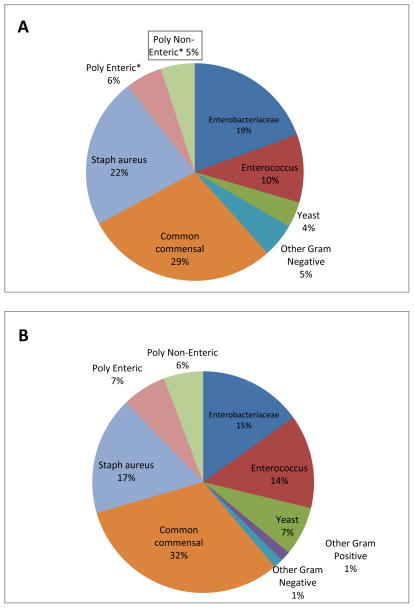
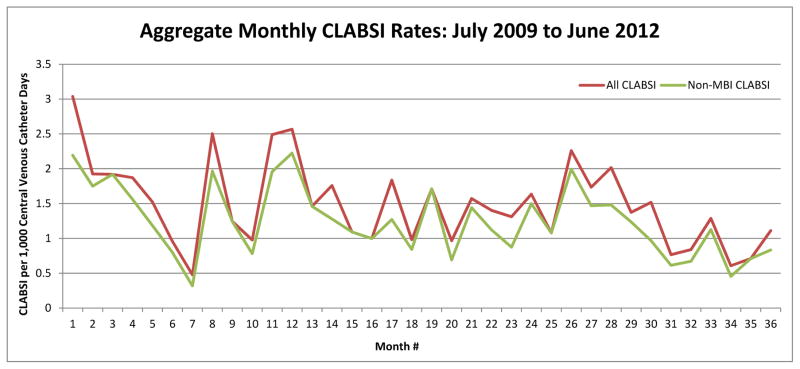
During 2009–12, 410 CLABSI occurred in 376 infants. MBI-GI conditions and PN exposure occurred in 149 (40%) and 324 (86%) of these 376 neonates, respectively. The distribution of pathogens was similar among neonates with versus without MBI-GI conditions and PN exposure. Fifty-nine (16%) of the 376 initial CLABSI episodes met the candidate MBI-GI CLABSI definition. Subsequent versus initial CLABSI were more likely to be caused by an enteric organism (22 of 34, 65% vs. 151 of 376, 40%; p = 0.009) and to meet the candidate MBI-GI CLABSI definition (19 of 34, 56% vs. 59 of 376, 16%; p < 0.01).
Conclusions
While MBI-GI conditions and PN exposure were common, only 16% of initial CLABSI met the candidate definition of MBI-GI CLABSI. The high proportion of MBI-GI CLABSI among subsequent infections suggests infants with MBI-GI CLABSI should be a population targeted for further surveillance and interventional research.
-
Subjects:
-
Source:Infect Control Hosp Epidemiol. 35(11):1391-1399.
-
Pubmed ID:25333434
-
Pubmed Central ID:PMC4551075
-
Document Type:
-
Funding:
-
Volume:35
-
Issue:11
-
Collection(s):
-
Main Document Checksum:urn:sha256:117de9572cf7acdd52717af6724951cedc86e47f952ad50d0767d1b44d4f17d4
-
Download URL:
-
File Type:
 [PDF
- 413.81 KB
]
[PDF
- 413.81 KB
]
Supporting Files


ON THIS PAGE

CDC STACKS serves as an archival repository of CDC-published products including
scientific findings,
journal articles, guidelines, recommendations, or other public health information authored or
co-authored by CDC or funded partners.
As a repository, CDC STACKS retains documents in their original published format to ensure public access to scientific information.
As a repository, CDC STACKS retains documents in their original published format to ensure public access to scientific information.
You May Also Like
COLLECTION
CDC Public Access