


Neural Tube Defects in Costa Rica, 1987–2012: Origins and Development of Birth Defect Surveillance and Folic Acid Fortification
Supporting Files

-
Mar 2015
Details
-
Alternative Title:Matern Child Health J
-
Personal Author:
-
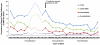
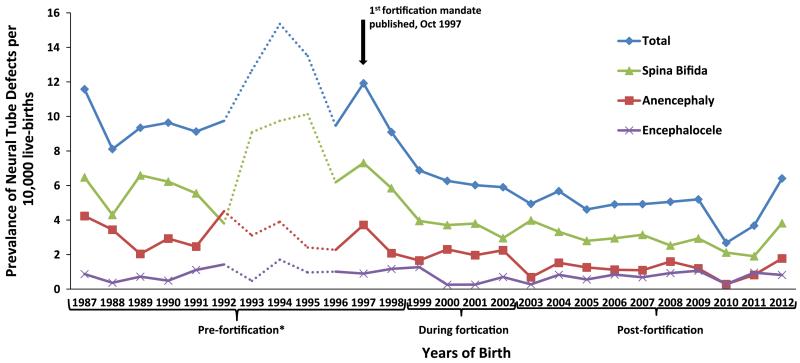
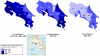
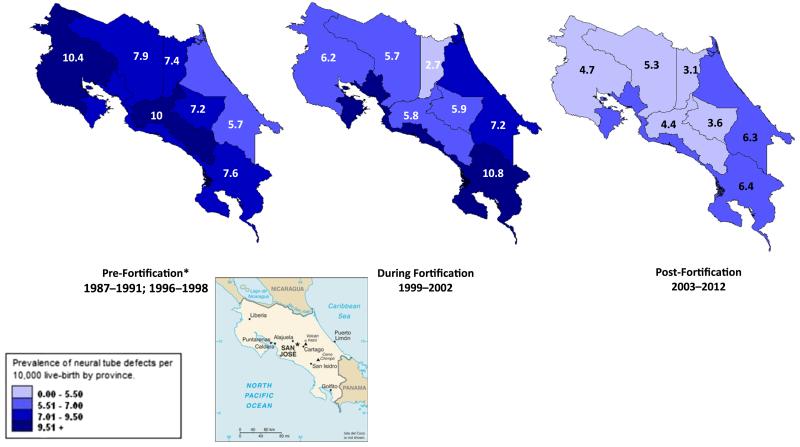
Description:Our aim was to provide a descriptive overview of how the birth defects surveillance and folic acid fortification programs were implemented in Costa Rica-through the establishment of the Registry Center for Congenital Anomalies (Centro de Registro de Enfermedades Congénitas-CREC), and fortification legislation mandates. We estimated the overall prevalence of neural tube defects (i.e., spina bifida, anencephaly and encephalocele) before and after fortification captured by CREC. Prevalence was calculated by dividing the total number of infants born with neural tube defects by the total number of live births in the country (1987-2012).A total of 1,170 newborns with neural tube defects were identified from 1987 to 2012 (1992-1995 data excluded); 628 were identified during the baseline pre-fortification period (1987-1991; 1996-1998); 191 during the fortification period (1999-2002); and 351 during the post-fortification time period (2003-2012). The overall prevalence of neural tube defects decreased from 9.8 per 10,000 live-births (95 % CI 9.1-10.5) for the pre-fortification period to 4.8 per 10,000 live births (95 % CI 4.3-5.3) for the post-fortification period. Results indicate a statistically significant (P < 0.05) decrease of 51 % in the prevalence of neural tube defects from the pre-fortification period to the post-fortification period. Folic acid fortification via several basic food sources has shown to be a successful public health intervention for Costa Rica. Costa Rica's experience can serve as an example for other countries seeking to develop and strengthen both their birth defects surveillance and fortification programs.
-
Subjects:
-
Source:Matern Child Health J. 19(3):583-590.
-
Pubmed ID:24952876
-
Pubmed Central ID:PMC4539153
-
Document Type:
-
Funding:
-
Volume:19
-
Issue:3
-
Collection(s):
-
Main Document Checksum:urn:sha256:ce716967285324571408ed982a11705c91caebb6584eabc173ef61229bca81b5
-
Download URL:
-
File Type:
 [PDF
- 524.10 KB
]
[PDF
- 524.10 KB
]
Supporting Files


ON THIS PAGE

CDC STACKS serves as an archival repository of CDC-published products including
scientific findings,
journal articles, guidelines, recommendations, or other public health information authored or
co-authored by CDC or funded partners.
As a repository, CDC STACKS retains documents in their original published format to ensure public access to scientific information.
As a repository, CDC STACKS retains documents in their original published format to ensure public access to scientific information.
You May Also Like
COLLECTION
CDC Public Access