



How Design of Places Promotes or Inhibits Mobility of Older Adults: Realist Synthesis of 20 Years of Research
Supporting Files

-
12 2014
-
Available in CDC Stacks on 2015-12-01T00:00:00Z
File Language:
English
Details
-
Alternative Title:J Aging Health
-
Personal Author:
-
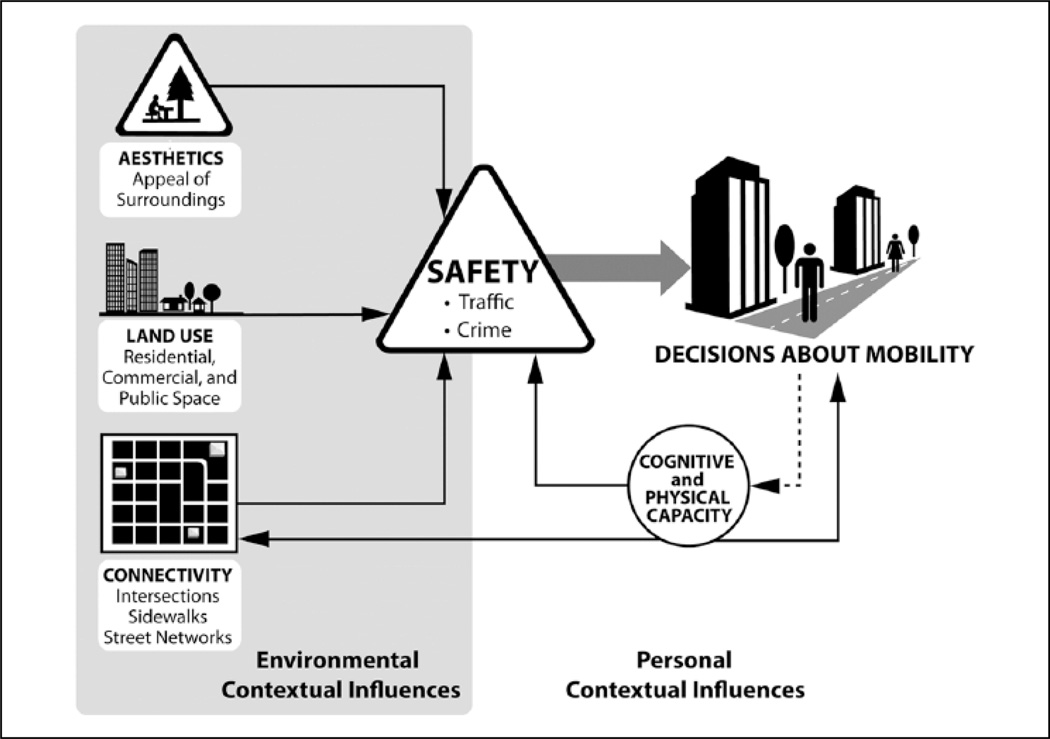
Description:Objective ; The objective of this study was to determine the environmental features that best support aging in place. ; Method ; We conducted a realist synthesis, a theory-driven interpretive method of evidence synthesis, of 120+ articles (published 1991–2011) that attempts to explain how place may influence older adults’ decisions about mobility (e.g., physical activity). We developed an initial program theory, reviewed the literature, identified outcomes, analyzed and synthesized patterns, and created a final program theory. ; Results ; Safety was a central mechanism, serving as one of the bridges between environmental components (e.g., connectivity, aesthetics, retail and services) and decisions about mobility. Population density, sidewalk presence, and park proximity did not emerge as key factors. ; Discussion ; Safety considerations are one of the most prominent influences of older adults’ decisions about mobility. Street connectivity, pedestrian access and transit, and retail and services were also important. These factors are amenable to change and can help promote mobility for older adults.
-
Subjects:
-
Keywords:
-
Source:J Aging Health. 26(8):1340-1372
-
Pubmed ID:24788714
-
Pubmed Central ID:PMC4535337
-
Document Type:
-
Funding:
-
Volume:26
-
Issue:8
-
Download URL:
-
File Type:
 [PDF - 905.26 KB]
 -
Collection(s):
-
Main Document Checksum:urn:sha256:87e1c20c3bc870ffb0482b5eacd9db74c7b7661d0da48fd6d27bab5ea9a25969
Supporting Files


File Language:
English
 Was this page helpful?
 Found an issue?


CDC STACKS serves as an archival repository of CDC-published products including
scientific findings, journal articles, guidelines, recommendations, or other public health information authored or
co-authored by CDC or funded partners.
As a repository, CDC STACKS retains documents in their original published format to ensure public access to scientific information.
As a repository, CDC STACKS retains documents in their original published format to ensure public access to scientific information.
You May Also Like
COLLECTION
CDC Public Access