



Prevalence of use of human milk in U.S. advanced care neonatal units
Supporting Files

-
6 2013 ; 6-2013
-
Available in CDC Stacks on 2015-08-14T00:00:00Z
File Language:
English
Details
-
Alternative Title:Pediatrics
-
Personal Author:
-
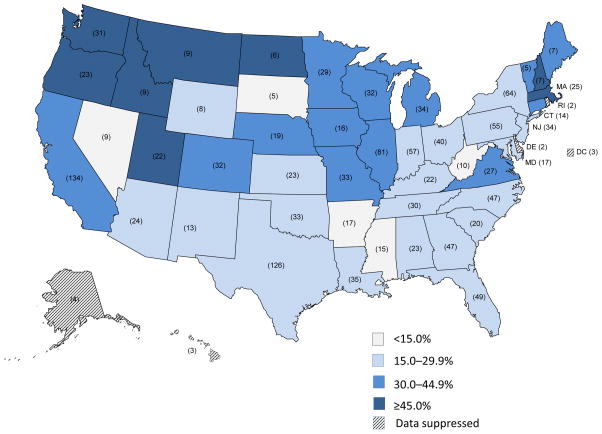
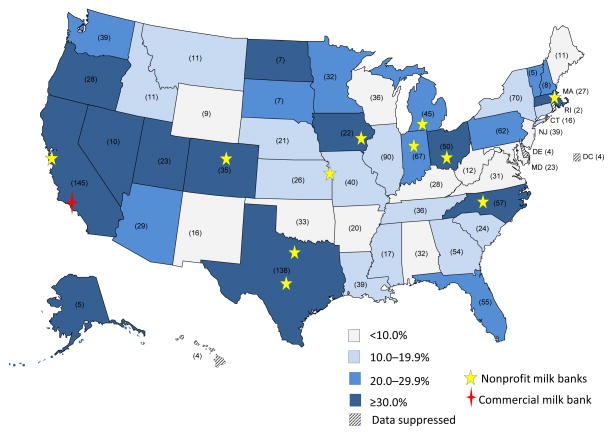
Description:Background ; The American Academy of Pediatrics recommends all preterm infants receive human milk. ; Objective ; To describe the use of human milk in advanced care neonatal units of U.S. maternity hospitals. ; Methods ; We used CDC’s national Maternity Practices in Infant Nutrition and Care (mPINC) survey from 2007, 2009, and 2011 to analyze 2 questions to describe the prevalence of U.S. advanced care (special/level 2 or intensive/level 3) neonatal units routinely providing human milk to infants, and the use of any donor milk in these units. ; Results ; In 2011, 30.8% of maternity hospitals reported that most infants (≥90%) were routinely provided human milk in advanced care units, compared to 26.7% in 2009 and 21.2% in 2007 (trend p<0.001). States in the northwest and northeast had a higher prevalence of hospitals routinely providing human milk to ≥90% of infants in advanced care units. In 2011, 22.0% of maternity hospitals providing advanced care used banked donor milk, compared to 14.4% in 2009 and 11.5% in 2007 (trend p<0.001). Most of this increase occurred in intensive care units (25.1% 2007 vs. 45.2% 2011; trend p<0.001). There was substantial geographic variation in the prevalence of advanced care units using donor milk; generally the prevalence was higher in the west and in states with a milk bank in the state or neighboring state. ; Conclusion ; The use of human milk in U.S. advanced care neonatal units is increasing; however, only one-third of these units are routinely providing human milk to most infants.
-
Keywords:
-
Source:Pediatrics. 131(6):1066-1071
-
Pubmed ID:23669517
-
Pubmed Central ID:PMC4535053
-
Document Type:
-
Funding:
-
Volume:131
-
Issue:6
-
Download URL:
-
File Type:
 [PDF - 355.50 KB]
 -
Collection(s):
-
Main Document Checksum:urn:sha256:4d433e6b2fcda9108d46f0ab5b079b07daf921abed24525748006c7af63f4dca
Supporting Files


File Language:
English
 Was this page helpful?
 Found an issue?



CDC STACKS serves as an archival repository of CDC-published products including
scientific findings, journal articles, guidelines, recommendations, or other public health information authored or
co-authored by CDC or funded partners.
As a repository, CDC STACKS retains documents in their original published format to ensure public access to scientific information.
As a repository, CDC STACKS retains documents in their original published format to ensure public access to scientific information.
You May Also Like
COLLECTION
CDC Public Access