


Occupational Burns Treated in Emergency Departments
Supporting Files

-
Mar 2015
Details
-
Alternative Title:Am J Ind Med
-
Personal Author:
-
Description:Background
Despite reported declines, occupational burn injuries remain a workplace safety concern. More severe burns may result in costly medical treatment and long-term physical and psychological consequences.
Methods
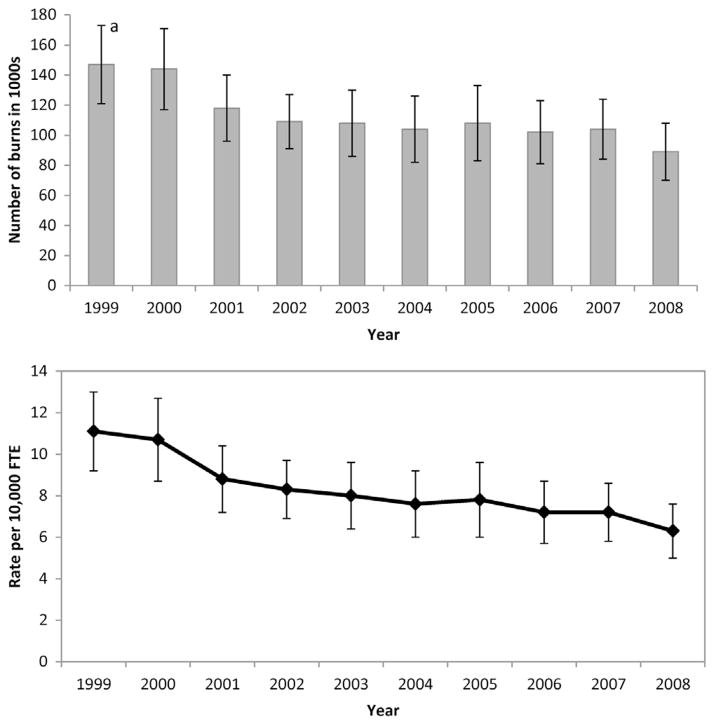
We used the National Electronic Injury Surveillance System—Occupational Supplement to produce national estimates of burns treated in emergency departments (EDs). We analyzed data trends from 1999 to 2008 and provided detailed descriptions of 2008 data.
Results
From 1999 to 2008 there were 1,132,000 (95% CI: ±192,300) nonfatal occupational burns treated in EDs. Burn numbers and rates declined approximately 40% over the 10 years. In 2008, men and younger workers 15–24 years old had the highest rates. Scalds and thermal burns accounted for more than 60% of burns. Accommodation and food service, manufacturing, and construction industries had the largest number of burns.
Conclusions
Despite declining burn rates, emphasis is needed on reducing burn hazards to young food service workers and using job specific hazard analyses to prevent burns.
-
Subjects:
-
Source:Am J Ind Med. 58(3):290-298.
-
Pubmed ID:25678457
-
Pubmed Central ID:PMC4528302
-
Document Type:
-
Funding:
-
Volume:58
-
Issue:3
-
Collection(s):
-
Main Document Checksum:urn:sha256:c59477c599d7b43bb3a4e68549d37d574ebbbc7d2f01c60310e2ec05215fee5b
-
Download URL:
-
File Type:
 [PDF
- 336.89 KB
]
[PDF
- 336.89 KB
]
Supporting Files


ON THIS PAGE

CDC STACKS serves as an archival repository of CDC-published products including
scientific findings,
journal articles, guidelines, recommendations, or other public health information authored or
co-authored by CDC or funded partners.
As a repository, CDC STACKS retains documents in their original published format to ensure public access to scientific information.
As a repository, CDC STACKS retains documents in their original published format to ensure public access to scientific information.
You May Also Like
COLLECTION
CDC Public Access