



Within-Gender Changes in HIV Prevalence among Adults between 2005/6 and 2010/11 in Zimbabwe
Supporting Files
Public Domain

-
Jul 24 2015
File Language:
English
Details
-
Alternative Title:PLoS One
-
Personal Author:
-
Description:Introduction
Zimbabwe has reported significant declines in HIV prevalence between 2005/06 and 2010/11 Demography and Health Surveys; a within-gender analysis to identify the magnitude and factors associated with this change, which can be masked, is critical for targeting interventions.
Methods
We analyzed change in HIV prevalence for 6,947 women and 5,848 men in the 2005/06 survey and 7,313 women and 6,250 men in 2010/11 surveys using 2005/06 as referent. The data was analyzed taking into consideration the survey design and therefore the svy, mean command in Stata was used in both linear and logistic regression.
Results
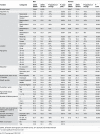
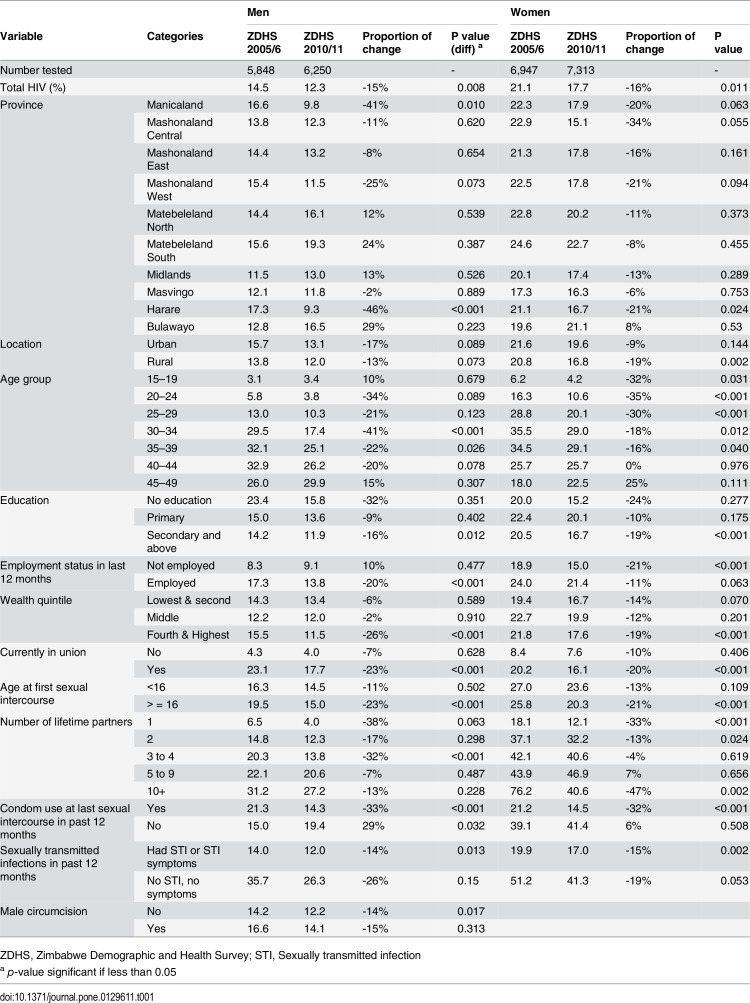
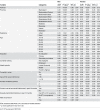
There were similar proportional declines in prevalence at national level for males (15% p=0.011) and females (16%,p=0.008). However, there were variations in decline by provincial setting, demographic variables of age, educational level and some sexual risk behaviours. In logistic regression analysis, statistically significant declines were observed among men in Manicaland, Mashonaland East and Harare (p<0.01) and for women in Manicaland, Mashonaland Central and Harare (p<0.01). Although not statistically significant, numerical increases were observed among men in Matebeleland North, Matebeleland South, Midlands and for both men and women in Bulawayo. Young women in the age range 15-34 experienced a decline in prevalence (p<0.01) while older men 30-44 had a statistically significant decline (p<0.01). Having a secondary and above education, regardless of employment status for both men and women recorded a significant decline. For sexual risk behaviours, currently in union for men and women and not in union for women there was a significant decline in prevalence.
Conclusion
Zimbabwe has reported a significant decline among both men and women but there are important differentials across provinces, demographic characteristics and sexual risk behaviours that suggest that the epidemic in Zimbabwe is heterogeneous and therefore interventions must be targeted in order to achieve epidemic control. -
Subjects:
-
Source:PLoS One. 10(7).
-
Pubmed ID:26208134
-
Pubmed Central ID:PMC4514831
-
Document Type:
-
Corporate as Subject:
-
Volume:10
-
Issue:7
-
Download URL:
-
File Type:
 [PDF - 199.33 KB]
 -
Collection(s):
-
Main Document Checksum:urn:sha-512:c724d2a6f869ae8c775b48ca1889c1e5273c93e7d331869fcd5622848d8ad27db735913d9d5406dccd45093f72258a6786ffa700275f76c3b92dc0f448b4b05c
Supporting Files


File Language:
English
 Was this page helpful?
 Found an issue?


CDC STACKS serves as an archival repository of CDC-published products including
scientific findings, journal articles, guidelines, recommendations, or other public health information authored or
co-authored by CDC or funded partners.
As a repository, CDC STACKS retains documents in their original published format to ensure public access to scientific information.
As a repository, CDC STACKS retains documents in their original published format to ensure public access to scientific information.
You May Also Like
COLLECTION
CDC Public Access