



Phylogeography of Influenza A(H3N2) Virus in Peru, 2010–2012
Supporting Files
Public Domain

-
Aug 2015
Details
-
Alternative Title:Emerg Infect Dis
-
Personal Author:Pollett, Simon ; Nelson, Martha I. ; Kasper, Matthew ; Tinoco, Yeny ; Simons, Mark ; Romero, Candice ; Silva, Marita ; Lin, Xudong ; Halpin, Rebecca A. ; Fedorova, Nadia ; Stockwell, Timothy B. ; Wentworth, David ; Holmes, Edward C. ; Bausch, Daniel G.
-
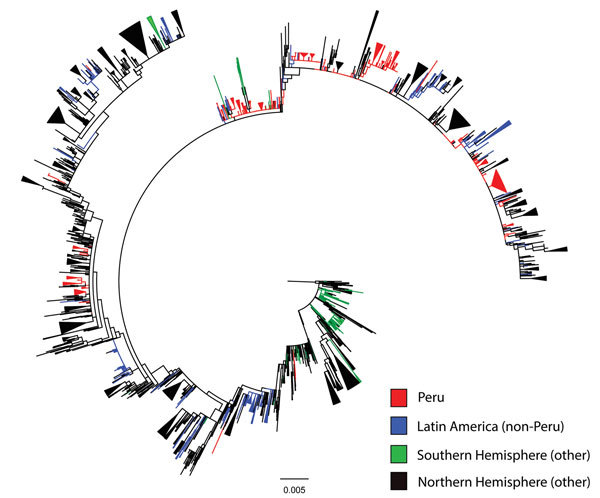
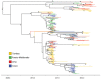
Description:It remains unclear whether lineages of influenza A(H3N2) virus can persist in the tropics and seed temperate areas. We used viral gene sequence data sampled from Peru to test this source-sink model for a Latin American country. Viruses were obtained during 2010-2012 from influenza surveillance cohorts in Cusco, Tumbes, Puerto Maldonado, and Lima. Specimens positive for influenza A(H3N2) virus were randomly selected and underwent hemagglutinin sequencing and phylogeographic analyses. Analysis of 389 hemagglutinin sequences from Peru and 2,192 global sequences demonstrated interseasonal extinction of Peruvian lineages. Extensive mixing occurred with global clades, but some spatial structure was observed at all sites; this structure was weakest in Lima and Puerto Maldonado, indicating that these locations may experience greater viral traffic. The broad diversity and co-circulation of many simultaneous lineages of H3N2 virus in Peru suggests that this country should not be overlooked as a potential source for novel pandemic strains.
-
Subjects:
- Research
- Phylogeography of Influenza A(H3N2) Virus in Peru, 2010–2012
- Peru
- H3N2
- influenza virus
- evolution
- viruses
- phylogeography
- phylogeny
- viral traffic
- subtropical
- tropical
- gene pool
- source population
- surveillance
- source–sink dynamic
- source–sink model
- interseasonal extinction
- influenza A(H3N2) virus
- human influenza
- influenza
-
Source:Emerg Infect Dis. 21(8):1330-1338.
-
Pubmed ID:26196599
-
Pubmed Central ID:PMC4517729
-
Document Type:
-
Volume:21
-
Issue:8
-
Download URL:
-
File Type:
 [PDF - 2.76 MB]
 -
Collection(s):
-
Main Document Checksum:urn:sha256:79a91b33e84aafd164ca35f473c7ab2145c9dd778f88b88c1c8e6dbc13db2103
Supporting Files


 Was this page helpful?
 Found an issue?



CDC STACKS serves as an archival repository of CDC-published products including
scientific findings, journal articles, guidelines, recommendations, or other public health information authored or
co-authored by CDC or funded partners.
As a repository, CDC STACKS retains documents in their original published format to ensure public access to scientific information.
As a repository, CDC STACKS retains documents in their original published format to ensure public access to scientific information.
You May Also Like
COLLECTION
Emerging Infectious Diseases