



Community Engagement in Health-Related Research: A Case Study of a Community-Linked Research Infrastructure, Jefferson County, Arkansas, 2011–2013
Supporting Files

-
Jul 23 2015
File Language:
English
Details
-
Journal Article:Preventing Chronic Disease (PCD)
-
Personal Author:
-
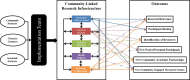
Description:Background ; Underrepresentation of racial minorities in research contributes to health inequities. Important factors contributing to low levels of research participation include limited access to health care and research opportunities, lack of perceived relevance, power differences, participant burden, and absence of trust. We describe an enhanced model of community engagement in which we developed a community-linked research infrastructure to involve minorities in research both as participants and as partners engaged in issue selection, study design, and implementation. ; Community Context ; We implemented this effort in Jefferson County, Arkansas, which has a predominantly black population, bears a disproportionate burden of chronic disease, and has death rates above state and national averages. ; Methods ; Building on existing community–academic partnerships, we engaged new partners and adapted a successful community health worker model to connect community residents to services and relevant research. We formed a community advisory board, a research collaborative, a health registry, and a resource directory. ; Outcome ; Newly formed community–academic partnerships resulted in many joint grant submissions and new projects. Community health workers contacted 2,665 black and 913 white community residents from December 2011 through April 2013. Eighty-five percent of blacks and 88% of whites were willing to be re-contacted about research of potential interest. Implementation challenges were addressed by balancing the needs of science with community needs and priorities. ; Interpretation ; Our experience indicates investments in community-linked research infrastructure can be fruitful and should be considered by academic health centers when assessing institutional research infrastructure needs.
-
Subjects:
- Community Case Study
- Chronic Disease/epidemiology
- Chronic Disease/mortality
- Chronic Disease/prevention & control
- Community Health Workers
- Community Participation
- Community-Based Participatory Research
- Community-Institutional Relations
- Cooperative Behavior
- Health Plan Implementation
- Health Services Needs and Demand
- Health Status Indicators
- Healthcare Disparities
- Humans
- Minority Groups
- Organizational Case Studies
- Registries
- Socioeconomic Factors
-
Source:Prev Chronic Dis. 12.
-
DOI:
-
ISSN:1545-1151
-
Pubmed ID:26203813
-
Pubmed Central ID:PMC4515917
-
Document Type:
-
Funding:
-
Place as Subject:
-
Location:
-
Volume:12
-
Download URL:
-
File Type:
 [PDF - 413.98 KB]
 -
Collection(s):
-
Main Document Checksum:urn:sha-512:38b16bbfcef5199c2d159ce258e19d3ceef33b8c4033bbeaf8aee6367674265bd519f5bd8788e54f52ed80b59d8e46156783fe1d1ff71a0a72b82f0a37abf171
Supporting Files


File Language:
English
 Was this page helpful?
 Found an issue?


CDC STACKS serves as an archival repository of CDC-published products including
scientific findings, journal articles, guidelines, recommendations, or other public health information authored or
co-authored by CDC or funded partners.
As a repository, CDC STACKS retains documents in their original published format to ensure public access to scientific information.
As a repository, CDC STACKS retains documents in their original published format to ensure public access to scientific information.
You May Also Like
COLLECTION
Preventing Chronic Disease