


Occupational exposure to extremely low frequency magnetic fields and brain tumour risks in the INTEROCC study
Supporting Files

-
Jun 16 2014
-
File Language:
English
Details
-
Alternative Title:Cancer Epidemiol Biomarkers Prev
-
Personal Author:Turner, Michelle C ; Benke, Geza ; Bowman, Joseph D ; Figuerola, Jordi ; Fleming, Sarah ; Hours, Martine ; Kincl, Laurel ; Krewski, Daniel ; McLean, Dave ; Parent, Marie-Elise ; Richardson, Lesley ; Sadetzki, Siegal ; Schlaefer, Klaus ; Schlehofer, Brigitte ; Schüz, Joachim ; Siemiatycki, Jack ; van Tongeren, Martie ; Cardis, Elisabeth
-
Description:Background
Occupational exposure to extremely low frequency magnetic fields (ELF) is a suspected risk factor for brain tumours, however the literature is inconsistent. Few studies have assessed whether ELF in different time windows of exposure may be associated with specific histologic types of brain tumours. This study examines the association between ELF and brain tumours in the large-scale INTEROCC study.
Methods
Cases of adult primary glioma and meningioma were recruited in seven countries (Australia, Canada, France, Germany, Israel, New Zealand, United Kingdom) between 2000 and 2004. Estimates of mean workday ELF exposure based on a job exposure matrix assigned. Estimates of cumulative exposure, average exposure, maximum exposure, and exposure duration were calculated for the lifetime, and 1–4, 5–9, and 10+ years prior to the diagnosis/reference date.
Results
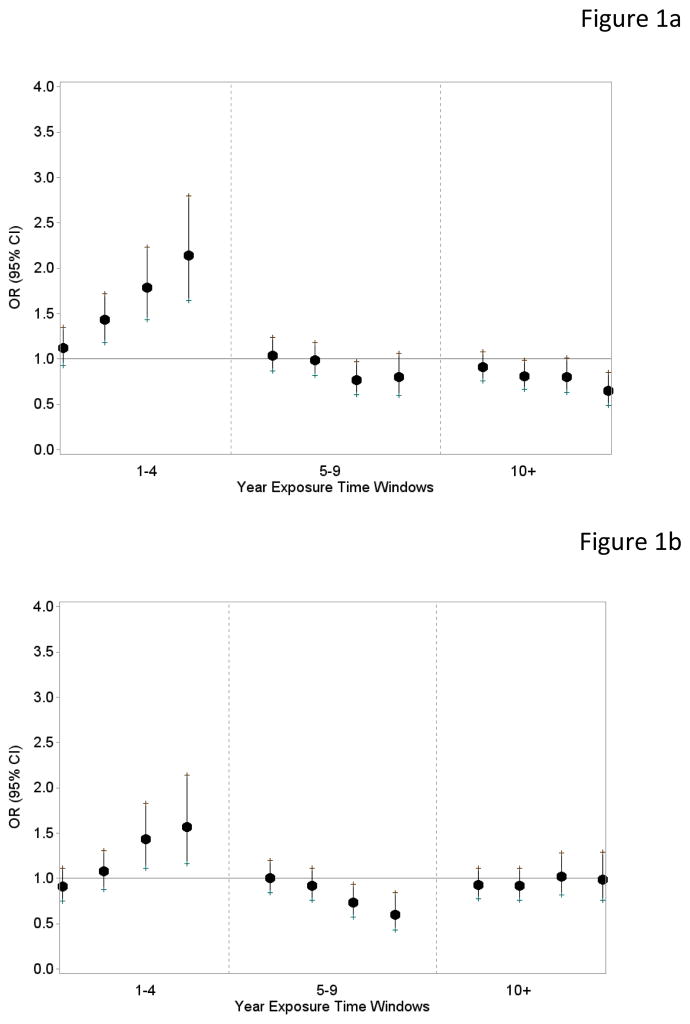
There were 3,761 included brain tumour cases (1,939 glioma, 1,822 meningioma) and 5,404 population controls. There was no association between lifetime cumulative ELF exposure and glioma or meningioma risk. However, there were positive associations between cumulative ELF 1–4 years prior to the diagnosis/reference date and glioma (odds ratio (OR) ≥ 90th percentile vs < 25th percentile = 1.67, 95% confidence interval (CI) 1.36–2.07, p < 0.0001 linear trend), and, somewhat weaker associations with meningioma (OR ≥ 90th percentile vs < 25th percentile = 1.23, 95% CI 0.97–1.57, p = 0.02 linear trend).
Conclusions
Results showed positive associations between ELF in the recent past and glioma.
Impact
Occupational ELF exposure may play a role in the later stages (promotion and progression) of brain tumourigenesis.
-
Subjects:
-
Source:Cancer Epidemiol Biomarkers Prev. 23(9):1863-1872.
-
Pubmed ID:24935666
-
Pubmed Central ID:PMC4154968
-
Document Type:
-
Funding:
-
Place as Subject:
-
Volume:23
-
Issue:9
-
Collection(s):
-
Main Document Checksum:urn:sha256:dcd92c3ab04cc7f3f25b26ccf1972e91d7c8dcb73cfd8eb25a79bc5116379329
-
Download URL:
-
File Type:
 [PDF
- 217.00 KB
]
[PDF
- 217.00 KB
]
Supporting Files


File Language:
English
ON THIS PAGE


CDC STACKS serves as an archival repository of CDC-published products including
scientific findings,
journal articles, guidelines, recommendations, or other public health information authored or
co-authored by CDC or funded partners.
As a repository, CDC STACKS retains documents in their original published format to ensure public access to scientific information.
As a repository, CDC STACKS retains documents in their original published format to ensure public access to scientific information.
You May Also Like
COLLECTION
CDC Public Access