


Trends and Correlates of Monozygotic Twinning After Single Embryo Transfer
Supporting Files

-
Jan 2015
-
File Language:
English
Details
-
Alternative Title:Obstet Gynecol
-
Personal Author:
-
Description:OBJECTIVE
To evaluate trends of monozygotic twinning after single embryo transfer and its association with patient and treatment factors.
METHODS
Our retrospective cohort study included 28,596 pregnancies after fresh, nondonor single embryo transfer during 2003–2012 reported to the National ART Surveillance System. We examined trends of monozygotic twin pregnancies (number of fetal heart tones on first-trimester ultrasonography more than one or number of neonates born more than one) and assessed patient and treatment factors for monozygotic twin compared with singleton pregnancies. Modified Poisson regression models were used to estimate adjusted risk ratios (RRs) and 95% confidence intervals (CIs) for association between monozygotic twinning and selected factors stratified by day 2–3 and day 5–6 transfer.
RESULTS
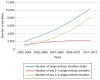
During 2003–2012, the incidence of monozygotic twinning after single embryo transfer was lower for day 2–3 transfers than for day 5–6 transfers (1.71%, 95% CI 1.45–1.98, n=162 compared with 2.50%, 95% CI 2.28–2.73, n=472); the incidence did not change significantly over the study period. Among day 2–3 transfers, assisted hatching increased the risk for monozygotic twinning compared with singletons (adjusted RR 2.16, 95% CI 1.53–3.06); use of intracytoplasmic sperm injection decreased the risk (adjusted RR 0.60, 95% CI 0.42–0.85). Having one or more prior pregnancies increased the risk for monozygotic twinning among day 5–6 transfers (adjusted RR 1.26, 95% CI 1.03–1.53).
CONCLUSION
Monozygotic twinning after single embryo transfers was more common among day 5–6 embryo transfers than day 2–3 transfers. Use of assisted hatching was associated with increased risk for monozygotic twinning for day 2–3 transfers.
-
Subjects:
-
Source:Obstet Gynecol. 2014; 125(1):111-117
-
Pubmed ID:25560112
-
Pubmed Central ID:PMC4515956
-
Document Type:
-
Funding:
-
Place as Subject:
-
Volume:125
-
Issue:1
-
Collection(s):
-
Main Document Checksum:urn:sha-512:97d5dd5b3909e483d2d7dcfaad8cbff08c3971f6d4ff0c240cb0da53edd45b85c0ad73ec0b439dddd7650b555e37dcd23059eb78edf3f834568c0b207adf5ee9
-
Download URL:
-
File Type:
 [PDF
- 449.60 KB
]
[PDF
- 449.60 KB
]
Supporting Files


File Language:
English
ON THIS PAGE



CDC STACKS serves as an archival repository of CDC-published products including
scientific findings,
journal articles, guidelines, recommendations, or other public health information authored or
co-authored by CDC or funded partners.
As a repository, CDC STACKS retains documents in their original published format to ensure public access to scientific information.
As a repository, CDC STACKS retains documents in their original published format to ensure public access to scientific information.
You May Also Like
COLLECTION
CDC Public Access