


Hepatitis E virus and coliphages in waters proximal to swine concentrated animal feeding operations
Supporting Files

-
Oct 22 2014
-
Details
-
Alternative Title:Sci Total Environ
-
Personal Author:
-
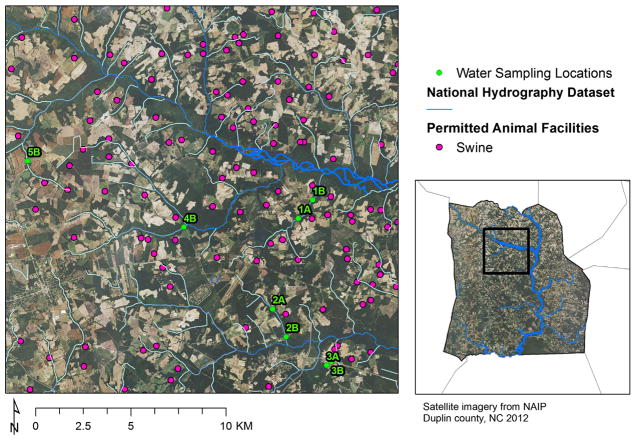
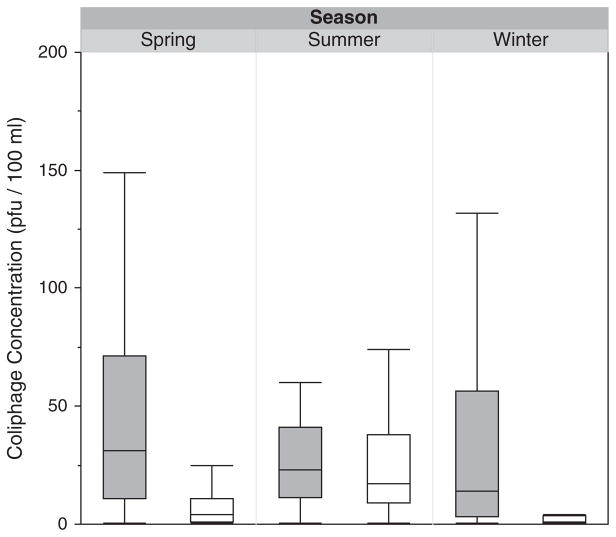
Description:North Carolina is the second leading state in pork production in the United States, with over 10 million swine. Swine manure in NC is typically collected and stored in open-pit lagoons before the liquid waste is sprayed onto agricultural fields for disposal. Components of this waste may be able to impact surface water quality with the potential for human exposure. This study examined viruses of public health concern in creeks adjacent to swine concentrated animal feeding operation (CAFO) spray fields. Surface water samples (n=154) were collected from public access waters in proximity to swine CAFO spray fields for six months and were tested for hepatitis E virus (HEV) and coliphages. HEV was detected in one sample. Somatic coliphages were detected in 98% of samples (geometric mean 24 ± 4.1 PFU per 100 ml), and F+ coliphages were detected in 85% of samples (geometric mean 6.8 ± 5.0 PFU per 100 ml). Only 3% (21) of the F+ coliphage isolates were RNA phage, and all of the F+ RNA coliphages belonged to genogroup I. Although the pervasiveness of swine CAFOs in this area prevented a comparison with samples from un-impacted sites, the near ubiquity of coliphages, as well as the presence of HEV, suggests that current waste management practices may be associated with the dissemination of viruses of public health concern in waters proximal to CAFO spray fields.
-
Subjects:
-
Source:Sci Total Environ. 2014; 505:487-493.
-
Pubmed ID:25461050
-
Pubmed Central ID:PMC4514618
-
Document Type:
-
Funding:
-
Volume:505
-
Collection(s):
-
Main Document Checksum:urn:sha256:faa922a482fa4526a050f3693e097df7db108bf5cade7735f20e76e77730ace4
-
Download URL:
-
File Type:
 [PDF
- 614.23 KB
]
[PDF
- 614.23 KB
]
Supporting Files


ON THIS PAGE




CDC STACKS serves as an archival repository of CDC-published products including
scientific findings,
journal articles, guidelines, recommendations, or other public health information authored or
co-authored by CDC or funded partners.
As a repository, CDC STACKS retains documents in their original published format to ensure public access to scientific information.
As a repository, CDC STACKS retains documents in their original published format to ensure public access to scientific information.
You May Also Like
COLLECTION
CDC Public Access