



What we Don’t Know Can Hurt us: Nonresponse Bias Assessment in Birth Defects Research
Supporting Files

-
Jul 14 2015
-
Available in CDC Stacks on 2015-10-14T00:00:00Z
Details
-
Alternative Title:Birth Defects Res A Clin Mol Teratol
-
Personal Author:
-
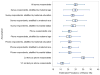
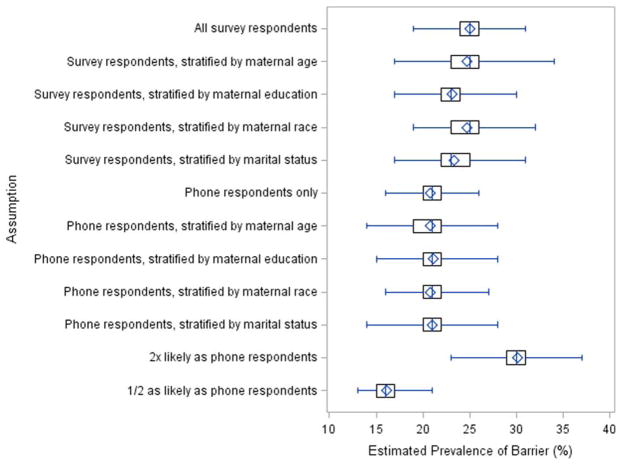
Description:Background ; Nonresponse bias assessment is an important and underutilized tool in survey research to assess potential bias due to incomplete participation. This study illustrates a nonresponse bias sensitivity assessment using a survey on perceived barriers to care for children with orofacial clefts in North Carolina. ; Methods ; Children born in North Carolina between 2001 and 2004 with an orofacial cleft were eligible for inclusion. Vital statistics data, including maternal and child characteristics, were available on all eligible subjects. Missing ‘responses’ from nonparticipants were imputed using assumptions based on the distribution of responses, survey method (mail or phone), and participant maternal demographics. ; Results ; Overall, 245 of 475 subjects (51.6%) responded to either a mail or phone survey. Cost as a barrier to care was reported by 25.0% of participants. When stratified by survey type, 28.3% of mail respondents and 17.2% of phone respondents reported cost as a barrier. Under various assumptions, the bias-adjusted estimated prevalence of cost as barrier to care ranged from 16.1% to 30.0%. Maternal age, education, race, and marital status at time of birth were not associated with subjects reporting cost as a barrier. ; Conclusion ; As survey response rates continue to decline, the importance of assessing the potential impact of nonresponse bias has become more critical. Birth defects research is particularly conducive to nonresponse bias analysis, especially when birth defect registries and birth certificate records are used. Future birth defect studies which use population-based surveillance data and have incomplete participation could benefit from this type of nonresponse bias assessment.
-
Subjects:
-
Source:Birth Defects Res A Clin Mol Teratol. 2015; 103(7):603-609.
-
Pubmed ID:26173046
-
Pubmed Central ID:PMC4514019
-
Document Type:
-
Funding:
-
Volume:103
-
Issue:7
-
Download URL:
-
File Type:
 [PDF - 342.45 KB]
 -
Collection(s):
-
Main Document Checksum:urn:sha256:347cd6266418d04a7e05773ac1e3d01d3b0f82efa29d53e6da451766ed9e9715
Supporting Files


 Was this page helpful?
 Found an issue?

CDC STACKS serves as an archival repository of CDC-published products including
scientific findings, journal articles, guidelines, recommendations, or other public health information authored or
co-authored by CDC or funded partners.
As a repository, CDC STACKS retains documents in their original published format to ensure public access to scientific information.
As a repository, CDC STACKS retains documents in their original published format to ensure public access to scientific information.
You May Also Like
COLLECTION
CDC Public Access