


Communication practices about HPV testing among providers in Federally Qualified Health Centers
Supporting Files

-
2015
-
Details
-
Alternative Title:Prev Med Rep
-
Personal Author:
-
Description:Objective
Little is known about the information providers share with patients when ordering a co-test, or combined human papillomavirus (HPV) and Papanicolaou (Pap) test, for cervical cancer screening. We assessed provider perceptions of such communication practices with female patients aged 30–60 years.
Methods
We analyzed data from 98 providers in 15 Federally Qualified Health Center clinics across Illinois (2009–2010).
Results
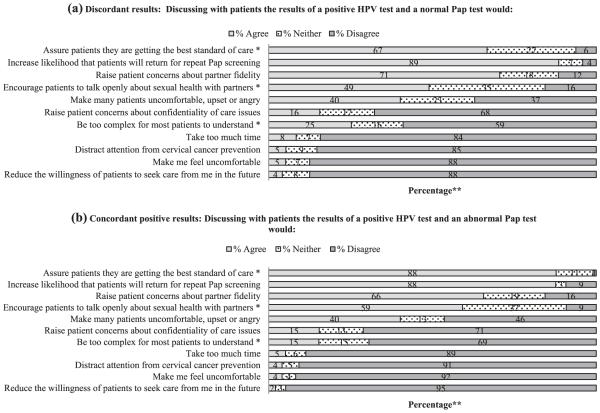
About 70% of the providers reported that when ordering a co-test, they would usually or always communicate information about the HPV test to their patients, explain the test detects a sexually transmitted infection, and discuss how the test results may determine their next screening interval. Most (>85%) reported that they were comfortable discussing co-test results. Compared with concordant positive results (HPV positive/Pap positive), providers were more likely to perceive that discordant results (HPV positive/Pap negative) would be too complex for patients to understand (25% vs. 15%, p = 0.006), and make patients feel less assured that they were getting the best standard of care (67% vs. 88%, p < 0.001).
Conclusion
As HPV testing plays a more prominent role in cervical cancer screening, more attention should be given to communications between providers and patients about the benefits and harms of different screening options.
-
Subjects:
-
Source:Prev Med Rep. 2015; 2:436-439.
-
Pubmed ID:26213683
-
Pubmed Central ID:PMC4511727
-
Document Type:
-
Funding:
-
Volume:2
-
Collection(s):
-
Main Document Checksum:urn:sha256:ac2d67e08d2e48f7d525edf8ddf54065eb3d6d85e4a41be797635c1a23599b44
-
Download URL:
-
File Type:
 [PDF
- 277.69 KB
]
[PDF
- 277.69 KB
]
Supporting Files


ON THIS PAGE


CDC STACKS serves as an archival repository of CDC-published products including
scientific findings,
journal articles, guidelines, recommendations, or other public health information authored or
co-authored by CDC or funded partners.
As a repository, CDC STACKS retains documents in their original published format to ensure public access to scientific information.
As a repository, CDC STACKS retains documents in their original published format to ensure public access to scientific information.
You May Also Like
COLLECTION
CDC Public Access