



Effect of Childhood Victimization on Occupational Prestige and Income Trajectories
Supporting Files
Peer Reviewed

-
-
By Show All

-
File Language:
English
Details
-
Journal Article:PLoS One
-
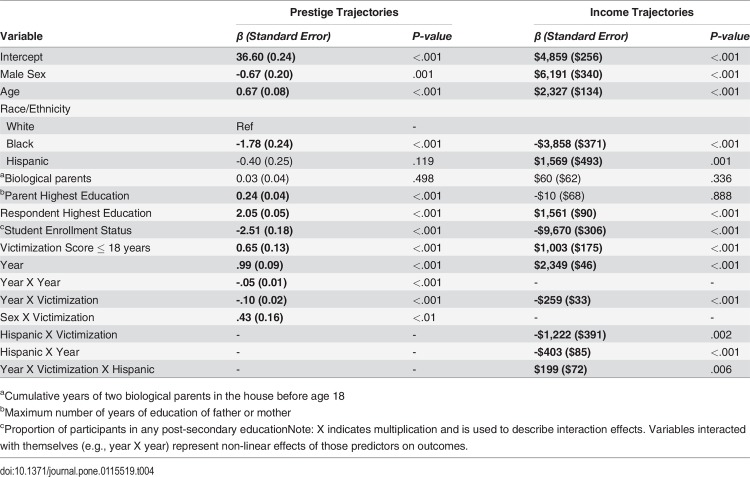
Description:BACKGROUND: Violence toward children (childhood victimization) is a major public health problem, with long-term consequences on economic well-being. The purpose of this study was to determine whether childhood victimization affects occupational prestige and income in young adulthood. We hypothesized that young adults who experienced more childhood victimizations would have less prestigious jobs and lower incomes relative to those with no victimization history. We also explored the pathways in which childhood victimization mediates the relationships between background variables, such as parent's educational impact on the socioeconomic transition into adulthood. METHODS: A nationally representative sample of 8,901 young adults aged 18-28 surveyed between 1999-2009 from the National Longitudinal Survey of Youth 1997 (NLSY) were analyzed. Covariate-adjusted multivariate linear regression and path models were used to estimate the effects of victimization and covariates on income and prestige levels and on income and prestige trajectories. After each participant turned 18, their annual 2002 Census job code was assigned a yearly prestige score based on the 1989 General Social Survey, and their annual income was calculated via self-reports. Occupational prestige and annual income are time-varying variables measured from 1999-2009. Victimization effects were tested for moderation by sex, race, and ethnicity in the multivariate models. RESULTS: Approximately half of our sample reported at least one instance of childhood victimization before the age of 18. Major findings include 1) childhood victimization resulted in slower income and prestige growth over time, and 2) mediation analyses suggested that this slower prestige and earnings arose because victims did not get the same amount of education as non-victims. CONCLUSIONS: Results indicated that the consequences of victimization negatively affected economic success throughout young adulthood, primarily by slowing the growth in prosperity due to lower education levels. [Description provided by NIOSH]
-
Subjects:
-
Keywords:
-
ISSN:1932-6203
-
Pubmed ID:25723670
-
Pubmed Central ID:PMC4344214
-
Document Type:
-
Funding:
-
Genre:
-
Place as Subject:
-
CIO:
-
Topic:
-
Location:
-
Pages in Document:14 pdf pages
-
Volume:10
-
Issue:2
-
NIOSHTIC Number:nn:20047161
-
Contact Point Address:Cristina A. Fernandez, Department of Public Health Sciences, University of Miami Miller School of Medicine, Miami, Florida, United States of America
-
Email:CFernandez5@med.miami.edu
-
Federal Fiscal Year:2015
-
Performing Organization:
-
Peer Reviewed:True
-
Download URL:
-
File Type:
 [PDF - 395.74 KB]
-
Collection(s):
-
Main Document Checksum:urn:sha-512:d88563209b450a9ad6ee0251bf1c66cc810c04f199fa47d592f07f9b9803b88dca8676a6ee71686409732d7014c220731294d732df02e61ccaaa46dc8244cf70
Supporting Files


File Language:
English
 Was this page helpful?
 Found an issue?




CDC STACKS serves as an archival repository of CDC-published products including
scientific findings, journal articles, guidelines, recommendations, or other public health information authored or
co-authored by CDC or funded partners.
As a repository, CDC STACKS retains documents in their original published format to ensure public access to scientific information.
As a repository, CDC STACKS retains documents in their original published format to ensure public access to scientific information.
You May Also Like