


The Los Angeles County Community Disaster Resilience Project — A Community-Level, Public Health Initiative to Build Community Disaster Resilience
Supporting Files

-
Aug 19 2014
-
Details
-
Alternative Title:Int J Environ Res Public Health
-
Personal Author:
-
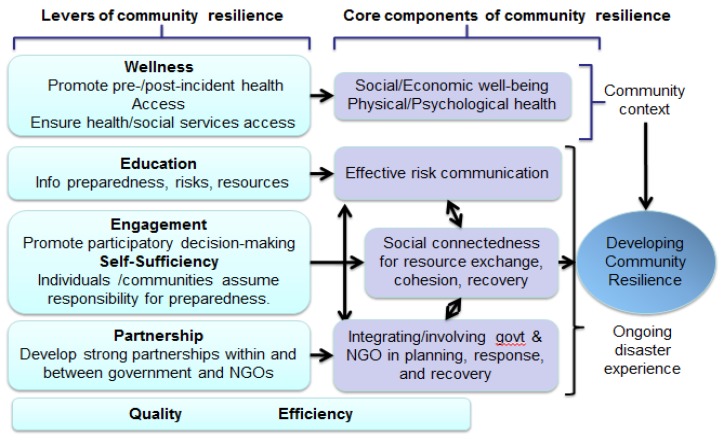
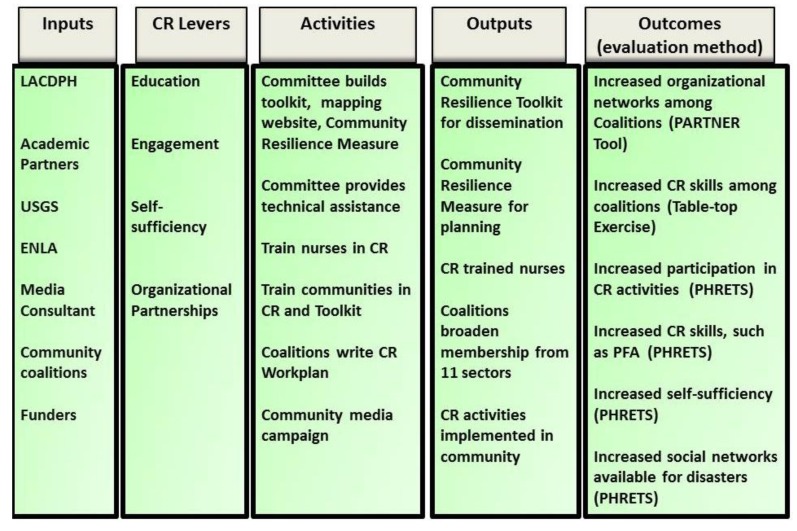
Description:Public health officials need evidence-based methods for improving community disaster resilience and strategies for measuring results. This methods paper describes how one public health department is addressing this problem. This paper provides a detailed description of the theoretical rationale, intervention design and novel evaluation of the Los Angeles County Community Disaster Resilience Project (LACCDR), a public health program for increasing community disaster resilience. The LACCDR Project utilizes a pretest-posttest method with control group design. Sixteen communities in Los Angeles County were selected and randomly assigned to the experimental community resilience group or the comparison group. Community coalitions in the experimental group receive training from a public health nurse trained in community resilience in a toolkit developed for the project. The toolkit is grounded in theory and uses multiple components to address education, community engagement, community and individual self-sufficiency, and partnerships among community organizations and governmental agencies. The comparison communities receive training in traditional disaster preparedness topics of disaster supplies and emergency communication plans. Outcome indicators include longitudinal changes in inter-organizational linkages among community organizations, community member responses in table-top exercises, and changes in household level community resilience behaviors and attitudes. The LACCDR Project is a significant opportunity and effort to operationalize and meaningfully measure factors and strategies to increase community resilience. This paper is intended to provide public health and academic researchers with new tools to conduct their community resilience programs and evaluation research. Results are not yet available and will be presented in future reports.
-
Subjects:
-
Source:Int J Environ Res Public Health. 2014; 11(8):8475-8490.
-
Pubmed ID:25153472
-
Pubmed Central ID:PMC4143872
-
Document Type:
-
Funding:
-
Volume:11
-
Issue:8
-
Collection(s):
-
Main Document Checksum:urn:sha256:bcd25ba0b0d186d6f97e321b99cc26b5c2383ff99ce35ed6856c4ad64b9c19ae
-
Download URL:
-
File Type:
 [PDF
- 1.11 MB
]
[PDF
- 1.11 MB
]
Supporting Files


ON THIS PAGE

CDC STACKS serves as an archival repository of CDC-published products including
scientific findings,
journal articles, guidelines, recommendations, or other public health information authored or
co-authored by CDC or funded partners.
As a repository, CDC STACKS retains documents in their original published format to ensure public access to scientific information.
As a repository, CDC STACKS retains documents in their original published format to ensure public access to scientific information.
You May Also Like
COLLECTION
CDC Public Access