


The Component Model of Infrastructure: A Practical Approach to Understanding Public Health Program Infrastructure
Supporting Files

-
Jun 12 2014
File Language:
English
Details
-
Alternative Title:Am J Public Health
-
Personal Author:
-
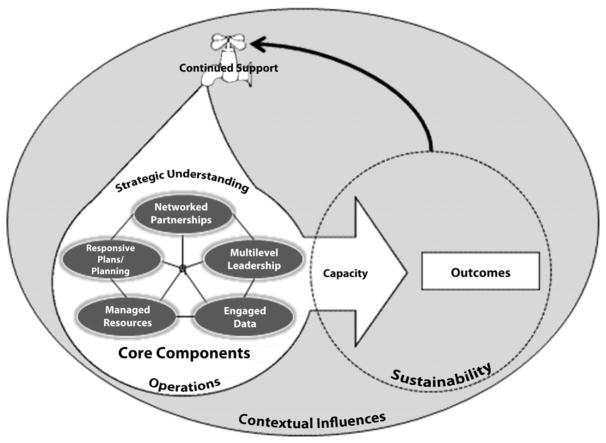
Description:Functioning program infrastructure is necessary for achieving public health outcomes. It is what supports program capacity, implementation, and sustainability. The public health program infrastructure model presented in this article is grounded in data from a broader evaluation of 18 state tobacco control programs and previous work. The newly developed Component Model of Infrastructure (CMI) addresses the limitations of a previous model and contains 5 core components (multilevel leadership, managed resources, engaged data, responsive plans and planning, networked partnerships) and 3 supporting components (strategic understanding, operations, contextual influences). The CMI is a practical, implementation-focused model applicable across public health programs, enabling linkages to capacity, sustainability, and outcome measurement.
-
Subjects:
-
Source:Am J Public Health. 104(8):e14-e24
-
Pubmed ID:24922125
-
Pubmed Central ID:PMC4103204
-
Document Type:
-
Funding:
-
Volume:104
-
Issue:8
-
Collection(s):
-
Main Document Checksum:urn:sha256:0200d0d8501f0fbf890a9dec89fd9aca2bc3ccbebc3ad2fc9e07e3aa662d5a81
-
Download URL:
-
File Type:
 [PDF
- 312.89 KB
]
[PDF
- 312.89 KB
]
Supporting Files


File Language:
English
ON THIS PAGE

CDC STACKS serves as an archival repository of CDC-published products including
scientific findings,
journal articles, guidelines, recommendations, or other public health information authored or
co-authored by CDC or funded partners.
As a repository, CDC STACKS retains documents in their original published format to ensure public access to scientific information.
As a repository, CDC STACKS retains documents in their original published format to ensure public access to scientific information.
You May Also Like
COLLECTION
CDC Public Access