



The effectiveness of targeting never or rarely screened women in a national cervical cancer screening program for underserved women
Supporting Files

-
5 2015 ; 5-2015
-
Available in CDC Stacks on May 01, 2016, 12:00 AM
File Language:
English
Details
-
Alternative Title:Cancer Causes Control
-
Personal Author:
-
Description:Purpose
To evaluate the effectiveness of a policy supporting early detection and prevention of cervical cancer among low-income and uninsured women by comparing women who reported never or rarely being screened (last screen >5 years) to those who reported screening in the past ≤5 years.
Methods
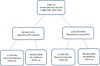
We analyzed data from 1,485,251 women who received their first Pap test in the National Breast and Cervical Cancer Early Detection Program (NBCCEDP) from July 2002 through June 2012. Of these, 461,893 women (31 %) reported being never or rarely screened and 1,023,358 (69 %) reported being screened in the past 5 years. Demographic (age, race/ethnicity, residence, and region) and clinic (cytologic and histologic results) characteristics were examined for the two groups.
Results
Women who were aged ≥50 years, Asian and Pacific Islander, American Indian or Alaska Native, multiracial, living in non-metro areas, or living in the South or a territory were more likely to report being never or rarely screened. The percentage of abnormal Pap tests and the rate of precancer and cancer (combined) was higher in the never or rarely screened group compared with the screened group (abnormal percentage: 2.9 vs 2.6 %, p value < 0.01; rate of precancer and cancer: 6.9 vs 3.7 per 1,000 women, p value < 0.01).
Conclusions
The priority of reaching never or rarely screened women should continue since those women who entered the NBCCEDP not adequately screened had a greater prevalence of high-grade histological lesions and invasive cervical cancers at later stages than women screened more recently. -
Subjects:
-
Keywords:
-
Source:Cancer Causes Control. 2015; 26(5):713-719
-
Pubmed ID:25754108
-
Pubmed Central ID:PMC4488897
-
Document Type:
-
Funding:
-
Volume:26
-
Issue:5
-
Download URL:
-
File Type:
 [PDF - 625.68 KB]
 -
Collection(s):
-
Main Document Checksum:urn:sha256:ae5d675f8e8658dfb7b36f989263361274d436dc02784ae599c25e2e9f68f6f2
Supporting Files


File Language:
English
 Was this page helpful?
 Found an issue?



CDC STACKS serves as an archival repository of CDC-published products including
scientific findings, journal articles, guidelines, recommendations, or other public health information authored or
co-authored by CDC or funded partners.
As a repository, CDC STACKS retains documents in their original published format to ensure public access to scientific information.
As a repository, CDC STACKS retains documents in their original published format to ensure public access to scientific information.
You May Also Like
COLLECTION
CDC Public Access