


Prediction of complex human diseases from pathway-focused candidate markers by joint estimation of marker effects: case of chronic fatigue syndrome
Supporting Files
Public Domain

-
Jun 11 2015
Details
-
Alternative Title:Hum Genomics
-
Personal Author:
-
Description:Background
The current practice of using only a few strongly associated genetic markers in regression models results in generally low power in prediction or accounting for heritability of complex human traits.
Purpose
We illustrate here a Bayesian joint estimation of single nucleotide polymorphism (SNP) effects principle to improve prediction of phenotype status from pathway-focused sets of SNPs. Chronic fatigue syndrome (CFS), a complex disease of unknown etiology with no laboratory methods for diagnosis, was chosen to demonstrate the power of this Bayesian method. For CFS, such a genetic predictive model in combination with clinical evidence might lead to an earlier diagnosis than one based solely on clinical findings.
Methods
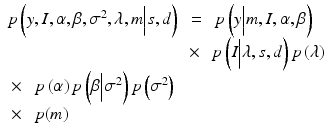
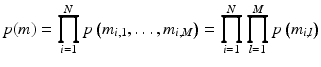
One of our goals is to model disease status using Bayesian statistics which perform variable selection and parameter estimation simultaneously and which can induce the sparseness and smoothness of the SNP effects. Smoothness of the SNP effects is obtained by explicit modeling of the covariance structure of the SNP effects.
Results
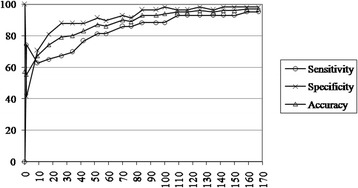
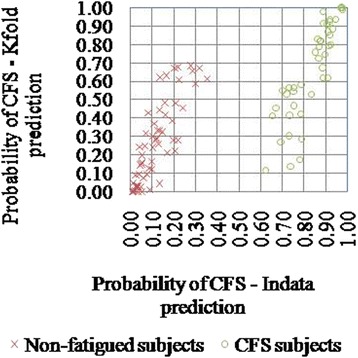
The Bayesian model achieved perfect goodness of fit when tested within the sampled data. Tenfold cross-validation resulted in 80 % accuracy, one of the best so far for CFS in comparison to previous prediction models. Model reduction aspects were investigated in a computationally feasible manner. Additionally, genetic variation estimates provided by the model identified specific genetic markers for their biological role in the disease pathophysiology.
Conclusions
This proof-of-principle study provides a powerful approach combining Bayesian methods, SNPs representing multiple pathways and rigorous case ascertainment for accurate genetic risk prediction modeling of complex diseases like CFS and other chronic diseases.
Electronic supplementary material
The online version of this article (doi:10.1186/s40246-015-0030-6) contains supplementary material, which is available to authorized users.
-
Subjects:
-
Source:Hum Genomics. 9(1).
-
Pubmed ID:26063326
-
Pubmed Central ID:PMC4479222
-
Document Type:
-
Volume:9
-
Issue:1
-
Collection(s):
-
Main Document Checksum:urn:sha256:2db14409c24afcf4f632159c3d9dd0d4574337db2bbf238230f60de0b6787b27
-
Download URL:
-
File Type:
 [PDF
- 935.90 KB
]
[PDF
- 935.90 KB
]
Supporting Files


ON THIS PAGE







CDC STACKS serves as an archival repository of CDC-published products including
scientific findings,
journal articles, guidelines, recommendations, or other public health information authored or
co-authored by CDC or funded partners.
As a repository, CDC STACKS retains documents in their original published format to ensure public access to scientific information.
As a repository, CDC STACKS retains documents in their original published format to ensure public access to scientific information.
You May Also Like
COLLECTION
CDC Public Access