



Drinking Water in California Child Care Sites Before and After 2011–2012 Beverage Policy
Supporting Files
Public Domain

-
Jun 04 2015
File Language:
English
Details
-
Journal Article:Preventing Chronic Disease (PCD)
-
Personal Author:
-
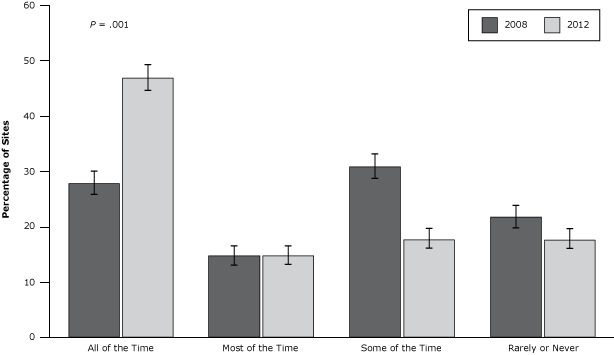
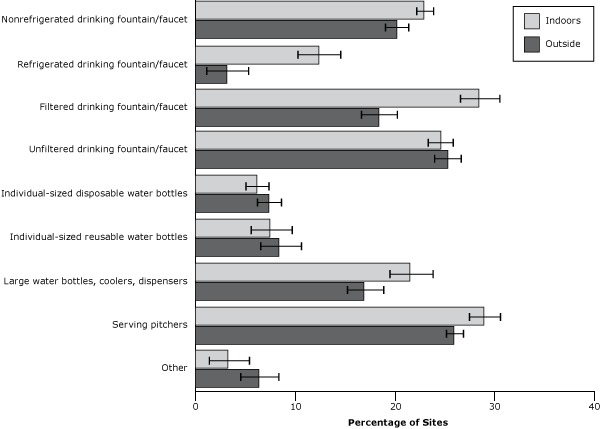
Description:Introduction ; Drinking water is promoted to improve beverage nutrition and reduce the prevalence of obesity. The aims of this study were to identify how water was provided to young children in child care and to determine the extent to which water access changed after a federal and state child care beverage policy was instituted in 2011 and 2012 in California. ; Methods ; Two independent cross-sectional samples of licensed child care providers completed a self-administered survey in 2008 (n = 429) and 2012 (n = 435). Logistic regression was used to analyze data for differences between 2008 and 2012 survey responses, after adjustment for correlations among the measurements in each of 6 child care categories sampled. ; Results ; A significantly larger percentage of sites in 2012 than in 2008 always served water at the table with meals or snacks (47.0% vs 28.0%, P = .001). A significantly larger percentage of child care sites in 2012 than in 2008 made water easily and visibly available for children to self-serve both indoors (77.9% vs 69.0%, P = .02) and outside (78.0% vs 69.0%, P = .03). Sites that participated in the federal Child and Adult Care Food Program had greater access to water indoors and outside than sites not in the program. In 2012 most (76.1%) child care providers reported no barriers to serving water to children. Factors most frequently cited to facilitate serving water were information for families (39.0% of sites), beverage policy (37.0%), and lessons for children (37.9%). ; Conclusion ; Water provision in California child care improved significantly between samples of sites studied in 2008 and 2012, but room for improvement remains after policy implementation. Additional training for child care providers and parents should be considered.
-
Subjects:
- Beverages
- Child Day Care Centers
- Child Nutritional Physiological Phenomena
- Child, Preschool
- Cross-Sectional Studies
- Diet Surveys
- Drinking Water
- Federal Government
- Food Assistance
- Guideline Adherence
- Health Status Disparities
- Humans
- Logistic Models
- Meals
- Nutrition Policy
- Program Evaluation
- Self Report
- State Government
-
Source:Prev Chronic Dis. 12.
-
DOI:
-
ISSN:1545-1151
-
Pubmed ID:26043304
-
Pubmed Central ID:PMC4456856
-
Document Type:
-
Place as Subject:
-
Volume:12
-
Download URL:
-
File Type:
 [PDF - 304.50 KB]
 -
Collection(s):
-
Main Document Checksum:urn:sha-512:d6a250e7da6b204c90815a7d2972617acce725dccea89f9f68a5a0641ebb35231616243d3cb406732b8dfa8600ae20039500badc03e91bc0b36e49b9b9495382
Supporting Files


File Language:
English
 Was this page helpful?
 Found an issue?


CDC STACKS serves as an archival repository of CDC-published products including
scientific findings, journal articles, guidelines, recommendations, or other public health information authored or
co-authored by CDC or funded partners.
As a repository, CDC STACKS retains documents in their original published format to ensure public access to scientific information.
As a repository, CDC STACKS retains documents in their original published format to ensure public access to scientific information.
You May Also Like
COLLECTION
Preventing Chronic Disease