


The role of migration and choice of denominator on the prevalence of cerebral palsy
Supporting Files

-
6 2013
-
File Language:
English
Details
-
Alternative Title:Dev Med Child Neurol
-
Personal Author:
-
Description:AIM
Differential migration and choice of denominator have been hypothesized to contribute to differences between period prevalence and birth prevalence of cerebral palsy (CP). The purpose of this study was to evaluate the effects of migration and choice of denominator on the prevalence of CP.
METHOD
Data from the Metropolitan Atlanta Developmental Disabilities Surveillance Program and census and birth certificate files were used to calculate various CP prevalence estimates for 2000.
RESULTS
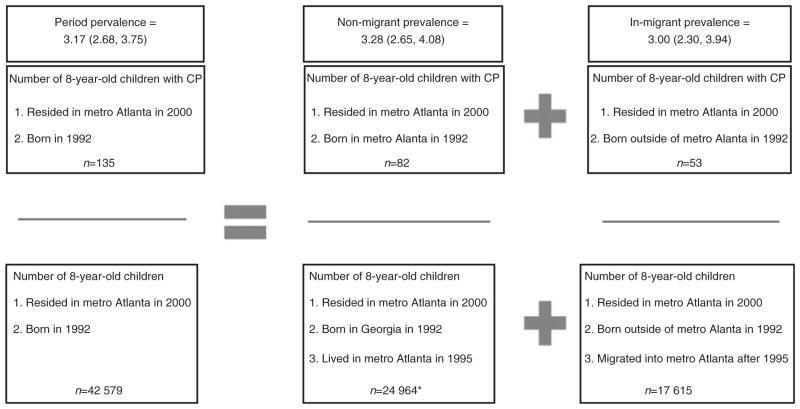
The overall CP period prevalence was 3.2 (95% confidence interval [CI] 2.7–3.8) per 1000 8-year-olds and was similar for those born in Atlanta who resided there at age 8 years (3.3; 95% CI 2.7–4.1) and those born outside Atlanta who moved into Atlanta by age 8 years (3.0; 95% CI 2.3–3.9). CP prevalence in these two migration strata was similar by sex and race/ethnicity. CP birth prevalence of 8-year-olds in Atlanta in 2000 was 2.0 (95% CI 1.6–2.5) per 1000 live births in 1992.
INTERPRETATION
The authors found no evidence to support the hypothesis that differential in-migration explained higher period than birth prevalence of CP in Atlanta. Comparability of CP prevalence across geographic areas will be enhanced if future studies report both period and birth prevalence.
-
Subjects:
-
Source:Dev Med Child Neurol. 55(6):520-526
-
Pubmed ID:23506432
-
Pubmed Central ID:PMC4455884
-
Document Type:
-
Funding:
-
Volume:55
-
Issue:6
-
Collection(s):
-
Main Document Checksum:urn:sha256:32b30f4f007ac80bb6c8694eb22399ec025df60f273265282259c22469fe1537
-
Download URL:
-
File Type:
 [PDF
- 293.20 KB
]
[PDF
- 293.20 KB
]
Supporting Files


File Language:
English
ON THIS PAGE

CDC STACKS serves as an archival repository of CDC-published products including
scientific findings,
journal articles, guidelines, recommendations, or other public health information authored or
co-authored by CDC or funded partners.
As a repository, CDC STACKS retains documents in their original published format to ensure public access to scientific information.
As a repository, CDC STACKS retains documents in their original published format to ensure public access to scientific information.
You May Also Like
COLLECTION
CDC Public Access