


Relationships of Thyroid Hormones with Polychlorinated Biphenyls, Dioxins, Furans, and DDE in Adults
Supporting Files

-
Aug 2007
Details
-
Alternative Title:Environ Health Perspect
-
Personal Author:
-
Description:Background
Thyroid hormone homeostasis can be disrupted by exposure to ubiquitous and bioaccumulative organochlorines such as polychlorinated biphenyls (PCBs) and polychlorinated dibenzo-p-dioxins (PCDDs). Whereas investigations of health effects have generally focused on human populations with relatively high exposures through occupation, accident, or high fish consumption, general population exposures may also carry risk.
Methods
We studied associations of total thyroxine (T4) and thyroid-stimulating hormone (TSH) with PCBs, dioxin-like toxic equivalents (TEQs), and p,p′-diphenyldichloroethene (DDE) in adult participants without thyroid disease who participated in the 1999–2002 National Health and Nutrition Examination Survey, a cross-sectional survey examining a random sample representative of the U.S. population.
Results
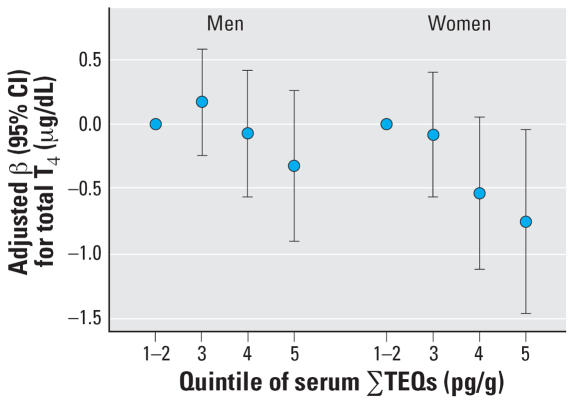
We found inverse associations of total T4 with exposure to TEQs in both sexes, with stronger associations in females. In women, mean T4 was 8.2 μg/dL, and levels were on average 0.75 μg/dL lower (95% confidence interval, 0.04–1.46) in women in the highest quintile of TEQ exposure compared with the lowest two quintiles. Effects were stronger in people > 60 years of age, with negative associations of T4 with PCBs and TEQs, and positive associations of TSH with PCBs and TEQs in older women, and a negative association of TSH with PCBs in older men.
Conclusions
The data show a dose-dependent decrease in total T4 with exposure to TEQs at levels similar to those found in the general U.S. population. The effects were stronger in women. The results suggest that older adults, who have a high risk of thyroid disease, may be more at risk for disruption of thyroid hormone homeostasis by dioxin-like organochlorines than younger adults.
-
Subjects:
-
Source:Environ Health Perspect. 2007; 115(8):1197-1203.
-
Document Type:
-
Funding:
-
Name as Subject:
-
Place as Subject:
-
Volume:115
-
Issue:8
-
Collection(s):
-
Main Document Checksum:urn:sha256:cc4493f2cd081e40b598e26f1537cd94233587319dab217fa7e814bd016cdc4c
-
Download URL:
-
File Type:
 [PDF
- 157.13 KB
]
[PDF
- 157.13 KB
]
Supporting Files


ON THIS PAGE


CDC STACKS serves as an archival repository of CDC-published products including
scientific findings,
journal articles, guidelines, recommendations, or other public health information authored or
co-authored by CDC or funded partners.
As a repository, CDC STACKS retains documents in their original published format to ensure public access to scientific information.
As a repository, CDC STACKS retains documents in their original published format to ensure public access to scientific information.
You May Also Like
COLLECTION
CDC Public Access