


Polybrominated Diphenyl Ether Levels in the Blood of Pregnant Women Living in an Agricultural Community in California
Supporting Files

-
Jan 2007
-
File Language:
English
Details
-
Alternative Title:Environ Health Perspect
-
Personal Author:
-
Description:Background
Recent studies have raised concerns about polybrominated diphenyl ether (PBDE) flame retardant exposures to pregnant women and women of child-bearing age in the United States. Few studies have measured PBDEs in immigrant populations.
Objectives
Our goal was to characterize levels of seven PBDE congeners, polychlorinated biphenyl (PCB)-153, and polybrominated biphenyl (PBB)-153 in plasma from 24 pregnant women of Mexican descent living in an agricultural community in California.
Results
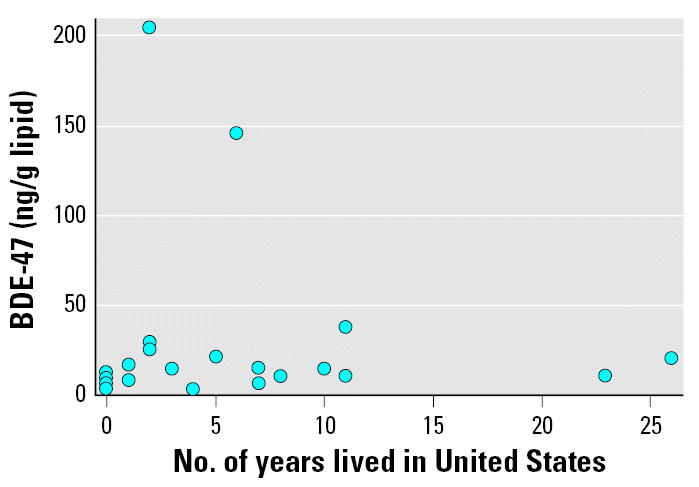
The median concentration of the sum of the PBDE congeners was 21 ng/g lipid and ranged from 5.3 to 320 ng/g lipid. Consistent with other studies, 2,2′,4,4′-tetrabromodiphenyl ether (BDE-47) was found at the highest concentration (median = 11 ng/g lipid; range, 2.5–205) followed by 2,2′,4,4′,5-pentabromobiphenyl (BDE-99) (median = 2.9 ng/g lipid; range, 0.5–54), 2,2′,4,4′,5-pentaBDE (BDE-100) (median = 1.8 ng/g lipid; range, 0.6–44), and 2,2′,4,4′,5,5′-hexaBDE (BDE-153) (median = 1.5 ng/g lipid; range, 0.4–35). Levels of PCB-153 (median= 4.4 ng/g lipid; range, < 2–75) were lower than U.S. averages and uncorrelated with PBDE levels, suggesting different exposure routes.
Conclusions
The overall levels of PBDEs found were lower than levels observed in other U.S. populations, although still higher than those observed previously in Europe or Japan. The upper range of exposure is similar to what has been reported in other U.S. populations. PBDEs have been associated with adverse developmental effects in animals. Future studies are needed to determine the sources and pathways of PBDE exposures and whether these exposures have adverse effects on human health.
-
Subjects:
-
Source:Environ Health Perspect. 2007; 115(1):71-74.
-
Document Type:
-
Funding:
-
Place as Subject:
-
Volume:115
-
Issue:1
-
Collection(s):
-
Main Document Checksum:urn:sha256:4bd649a69f78d25b63e3c37fc0a35d3ac570d97f5e6de636d28c7b967ccf5ae5
-
Download URL:
-
File Type:
 [PDF
- 511.49 KB
]
[PDF
- 511.49 KB
]
Supporting Files


File Language:
English
ON THIS PAGE



CDC STACKS serves as an archival repository of CDC-published products including
scientific findings,
journal articles, guidelines, recommendations, or other public health information authored or
co-authored by CDC or funded partners.
As a repository, CDC STACKS retains documents in their original published format to ensure public access to scientific information.
As a repository, CDC STACKS retains documents in their original published format to ensure public access to scientific information.
You May Also Like
COLLECTION
CDC Public Access