


Long-term cyclical in vivo loading increases cartilage proteoglycan content in a spatially specific manner: an infrared microspectroscopic imaging and polarized light microscopy study
Supporting Files

-
2006
-
File Language:
English
Details
-
Alternative Title:Arthritis Res Ther
-
Personal Author:
-
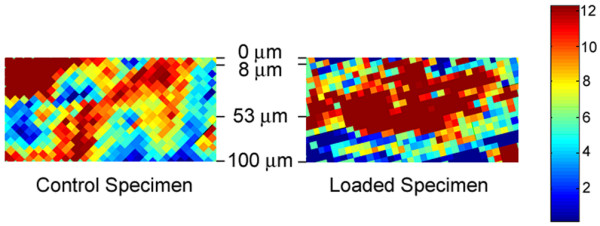
Description:Understanding the changes in collagen and proteoglycan content of cartilage due to physical forces is necessary for progress in treating joint disorders, including those due to overuse. Physical forces in the chondrocyte environment can affect the cellular processes involved in the biosynthesis of extracellular matrix. In turn, the biomechanical properties of cartilage depend on its collagen and proteoglycan content. To understand changes due to physical forces, this study examined the effect of 80 cumulative hours of in vivo cyclical joint loading on the cartilage content of proteoglycan and collagen in the rabbit metacarpophalangeal joint. The forepaw digits of six anesthetized New Zealand White adult female rabbits were repetitively flexed at 1 Hz with an estimated joint contact pressure of 1 to 2 MPa. Joints were collected from loaded and contralateral control specimens, fixed, decalcified, embedded, and thin-sectioned. Sections were examined under polarized light microscopy to identify and measure superficial and mid zone thicknesses of cartilage. Fourier Transform Infrared microspectroscopy was used to measure proteoglycan and collagen contents in the superficial, mid, and deep zones. Loading led to an increase in proteoglycan in the cartilage of all six rabbits. Specifically, there was a 46% increase in the cartilage deep zone (p = 0.003). The collagen content did not change with loading. Joint loading did not change the superficial and mid zone mean thicknesses. We conclude that long-term (80 cumulative hours) cyclical in vivo joint loading stimulates proteoglycan synthesis. Furthermore, stimulation is localized to cartilage regions of high hydrostatic pressure. These data may be useful in developing interventions to prevent overuse injuries or in developing therapies to improve joint function.
-
Subjects:
-
Source:Arthritis Res Ther. 2006; 8(5):R147.
-
Document Type:
-
Funding:
-
Volume:8
-
Issue:5
-
Collection(s):
-
Main Document Checksum:urn:sha256:ae3d4d9b448241570ff42335b0c0d9b79408730afedb29bd7cf4296ddb610564
-
Download URL:
-
File Type:
 [PDF
- 440.65 KB
]
[PDF
- 440.65 KB
]
Supporting Files


File Language:
English
ON THIS PAGE






CDC STACKS serves as an archival repository of CDC-published products including
scientific findings,
journal articles, guidelines, recommendations, or other public health information authored or
co-authored by CDC or funded partners.
As a repository, CDC STACKS retains documents in their original published format to ensure public access to scientific information.
As a repository, CDC STACKS retains documents in their original published format to ensure public access to scientific information.
You May Also Like
COLLECTION
CDC Public Access