


Variability in Airborne and Biological Measures of Exposure to Mercury in the Chloralkali Industry: Implications for Epidemiologic Studies
Supporting Files

-
2000/06/01
File Language:
English
Details
-
Journal Article:Environmental Health Perspectives
-
Personal Author:
-
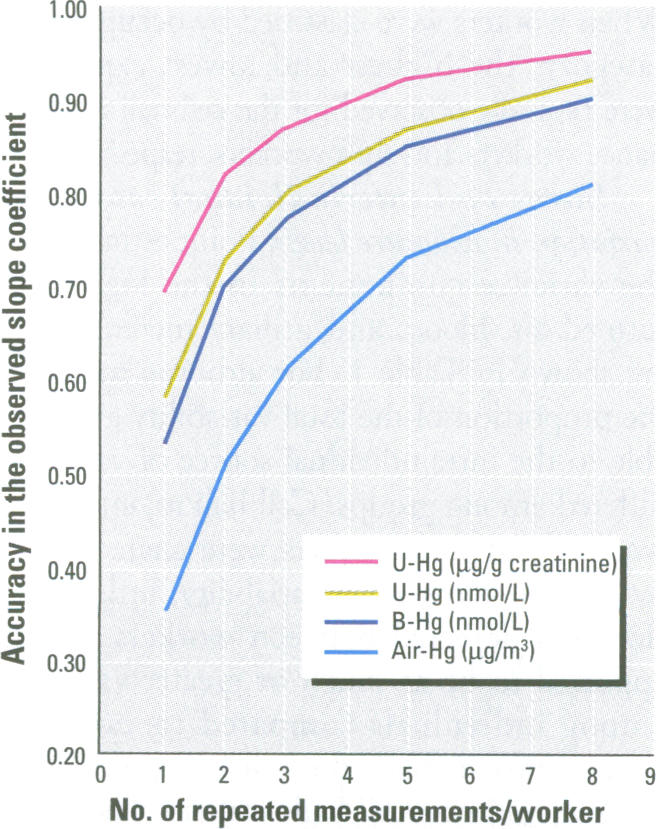
Description:Exposure assessment is a critical component of epidemiologic studies, and more sophisticated approaches require that variation in exposure be considered. We examined the intra- and interindividual sources of variation in exposure to mercury vapor as measured in air, blood, and urine among four groups of workers during 1990-1997 at a Swedish chloralkali plant. Consistent with the underlying kinetics of mercury in the body, the variability of biological measures was dampened considerably relative to the variation in airborne levels. Owing to the effects of intraindividual variation, estimating workers' exposures from a few measurements can attenuate measures of effect. To examine such effects on studies relating long-term exposure to a continuous health outcome, we evaluated the utility of each exposure measure by comparing the necessary sample sizes required for accurate estimation of a slope coefficient obtained from a regression analysis. No single measure outperformed the others for all groups of workers. However, when workers were evaluated together, creatinine-corrected urinary mercury better discriminated workers' exposures than airborne or blood mercury levels. Thus, pilot studies should be conducted to examine variability in both air and biomonitoring data because quantitative information about the relative magnitude of the intra- and interindividual sources of variation feeds directly into our efforts to design an optimal sampling strategy when evaluating health risks associated with occupational or environmental contaminants. [Description provided by NIOSH]
-
Subjects:
-
Keywords:Author Keywords: Biological Markers; Exposure Variability; Mercury; Variance Components Biological Monitoring; Occupational Exposure; Epidemiology; Exposure Methods; Styrenes; Air Contamination; Exposure Levels; Worker Health; Work Environment; Mercury Compounds; Airborne Particles; Occupational Health; Environmental Contamination; Heavy Metals;
-
Source:Environ Health Perspect 2000 Jun; 108(6):569-573
-
ISSN:0091-6765
-
Pubmed ID:10856033
-
Pubmed Central ID:PMC1638134
-
Document Type:
-
Funding:
-
Genre:
-
Place as Subject:
-
CIO:
-
Topic:
-
Location:
-
Pages in Document:5 pdf pages
-
Volume:108
-
Issue:6
-
NIOSHTIC Number:nn:20024411
-
Contact Point Address:E. Symanski, 1200 Herman Pressler Drive, RAS Suite W-642, Houston, TX 77030 USA
-
Email:esymanski@sph.uth.tmc.edu
-
CAS Registry Number:
-
Federal Fiscal Year:2000
-
Performing Organization:University of Texas School of Public Health, Houston, Texas
-
Peer Reviewed:True
-
Collection(s):
-
Main Document Checksum:urn:sha-512:1de18b4a335b3d788a4f3adaf9a2af32b42d364e51e99f16aaad624b5dce55a12dc42cb6037e3c1185e154cca12915604adc52a540da469eb8b4322e7c7c795d
-
Download URL:
-
File Type:
 [PDF
- 1.67 MB
]
[PDF
- 1.67 MB
]
Supporting Files


File Language:
English
ON THIS PAGE



CDC STACKS serves as an archival repository of CDC-published products including
scientific findings,
journal articles, guidelines, recommendations, or other public health information authored or
co-authored by CDC or funded partners.
As a repository, CDC STACKS retains documents in their original published format to ensure public access to scientific information.
As a repository, CDC STACKS retains documents in their original published format to ensure public access to scientific information.
You May Also Like