


Dose-Response Analysis in Animal Studies: Prediction of Human Responses
Supporting Files

-
1981/12/01
-
By Alarie, Yves
File Language:
English
Details
-
Journal Article:Environmental Health Perspectives
-
Personal Author:
-
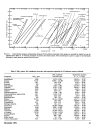
Description:Twenty five airborne chemical sensory irritants were evaluated for their potency in causing eyes, nose and throat irritation using an animal model. The model is based on the principle that when airborne chemicals impinge on the nasal mucosa, the trigeminal nerve endings are stimulated, and inhibition of respiration occurs, resulting in a decrease in respiratory rate. The decrease in respiratory rate is dependent on the exposure concentration of each chemical. By plotting the percentage decrease in respiratory rate versus the Logarithm of the exposure concentration, a Linear relationship is obtained. The exposure concentration necessary to evoke a 50 percent decrease in respiratory rate (RD50) was obtained in each case , and the potency of these 25 chemicals compared on the basis of their RD50 and predictions made from this value. A good correlation was found between the predictions and available data from literature. The proposed approach combines quantity, quality of the effect, and duration of administration required for an airborne contaminant and ranges for 0.001 from completely safe chemicals over a continuous period of years to 10 which is lethal in effects and requiring only minutes of exposure. Predictions corresponded well with the type of responses in humans at various multiples of RD50 values found in mice for Toluene-diisocyanate (584849), chlorobenzylidene-malononitrile (2698411), chloroacetophenone (1341248), acrolein (107028), formaldehyde (50000), chloropicrin (76062), chlorine (7782505), sulfur-dioxide (7446095), ammonia (7664417), hydrogen-chloride (7647010), and ethyl- acetate (141786). The authors conclude that appropriate choice of models should take precedence in toxicological evaluations rather than mere dose-response analyses. [Description provided by NIOSH]
-
Subjects:
-
Keywords:
-
Source:Environ Health Perspect 1981 Dec; 42:9-13
-
ISSN:0091-6765
-
Pubmed ID:7333265
-
Pubmed Central ID:PMC1568799
-
Document Type:
-
Funding:
-
Genre:
-
Place as Subject:
-
CIO:
-
Topic:
-
Location:
-
Pages in Document:5 pdf pages
-
Volume:42
-
NIOSHTIC Number:nn:00125200
-
Contact Point Address:Occupational Health University of Pittsburgh 130 DE Soto Street Pittsburgh, PA 15213
-
CAS Registry Number:2-Chlorobenzylidenemalononitrile (CAS RN 2698-41-1) ; Acrolein (CAS RN 107-02-8) ; Ammonia (CAS RN 7664-41-7) ; Chlorine (CAS RN 7782-50-5) ; Chloropicrin (CAS RN 76-06-2) ; Ethanone, 1-phenyl-, monochloro deriv. (CAS RN 1341-24-8) ; Ethyl acetate (CAS RN 141-78-6) ; Formaldehyde (CAS RN 50-00-0) ; Hydrochloric acid (CAS RN 7647-01-0) ; Sulfur dioxide (CAS RN 7446-09-5) ; Toluene 2,4-diisocyanate (CAS RN 584-84-9)
-
Federal Fiscal Year:1982
-
Performing Organization:University of Pittsburgh, Pittsburgh, Pennsylvania
-
Peer Reviewed:True
-
Collection(s):
-
Main Document Checksum:urn:sha-512:871f4562678395dd02124f19fe2f467c95f89f31440bc438a07a80fb15310eb08582c644f36088167933e63309f71012898eeb1600417a9ad6b9c5de30649397
-
Download URL:
-
File Type:
 [PDF
- 654.23 KB
]
[PDF
- 654.23 KB
]
Supporting Files


File Language:
English
ON THIS PAGE


CDC STACKS serves as an archival repository of CDC-published products including
scientific findings,
journal articles, guidelines, recommendations, or other public health information authored or
co-authored by CDC or funded partners.
As a repository, CDC STACKS retains documents in their original published format to ensure public access to scientific information.
As a repository, CDC STACKS retains documents in their original published format to ensure public access to scientific information.
You May Also Like