


Characterization of a highly negative and labile binding protein induced in Euglena gracilis by cadmium.
Supporting Files

-
Mar 1986
-
File Language:
English
Details
-
Alternative Title:Environ Health Perspect
-
Personal Author:
-
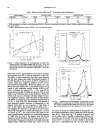
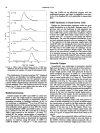
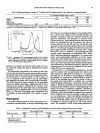
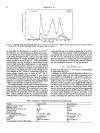
Description:The physiochemical properties and physiological significance of the cadmium-binding protein (CdBP) of the algae Euglena gracilis have been studied. Following in vivo exposure of cells to 0.4 or 1.3 micrograms/mL of Cd2+, all the cytosolic Cd is bound to high molecular weight species. At 4.7 micrograms/mL, appreciable CdBP has formed in cells grown under illumination or in the dark. An analogous ZnBP could not be isolated from control or Zn-exposed (20 micrograms/mL) cells, but zinc and a trace of copper were bound to the CdBP when 2-mercaptoethanol (2-ME) is added to the homogenates of Cd-treated cells and the buffers used during isolation. The large pool of very low molecular weight zinc species previously reported is increased when cells are exposed to high cadmium levels. Two distinct species, BP-1 and BP-2 are resolved by ion-exchange chromatography on DEAE-Sephadex. Unusually high conductivities (25 and 40 mSiemen) are required to displace them, indicating that they are very negatively charged proteins at pH 8.6. The pH for half-titration of bound Cd2+ is between 5 and 6. EDTA (0.4 M) and the CdBP isolated by gel-exclusion chromatography react biphasically with pseudo-first-order rate constants of 4 +/- 3 X 10(-4) sec-1 and 7 +/- 2 X 10(-5) sec-1. Neither form of the CdBP cross-reacts with antibodies to rat liver metallothionein (MT) antibodies. The structural, chemical, and functional differences between the Euglena CdBPs and mammalian MTs are discussed.(ABSTRACT TRUNCATED AT 250 WORDS)
-
Subjects:
-
Source:Environ Health Perspect. 65:77-85.
-
Document Type:
-
Funding:
-
Volume:65
-
Collection(s):
-
Main Document Checksum:urn:sha256:312ef0d0af2e0393bc0fb05195e2da7b3a4816d656defaf8aec156a4a0938d14
-
Download URL:
-
File Type:
 [PDF
- 1.65 MB
]
[PDF
- 1.65 MB
]
Supporting Files


File Language:
English
ON THIS PAGE




CDC STACKS serves as an archival repository of CDC-published products including
scientific findings,
journal articles, guidelines, recommendations, or other public health information authored or
co-authored by CDC or funded partners.
As a repository, CDC STACKS retains documents in their original published format to ensure public access to scientific information.
As a repository, CDC STACKS retains documents in their original published format to ensure public access to scientific information.
You May Also Like
COLLECTION
CDC Public Access