



Community Stakeholders’ Perceptions of Barriers to Childhood Obesity Prevention in Low-Income Families, Massachusetts 2012–2013
Supporting Files

-
Mar 26 2015
File Language:
English
Details
-
Journal Article:Preventing Chronic Disease (PCD)
-
Personal Author:
-
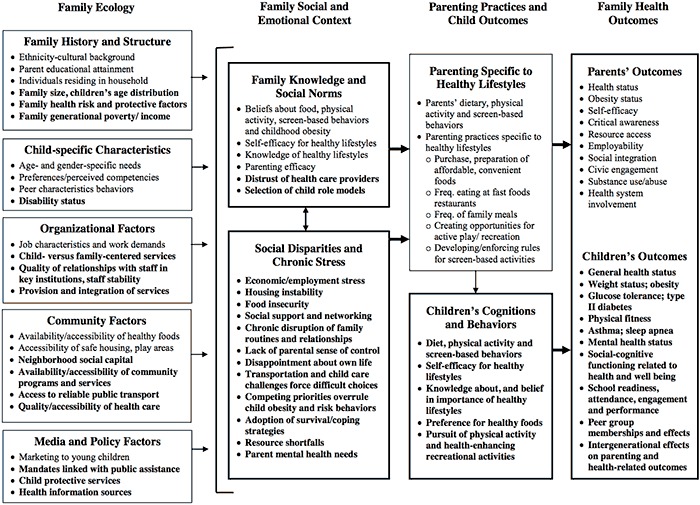
Description:Introduction ; The etiology of childhood obesity is multidimensional and includes individual, familial, organizational, and societal factors. Policymakers and researchers are promoting social–ecological approaches to obesity prevention that encompass multiple community sectors. Programs that successfully engage low-income families in making healthy choices are greatly needed, yet little is known about the extent to which stakeholders understand the complexity of barriers encountered by families. The objective of this study was to contextually frame barriers faced by low-income families reported by community stakeholders by using the Family Ecological Model (FEM). ; Methods ; From 2012 through 2013, we conducted semistructured interviews with 39 stakeholders from 2 communities in Massachusetts that were participating in a multisector intervention for childhood obesity prevention. Stakeholders represented schools; afterschool programs; health care; the Special Supplemental Nutrition Program for Women, Infants, and Children; and early care and education. Interviews were audio-recorded, transcribed, coded, and summarized. ; Results ; Stakeholder reports of the barriers experienced by low-income families had a strong degree of overlap with FEM and reflected awareness of the broader contextual factors (eg, availability of community resources, family culture, education) and social and emotional dynamics within families (eg, parent knowledge, social norms, distrust of health care providers, chronic life stressors) that could affect family adoption of healthy lifestyle behaviors. Furthermore, results illustrated a level of consistency in stakeholder awareness across multiple community sectors. ; Conclusion ; The congruity of stakeholder perspectives with those of low-income parents as summarized in FEM and across community sectors illustrates potential for synergizing the efforts necessary for multisector, multilevel community interventions for the prevention of childhood obesity.
-
Subjects:
- Child
- Child Health Services
- Community-Institutional Relations
- White People
- Family Characteristics
- Female
- Food Assistance
- Health Knowledge, Attitudes, Practice
- Health Status Disparities
- Hispanic or Latino
- Humans
- Income
- Interviews as Topic
- Pediatric Obesity
- Poverty
- Poverty Areas
- Preventive Health Services
- School Health Services
- Women's Health Services
-
Source:Prev Chronic Dis. 12.
-
DOI:
-
ISSN:1545-1151
-
Pubmed ID:25811497
-
Pubmed Central ID:PMC4375987
-
Document Type:
-
Funding:
-
Place as Subject:
-
Location:
-
Volume:12
-
Download URL:
-
File Type:
 [PDF - 400.06 KB]
 -
Collection(s):
-
Main Document Checksum:urn:sha-512:baf8e8a2ed684d32d2312fa6e617bec22fc1635108ed973d21bd1f6db608cf491ebd0a990c8ac8aa99fb6330f7ffeeb2cd2fe5f5d51e6e4a8598001a0e9956bb
Supporting Files


File Language:
English
 Was this page helpful?
 Found an issue?

CDC STACKS serves as an archival repository of CDC-published products including
scientific findings, journal articles, guidelines, recommendations, or other public health information authored or
co-authored by CDC or funded partners.
As a repository, CDC STACKS retains documents in their original published format to ensure public access to scientific information.
As a repository, CDC STACKS retains documents in their original published format to ensure public access to scientific information.
You May Also Like
COLLECTION
Preventing Chronic Disease