


Metabolic risk factors in U.S. youth with low relative muscle mass
Supporting Files

-
2015 Mar-Apr
File Language:
English
Details
-
Alternative Title:Obes Res Clin Pract
-
Personal Author:
-
Description:Aims
To examine the association between relative muscle mass (RMM) and nine risk factors for cardiovascular disease and diabetes (CVD/DM) in U.S. youth.
Methods
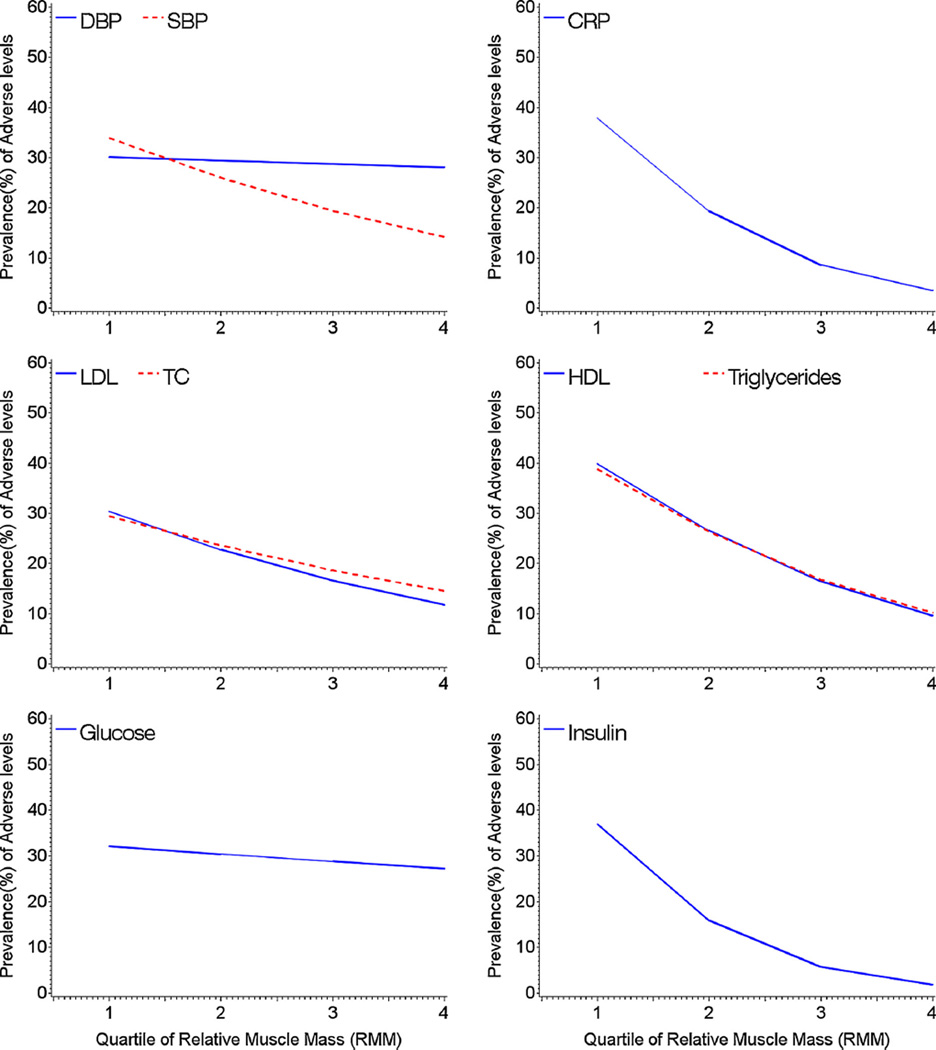
We used a sample representative of the U.S. population of youth, aged 8–20 years (NHANES 1999–2004). We compared the prevalence of adverse levels of nine CVD/DM risk factors between youths in the lowest quartile of RMM and their peers in the remaining quartiles, controlling for age, sex, and race/ethnicity. We also examined variations in the adjusted prevalence of these risk factors along the entire range of RMM.
Results
The adjusted prevalence of adverse levels of risk factors among youths in the lowest quartile of RMM was significantly higher for seven of the nine risk factors examined compared with their peers in the other quartiles. Over the entire range of RMM, the adjusted prevalence of adverse levels of each of these seven risk factors decreased gradually with increasing RMM values (all p for trend <0.001).
Conclusions
RMM and prevalence of adverse risk factors for CVD/DM are highly and inversely associated in U.S. youth. Among youth with low RMM, the risk of these chronic diseases could be significantly high later in life.
-
Subjects:
-
Source:Obes Res Clin Pract. 2014; 9(2):125-132.
-
Pubmed ID:25890427
-
Pubmed Central ID:PMC4412367
-
Document Type:
-
Funding:
-
Place as Subject:
-
Volume:9
-
Issue:2
-
Collection(s):
-
Main Document Checksum:urn:sha256:8e9d0c527084aaee56b86125f7047a4632b4f2b77ce5d6bb5215aceb4318f65b
-
Download URL:
-
File Type:
 [PDF
- 430.39 KB
]
[PDF
- 430.39 KB
]
Supporting Files


File Language:
English
ON THIS PAGE

CDC STACKS serves as an archival repository of CDC-published products including
scientific findings,
journal articles, guidelines, recommendations, or other public health information authored or
co-authored by CDC or funded partners.
As a repository, CDC STACKS retains documents in their original published format to ensure public access to scientific information.
As a repository, CDC STACKS retains documents in their original published format to ensure public access to scientific information.
You May Also Like
COLLECTION
CDC Public Access