


Inverse Size Scaling of the Nucleolus by a Concentration-Dependent Phase Transition
Supporting Files

-
Feb 19 2015
Details
-
Alternative Title:Curr Biol
-
Personal Author:
-
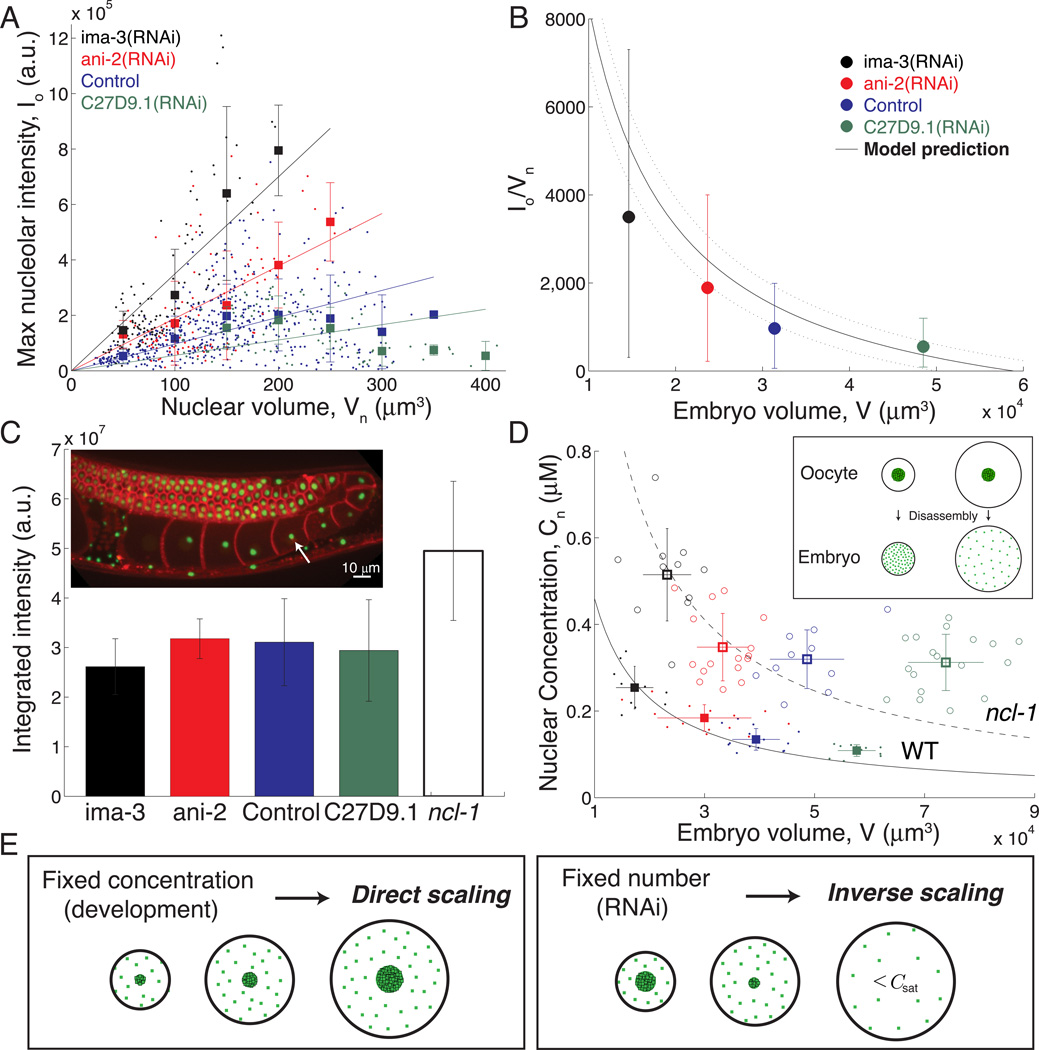
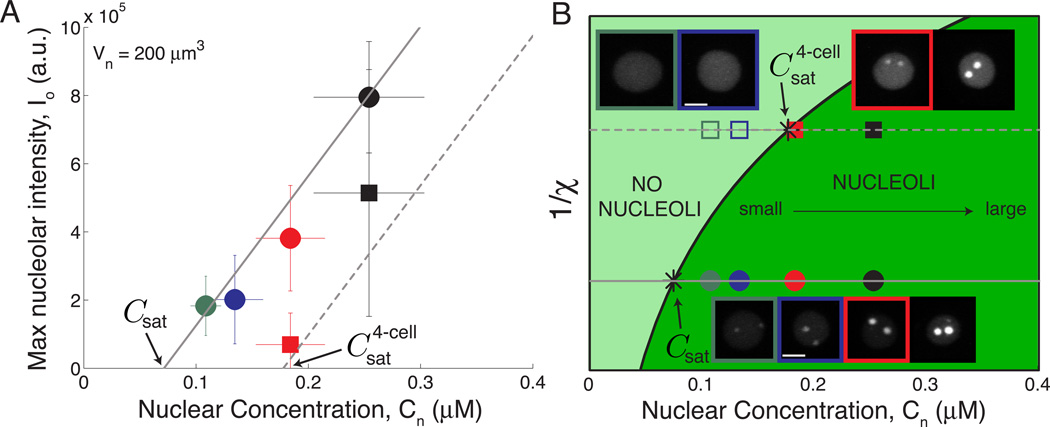
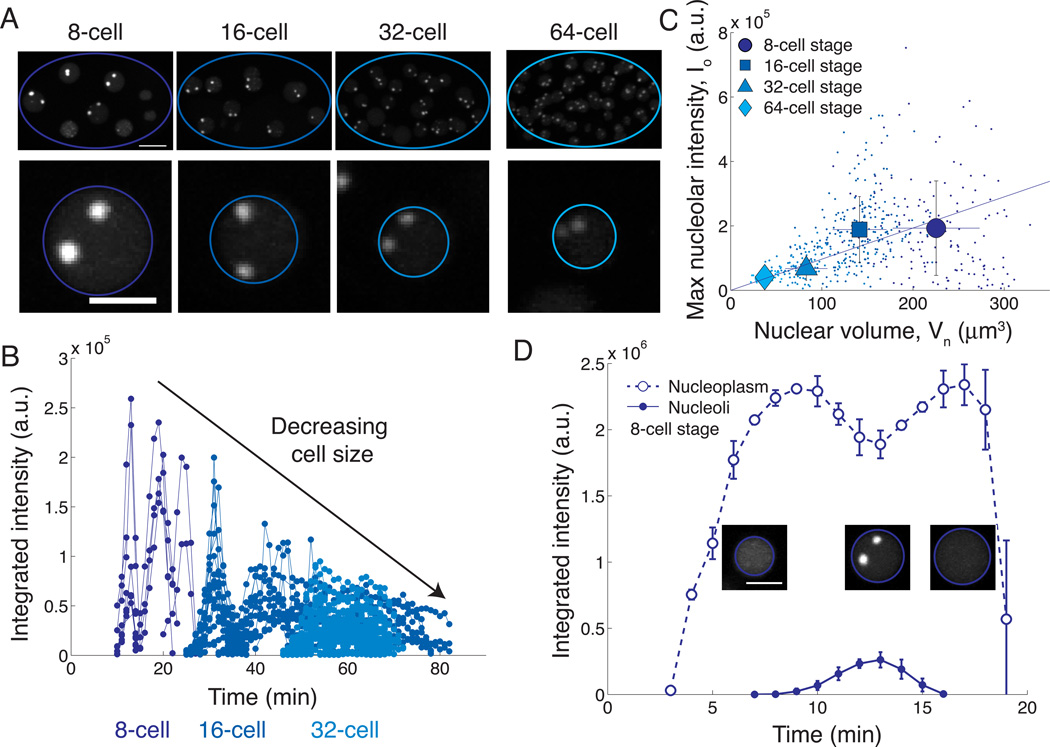
Description:Just as organ size typically increases with body size, the size of intracellular structures changes as cells grow and divide. Indeed, many organelles, such as the nucleus [1, 2], mitochondria [3], mitotic spindle [4, 5], and centrosome [6], exhibit size scaling, a phenomenon in which organelle size depends linearly on cell size. However, the mechanisms of organelle size scaling remain unclear. Here, we show that the size of the nucleolus, a membraneless organelle important for cell-size homeostasis [7], is coupled to cell size by an intracellular phase transition. We find that nucleolar size directly scales with cell size in early C. elegans embryos. Surprisingly, however, when embryo size is altered, we observe inverse scaling: nucleolar size increases in small cells and decreases in large cells. We demonstrate that this seemingly contradictory result arises from maternal loading of a fixed number rather than a fixed concentration of nucleolar components, which condense into nucleoli only above a threshold concentration. Our results suggest that the physics of phase transitions can dictate whether an organelle assembles, and, if so, its size, providing a mechanistic link between organelle assembly and cell size. Since the nucleolus is known to play a key role in cell growth, this biophysical readout of cell size could provide a novel feedback mechanism for growth control.
-
Subjects:
-
Source:Curr Biol. 2015; 25(5):641-646.
-
Pubmed ID:25702583
-
Pubmed Central ID:PMC4348177
-
Document Type:
-
Funding:
-
Volume:25
-
Issue:5
-
Collection(s):
-
Main Document Checksum:urn:sha256:7a7fedd2f87d163fbca6322a64d7645910ec855b254b6b44f6b30ee4c135f067
-
Download URL:
-
File Type:
 [PDF
- 1.31 MB
]
[PDF
- 1.31 MB
]
Supporting Files


ON THIS PAGE



CDC STACKS serves as an archival repository of CDC-published products including
scientific findings,
journal articles, guidelines, recommendations, or other public health information authored or
co-authored by CDC or funded partners.
As a repository, CDC STACKS retains documents in their original published format to ensure public access to scientific information.
As a repository, CDC STACKS retains documents in their original published format to ensure public access to scientific information.
You May Also Like
COLLECTION
CDC Public Access