



A Comparison of a Centralized Versus De-Centralized Recruitment Schema in Two Community-Based Participatory Research Studies for Cancer Prevention
Supporting Files

-
4 2015 ; 4-2015
-
Available in CDC Stacks on 2016-04-01T00:00:00Z
File Language:
English
Details
-
Alternative Title:J Community Health
-
Personal Author:Adams, Swann Arp ; Heiney, Sue P. ; Brandt, Heather M. ; Wirth, Michael D. ; Khan, Samira ; Johnson, Hiluv ; Davis, Lisa ; Wineglass, Cassandra M. ; Warren-Jones, Tatiana Y. ; Felder, Tisha M. ; Drayton, Ruby F. ; Davis, Briana ; Farr, Deeonna E. ; Hébert, James R.
-
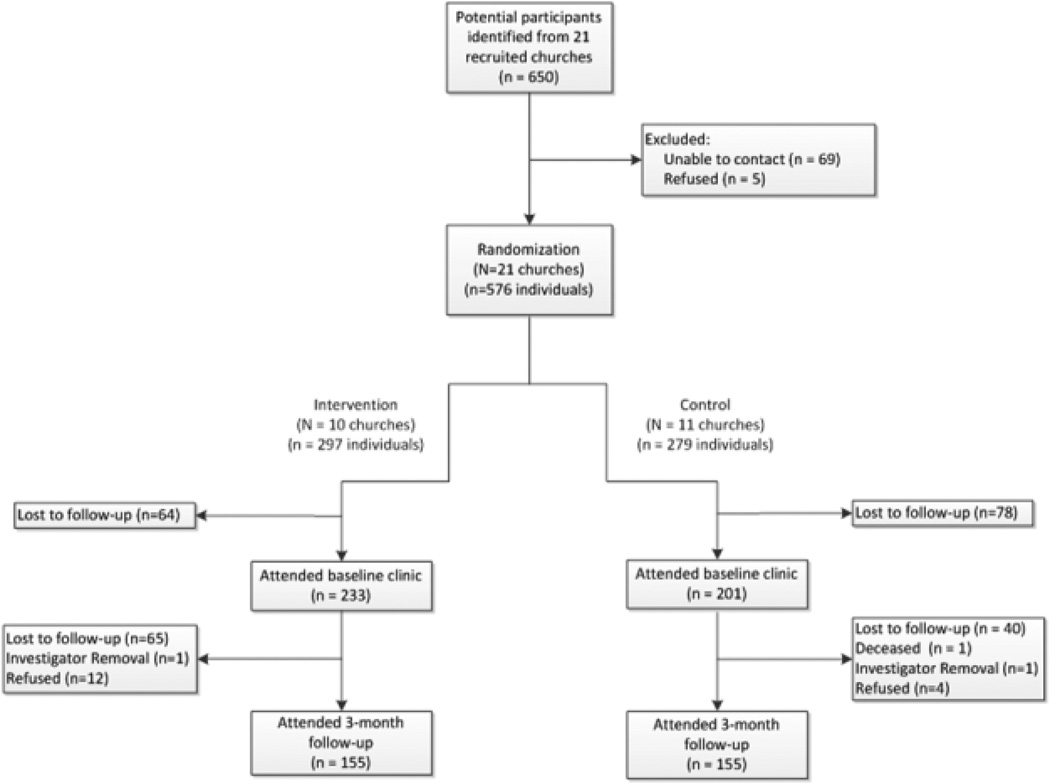
Description:Use of community-based participatory research (CBPR) approaches is increasing with the goal of making more meaningful and impactful advances in eliminating cancer-related health disparities. While many reports have espoused its advantages, few investigations have focused on comparing CBPR-oriented recruitment and retention. Consequently, the purpose of this analysis was to report and compare two different CBPR approaches in two cancer prevention studies. We utilized frequencies and Chi-squared tests to compare and contrast subject recruitment and retention for two studies that incorporated a randomized, controlled intervention design of a dietary and physical activity intervention among African Americans (AA). One study utilized a de-centralized approach to recruitment in which primary responsibility for recruitment was assigned to the general AA community of various church partners whereas the other incorporated a centralized approach to recruitment in which a single lay community individual was hired as research personnel to lead recruitment and intervention delivery. Both studies performed equally well for both recruitment and retention (75 and 88 % recruitment rates and 71 and 66 % retention rates) far exceeding those rates traditionally cited for cancer clinical trials (~5 %). The de-centralized approach to retention appeared to result in statistically greater retention for the control participants compared to the centralized approach (77 vs. 51 %, p < 0.01). Consequently, both CBPR approaches appeared to greatly enhance recruitment and retention rates of AA populations. We further note lessons learned and challenges to consider for future research opportunities.
-
Subjects:
-
Keywords:
-
Source:J Community Health. 40(2):251-259
-
Pubmed ID:25086566
-
Pubmed Central ID:PMC4315761
-
Document Type:
-
Funding:U48 DP001936/DP/NCCDPHP CDC HHSUnited States/ ; R24 MD002769/MD/NIMHD NIH HHSUnited States/ ; K05 CA136975/CA/NCI NIH HHSUnited States/ ; 3U48DP001936-01/DP/NCCDPHP CDC HHSUnited States/ ; U54CA153461/CA/NCI NIH HHSUnited States/ ; 3U54CA153461-04S2/CA/NCI NIH HHSUnited States/ ; U54 CA153461/CA/NCI NIH HHSUnited States/
-
Volume:40
-
Issue:2
-
Download URL:
-
File Type:
 [PDF - 1.01 MB]
 -
Collection(s):
-
Main Document Checksum:urn:sha256:fb57cb0556649ac0b9169f890c91c0cdc2eab244f5954993059a4ea15d6fbad4
Supporting Files


File Language:
English
 Was this page helpful?
 Found an issue?


CDC STACKS serves as an archival repository of CDC-published products including
scientific findings, journal articles, guidelines, recommendations, or other public health information authored or
co-authored by CDC or funded partners.
As a repository, CDC STACKS retains documents in their original published format to ensure public access to scientific information.
As a repository, CDC STACKS retains documents in their original published format to ensure public access to scientific information.
You May Also Like
COLLECTION
CDC Public Access