


Assisted hatching: trends and pregnancy outcomes, United States, 2000–2010
Supporting Files

-
July 17 2014
-
File Language:
English
Details
-
Alternative Title:Fertil Steril
-
Personal Author:
-
Description:Objective
To assess trends and outcomes of assisted hatching among assisted reproductive technology (ART) cycles.
Design
Retrospective cohort analysis using National ART Surveillance System (NASS) data.
Setting
U.S. fertility centers reporting to NASS.
Patient(s)
Fresh autologous noncanceled ART cycles conducted from 2000–2010.
Intervention(s)
None.
Main Outcome Measure(s)
Implantation, clinical pregnancy, live-birth, miscarriage, multiple gestation.
Result(s)
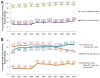
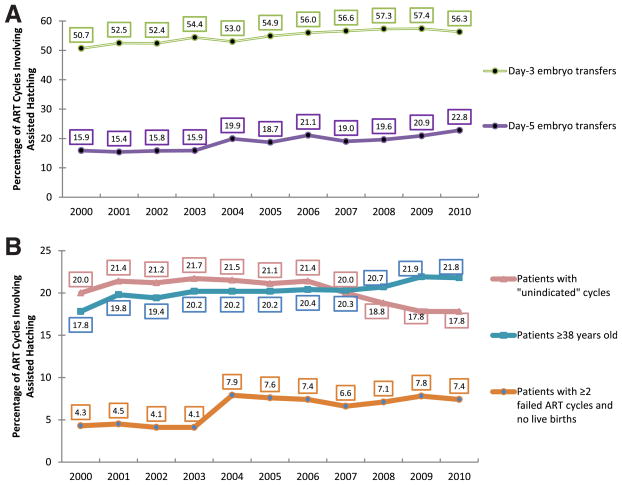
Assisted hatching use statistically significantly increased in absolute number (from 25,724 to 35,518 cycles), percentages of day-3 (from 50.7% to 56.3%) and day-5 transfers (from 15.9% to 22.8%), and percentage of transfers among women ≥38 years (from 17.8% to 21.8%) or women with ≥2 prior ART cycles and no live birth(s) (from 4.3% to 7.4%). Both day-3 and day-5 cycles involving assisted hatching were associated with lower odds of implantation (adjusted odds ratios [aOR] 0.7 and 0.6, respectively), clinical pregnancy (aOR 0.8 and 0.7, respectively), live birth (aOR 0.8 and 0.7, respectively), and increased odds of miscarriage (aOR 1.4 and 1.4, respectively), as compared with cycles without assisted hatching. Assisted hatching was associated with lower odds of multiple gestation in day-5 cycles (aOR 0.8). In cycles for women with a “poor prognosis,” the association of assisted hatching with pregnancy outcomes was not statistically significant.
Conclusion(s)
Assisted hatching use had an increasing trend but was not associated with improved pregnancy outcomes, even in poor-prognosis patients. Prospective studies are needed to identify the patients who may benefit from assisted hatching.
-
Subjects:
-
Source:Fertil Steril. 2014; 102(3):795-801
-
Pubmed ID:25044084
-
Pubmed Central ID:PMC4307791
-
Document Type:
-
Funding:
-
Volume:102
-
Issue:3
-
Collection(s):
-
Main Document Checksum:urn:sha-512:89bd058e430c5ae17d6d6812b0b248118bdf2e12eaa8b24580089dbb251e898ea81192a9cb2e4b1fc9e7eb52ccadcc6e4c4d54452b3e7bb471d824cb79c5b521
-
Download URL:
-
File Type:
 [PDF
- 384.68 KB
]
[PDF
- 384.68 KB
]
Supporting Files


File Language:
English
ON THIS PAGE

CDC STACKS serves as an archival repository of CDC-published products including
scientific findings,
journal articles, guidelines, recommendations, or other public health information authored or
co-authored by CDC or funded partners.
As a repository, CDC STACKS retains documents in their original published format to ensure public access to scientific information.
As a repository, CDC STACKS retains documents in their original published format to ensure public access to scientific information.
You May Also Like
COLLECTION
CDC Public Access