



A Frequency-Duty Cycle Equation for the ACGIH Hand Activity Level
Supporting Files

-
2014/10/24
-
Details
-
Alternative Title:Ergonomics
-
Personal Author:
-
Description:Objective
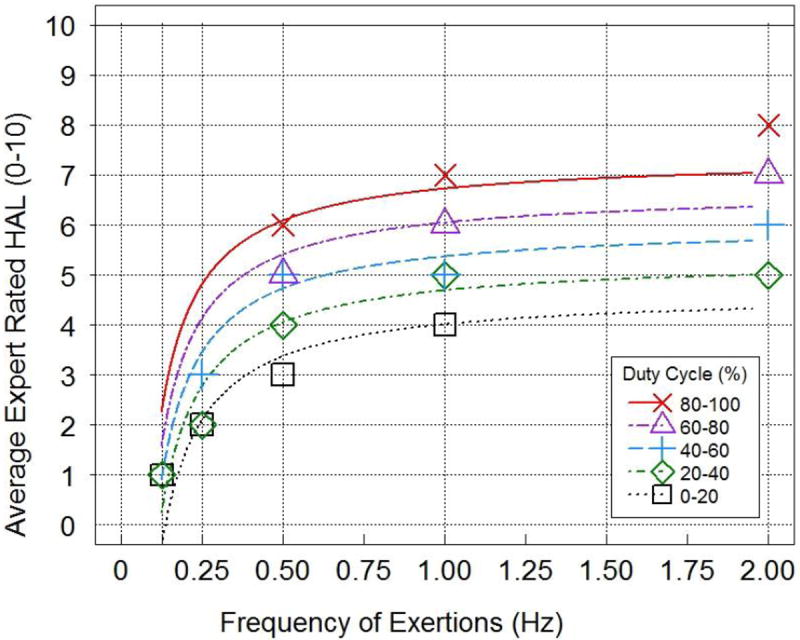
A new equation for predicting the hand activity level (HAL) used in the ACGIH threshold limit value® (TLV®), was based on exertion frequency (F) and percentage duty cycle (D).
Background
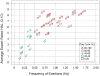
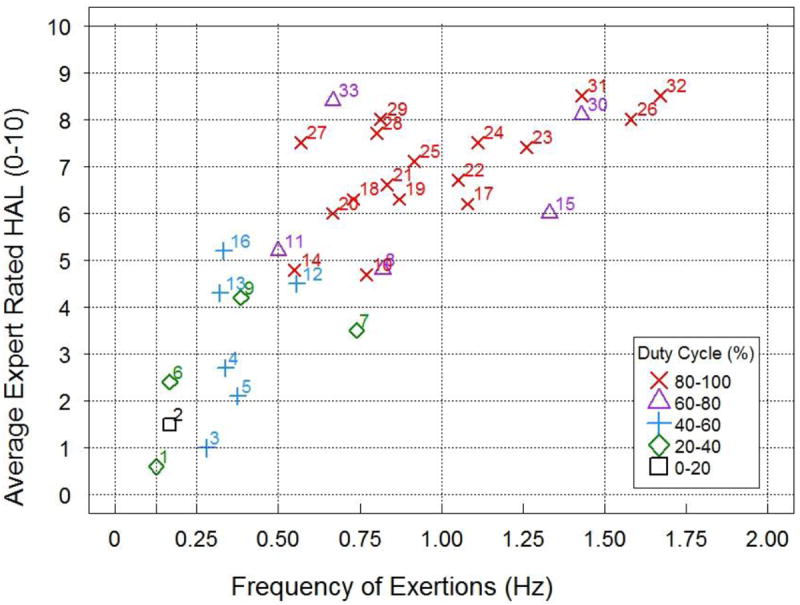
The TLV® includes a table for estimating HAL from F and D originating from data in Latko et al. (1997) and post-hoc adjustments that includes extrapolations outside of the data range.
Methods
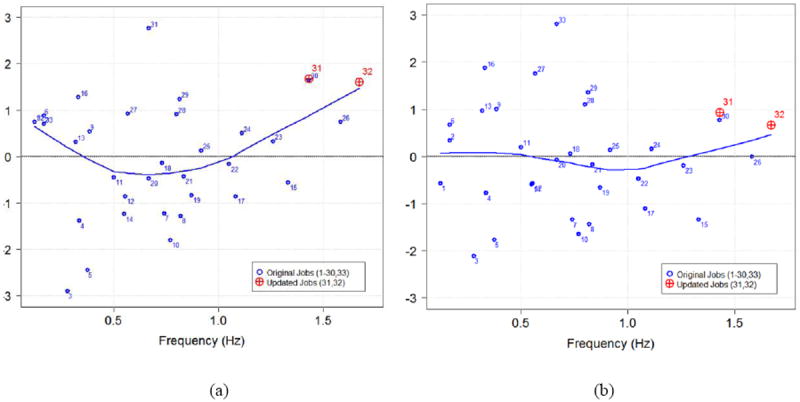
Multimedia video task analysis determined D for two additional jobs from Latko's study not in the original data set, and a new non-linear regression equation was developed to better fit the data and create a more accurate table.
Results
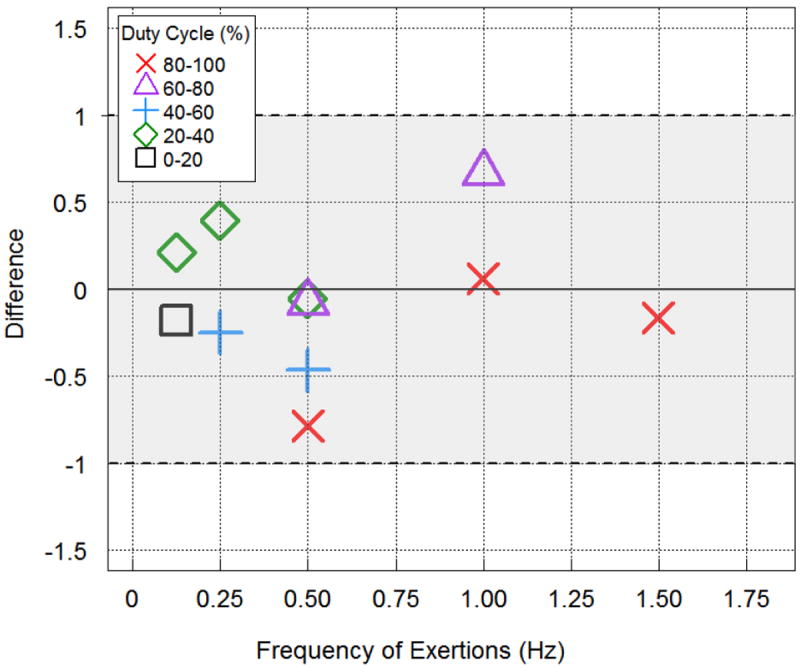
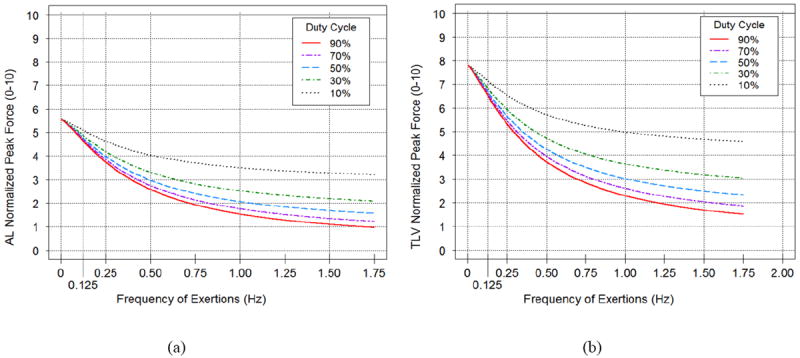
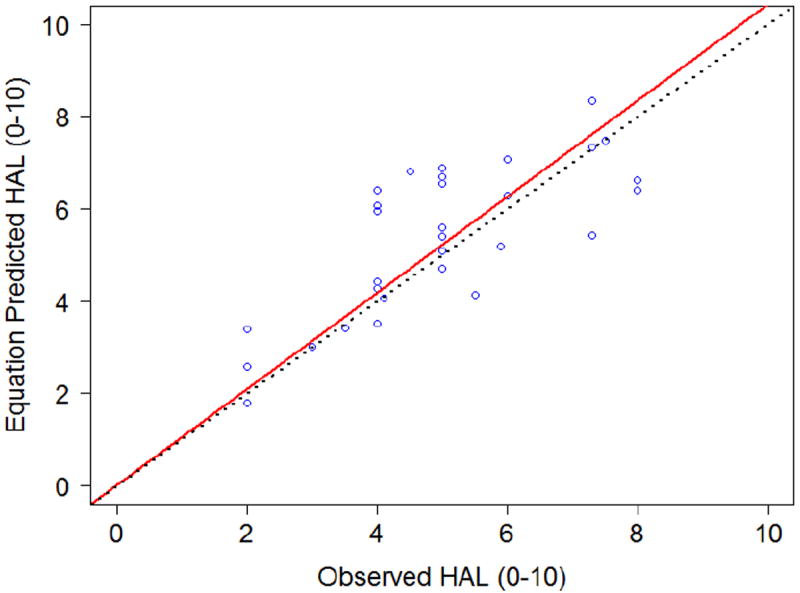
The equation, HAL=6.56lnD[F1.311+3.18F1.31], generally matches the TLV® HAL lookup table, and is a substantial improvement over the linear model, particularly for F > 1.25 Hz and D > 60% jobs.
Conclusion
The equation more closely fits the data and applies the TLV® using a continuous function.
Practitioner Summary
The original HAL lookup table is limited in resolution, omits values, and extrapolates values outside of the range of data. A new equation and table was developed to address these issues.
-
Source:Ergonomics. 58(2):173-183.
-
Pubmed ID:25343340
-
Pubmed Central ID:PMC4302734
-
Document Type:
-
Funding:
-
Genre:
-
Volume:58
-
Issue:2
-
Collection(s):
-
Main Document Checksum:urn:sha-512:d2c3370c3a715cd16a63944195b36045b98bdb1e18cc4927fc68e4fe82706cdc0ba1ca1ea41e64cbe7270ed01c874c1c51a76e15f2dcce616a4c94c26f0f5bb3
-
Download URL:
-
File Type:
 [PDF
- 1.35 MB
]
[PDF
- 1.35 MB
]
Supporting Files


 Was this page helpful?
 Found an issue?







CDC STACKS serves as an archival repository of CDC-published products including
scientific findings,
journal articles, guidelines, recommendations, or other public health information authored or
co-authored by CDC or funded partners.
As a repository, CDC STACKS retains documents in their original published format to ensure public access to scientific information.
As a repository, CDC STACKS retains documents in their original published format to ensure public access to scientific information.