


Cumulative Incidence of Cancer After Solid Organ Transplantation
Supporting Files

-
Apr 04 2013
-
File Language:
English
Details
-
Alternative Title:Cancer
-
Personal Author:
-
Description:BACKGROUND
Solid organ transplantation recipients have elevated cancer incidence. Estimates of absolute cancer risk after transplantation can inform prevention and screening.
METHODS
The Transplant Cancer Match Study links the US transplantation registry with 14 state/regional cancer registries. The authors used nonparametric competing risk methods to estimate the cumulative incidence of cancer after transplantation for 2 periods (1987–1999 and 2000–2008). For recipients from 2000 to 2008, the 5-year cumulative incidence, stratified by organ, sex, and age at transplantation, was estimated for 6 preventable or screen-detectable cancers. For comparison, the 5-year cumulative incidence was calculated for the same cancers in the general population at representative ages using Surveillance, Epidemiology, and End Results data.
RESULTS
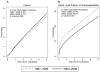
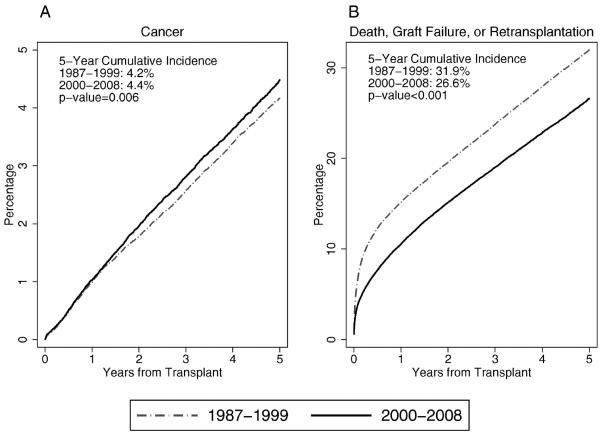
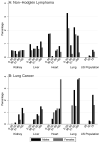
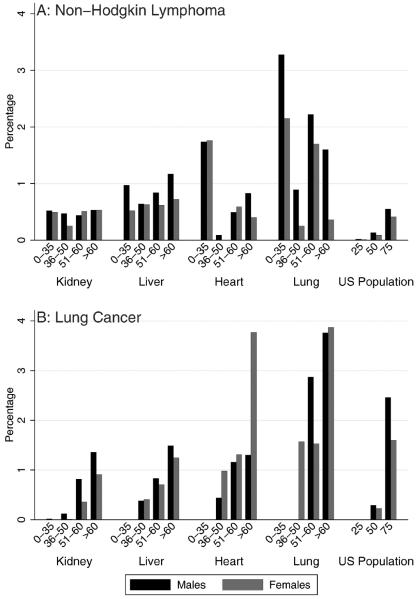
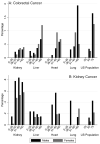
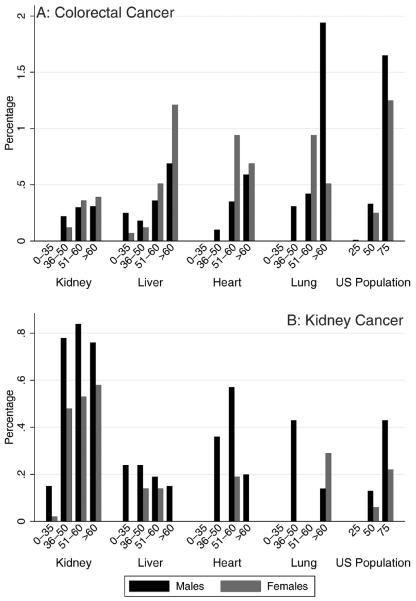
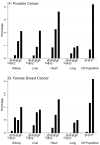
Among 164,156 recipients, 8520 incident cancers were identified. The absolute cancer risk was slightly higher for recipients during the period from 2000 to 2008 than during the period from 1987 to 1999 (5-year cumulative incidence: 4.4% vs 4.2%; P =.006); this difference arose from the decreasing risk of competing events (5-year cumulative incidence of death, graft failure, or retransplantation: 26.6% vs 31.9%; P <.001). From 2000 to 2008, the 5-year cumulative incidence of non-Hodgkin lymphoma was highest at extremes of age, especially in thoracic organ recipients (ages 0–34 years: range, 1.74%–3.28%; aged >50 years; range, 0.36%–2.22%). For recipients aged >50 years, the 5-year cumulative incidence was higher for colorectal cancer (range, 0.33%–1.94%) than for the general population at the recommended screening age (aged 50 years: range, 0.25%–0.33%). For recipients aged >50 years, the 5-year cumulative incidence was high for lung cancer among thoracic organ recipients (range, 1.16%–3.87%) and for kidney cancer among kidney recipients (range, 0.53%–0.84%). The 5-year cumulative incidence for prostate cancer and breast cancer was similar or lower in transplantation recipients than at the recommended ages of screening in the general population.
CONCLUSIONS
Subgroups of transplantation recipients have a high absolute risk of some cancers and may benefit from targeted prevention or screening.
-
Subjects:
-
Source:Cancer. 2013; 119(12):2300-2308.
-
Pubmed ID:23559438
-
Pubmed Central ID:PMC4241498
-
Document Type:
-
Funding:15-0351/PHS HHS/United States ; 1U58 DP000807-01/DP/NCCDPHP CDC HHS/United States ; 5658DP 000805-04/DP/NCCDPHP CDC HHS/United States ; 5U58/DP000808-05/DP/NCCDPHP CDC HHS/United States ; 5U58DP000812-03/DP/NCCDPHP CDC HHS/United States ; 5U58DP000817-05/DP/NCCDPHP CDC HHS/United States ; 5U58DP000824-04/DP/NCCDPHP CDC HHS/United States ; HHSH234200537009C/PHS HHS/United States ; HHSH250201000018C/PHS HHS/United States ; HHSN261201000024C/PHS HHS/United States ; HHSN261201000026C/PHS HHS/United States ; HHSN261201000027C/PHS HHS/United States ; HHSN261201000034C/PHS HHS/United States ; HHSN261201000035C/PHS HHS/United States ; HHSN261201000036C/PHS HHS/United States ; N01-PC-2012-00,027/PC/NCI NIH HHS/United States ; N01-PC-35,137/PC/NCI NIH HHS/United States ; N01-PC-35,139/PC/NCI NIH HHS/United States ; N01-PC-35,142/PC/NCI NIH HHS/United States ; N01-PC-35,143/PC/NCI NIH HHS/United States ; T32 CA126607/CA/NCI NIH HHS/United States ; T32CA126607/CA/NCI NIH HHS/United States ; U58 DP000848-04/DP/NCCDPHP CDC HHS/United States ; U58DP000832/DP/NCCDPHP CDC HHS/United States ; Z01 CP010150-08/Intramural NIH HHS/United States
-
Place as Subject:
-
Volume:119
-
Issue:12
-
Collection(s):
-
Main Document Checksum:urn:sha256:a32f1e43488ebfdf4292efae03a094e97ac13dcf76de68e687e41c06cb9a95f7
-
Download URL:
-
File Type:
 [PDF
- 498.90 KB
]
[PDF
- 498.90 KB
]
Supporting Files


File Language:
English
ON THIS PAGE


CDC STACKS serves as an archival repository of CDC-published products including
scientific findings,
journal articles, guidelines, recommendations, or other public health information authored or
co-authored by CDC or funded partners.
As a repository, CDC STACKS retains documents in their original published format to ensure public access to scientific information.
As a repository, CDC STACKS retains documents in their original published format to ensure public access to scientific information.
You May Also Like
COLLECTION
CDC Public Access