


Comparison of Prior Authorization and Prospective Audit with Feedback for Antimicrobial Stewardship
Supporting Files

-
Jul 23 2014
-
Details
-
Alternative Title:Infect Control Hosp Epidemiol
-
Personal Author:
-
Corporate Authors:
-
Description:OBJECTIVE
Although prior authorization and prospective audit with feedback are both effective antimicrobial stewardship program (ASP) strategies, the relative impact of these approaches remains unclear. We compared these core ASP strategies at an academic medical center.
DESIGN
Quasi-experimental study.
METHODS
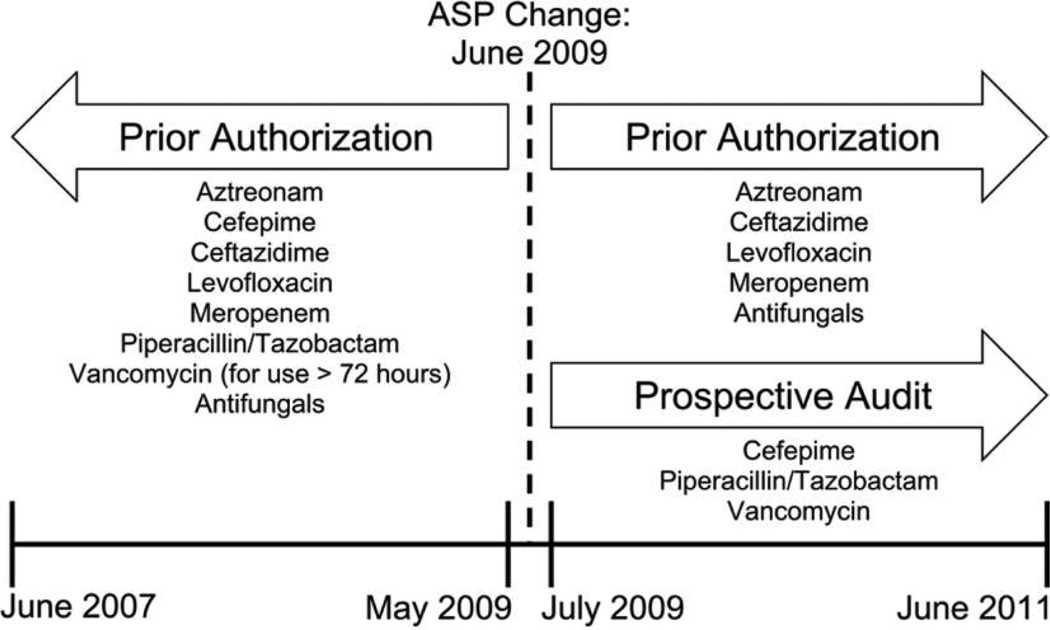
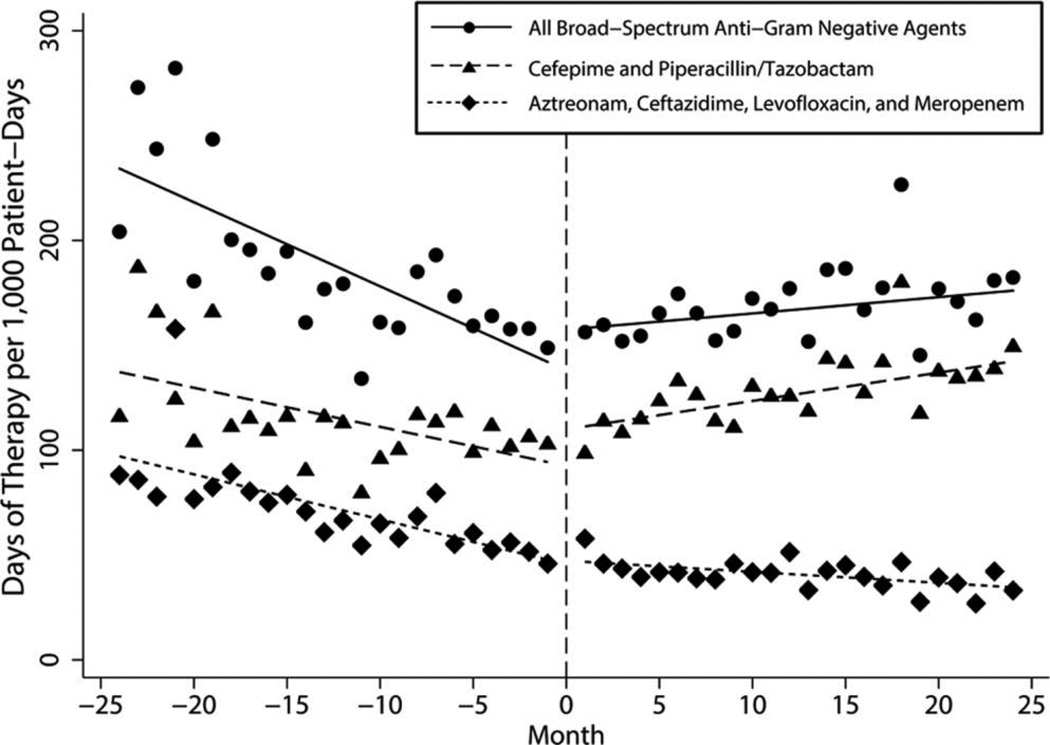
We compared antimicrobial use during the 24 months before and after implementation of an ASP strategy change. The ASP used prior authorization alone during the preintervention period, June 2007 through May 2009. In June 2009, many antimicrobials were unrestricted and prospective audit was implemented for cefepime, piperacillin/tazobactam, and vancomycin, marking the start of the postintervention period, July 2009 through June 2011. All adult inpatients who received more than or equal to 1 dose of an antimicrobial were included. The primary end point was antimicrobial consumption in days of therapy per 1,000 patient-days (DOT/1,000-PD). Secondary end points included length of stay (LOS).
RESULTS
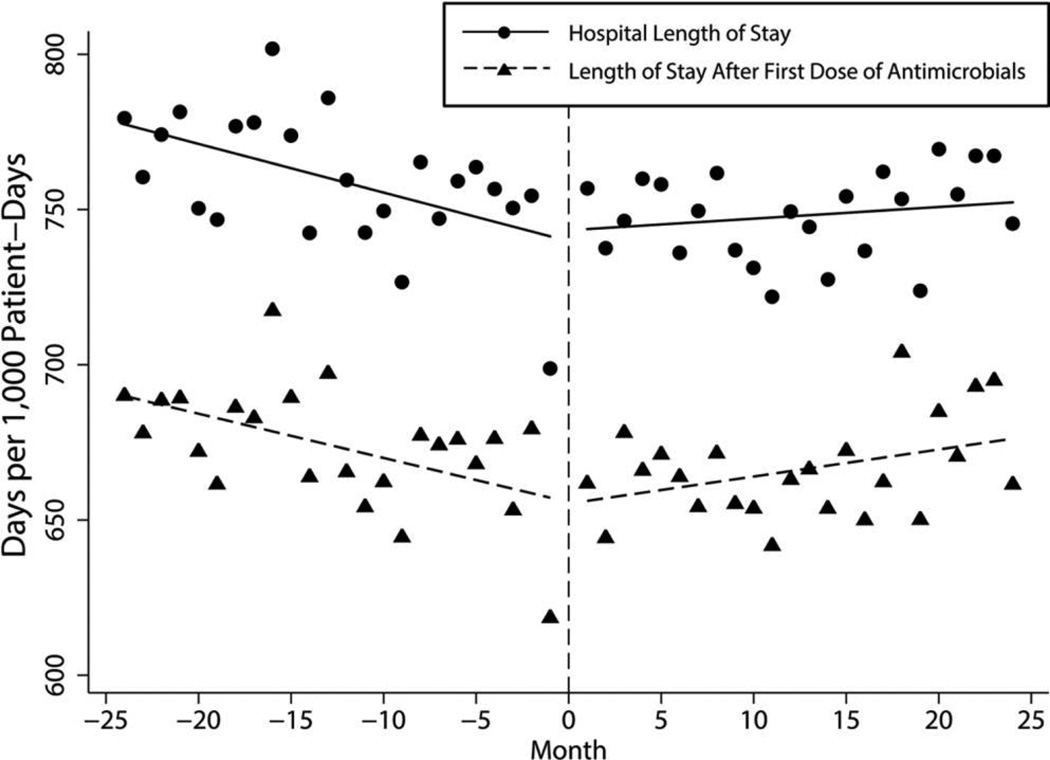
In total, 55,336 patients were included (29,660 preintervention and 25,676 postintervention). During the preintervention period, both total systemic antimicrobial use (−9.75 DOT/1,000-PD per month) and broad-spectrum anti-gram-negative antimicrobial use (−4.00 DOT/1,000-PD) declined. After the introduction of prospective audit with feedback, however, both total antimicrobial use (+9.65 DOT/1,000-PD per month; P < .001) and broad-spectrum anti-gram-negative antimicrobial use (+4.80 DOT/1,000-PD per month; P < .001) increased significantly. Use of cefepime and piperacillin/tazobactam both significantly increased after the intervention (P = .03). Hospital LOS and LOS after first antimicrobial dose also significantly increased after the intervention (P = .016 and .004, respectively).
CONCLUSIONS
Significant increases in antimicrobial consumption and LOS were observed after the change in ASP strategy.
-
Subjects:
-
Source:Infect Control Hosp Epidemiol. 2014; 35(9):1092-1099.
-
Pubmed ID:25111916
-
Pubmed Central ID:PMC4198070
-
Document Type:
-
Funding:
-
Volume:35
-
Issue:9
-
Collection(s):
-
Main Document Checksum:urn:sha256:14eeb027b1d7ed2a3d126e21262bdf1bfba7ad3cf89ab6fc9e5748447c0cc146
-
Download URL:
-
File Type:
 [PDF
- 2.27 MB
]
[PDF
- 2.27 MB
]
Supporting Files


ON THIS PAGE



CDC STACKS serves as an archival repository of CDC-published products including
scientific findings,
journal articles, guidelines, recommendations, or other public health information authored or
co-authored by CDC or funded partners.
As a repository, CDC STACKS retains documents in their original published format to ensure public access to scientific information.
As a repository, CDC STACKS retains documents in their original published format to ensure public access to scientific information.
You May Also Like
COLLECTION
CDC Public Access